

Spinal Decompression vs. Surgery for Herniated Disc: Making an Informed Choice in 2026
What if the most effective way to resolve your back pain isn’t a scalpel, but a sophisticated system designed to help your body heal itself from the inside out? When you’re stuck weighing spinal decompression vs surgery for herniated disc, the decision often feels like a choice between living in pain or risking a major operation. If you’re dealing with the sharp, radiating fire of sciatica, you’ve likely reached a point where temporary fixes like injections no longer provide comfort. You want to move freely through your day in Yuba City or Marysville without the fear of a long, difficult surgical recovery.
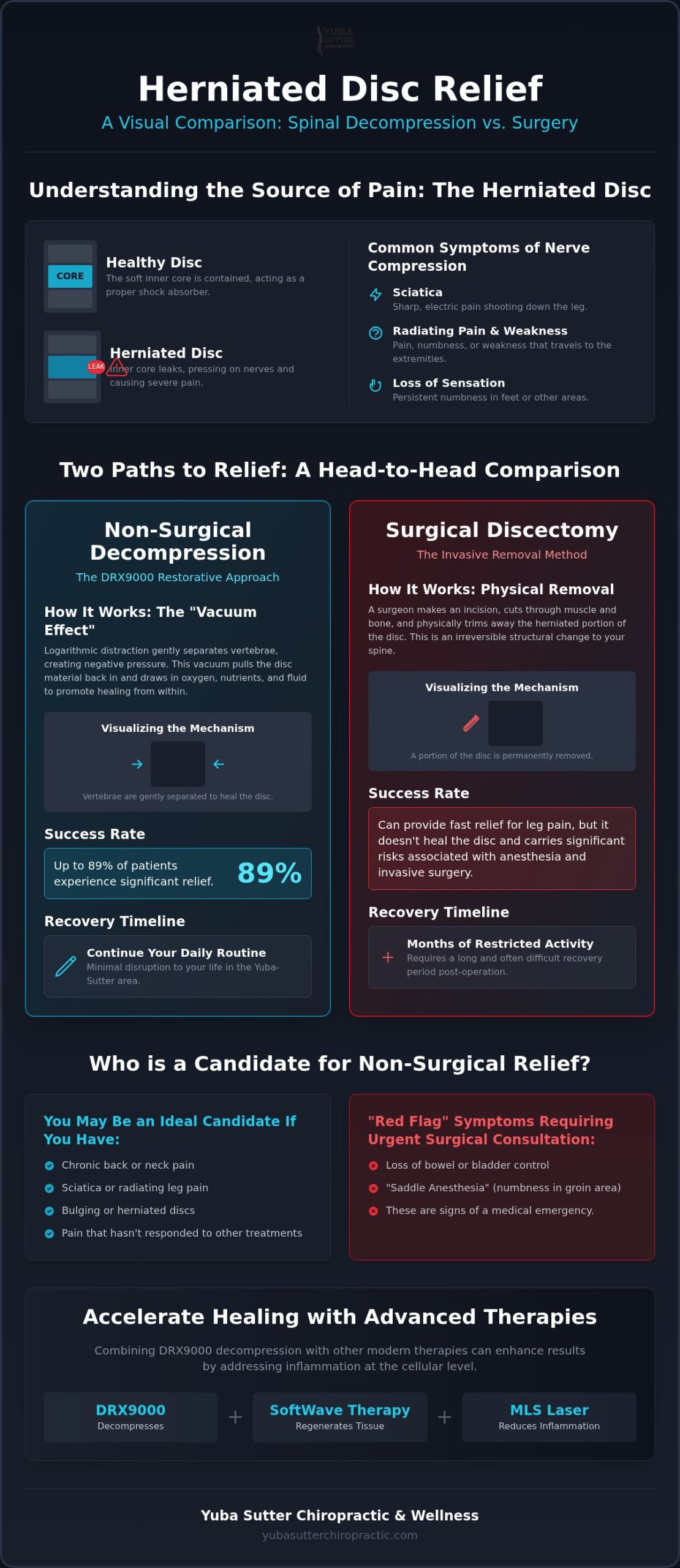
We understand that your goal is a return to an active life without the anxiety of anesthesia or spinal fusion. This guide compares the real-world outcomes of traditional back surgery against the non-surgical DRX9000-SL technology, which clinical research shows provides significant relief for 71% to 89% of patients. We’ll examine success rates, recovery timelines, and the specific mechanism of action that makes decompression a viable alternative to the scalpel. By the end, you’ll have a clear roadmap for recovery and a better understanding of how to find lasting relief right here in the Yuba-Sutter area.
Key Takeaways
- Understand the “vacuum effect” created by the DRX9000 and how it pulls disc material back into place without the invasive risks of surgery.
- Compare the clinical success rates of spinal decompression vs surgery for herniated disc, noting that non-surgical decompression helps up to 89% of eligible patients.
- Discover why decompression allows you to continue your daily routine in the Yuba-Sutter area while surgical recovery often requires months of restricted activity.
- Learn how combining the DRX9000 with SoftWave and MLS Laser therapy can accelerate your healing process by addressing inflammation at the cellular level.
- Identify the specific symptoms that make you a prime candidate for non-surgical relief and the “red flag” signs that require a surgical consultation.
Understanding the Herniated Disc: Why Surgery vs. Decompression is the Big Question
A herniated disc represents a mechanical failure within the spinal column. Think of your spinal discs as tough, rubbery shock absorbers that sit between your vertebrae. When the outer ring of a disc tears, the soft, jelly-like inner core, called the nucleus pulposus, leaks out. This isn’t just a generic back problem; it’s a structural breakdown. For many in the Yuba City workforce, from long-haul drivers on Highway 99 to manual laborers in local orchards, this condition is a career-threatening injury. Often, patients are told to “wait and see” while taking anti-inflammatories. This passive approach frequently leads to surgery by default because it fails to address the underlying structural collapse. When evaluating Spinal decompression options, you’re essentially choosing between two schools of thought: invasive removal of tissue or restorative healing.
The Anatomy of Nerve Compression
The real trouble begins when the nucleus pulposus makes contact with sensitive spinal nerves. This contact triggers a cascade of inflammation and physical pressure. You might feel a sharp, electric pain shooting down your leg, known as sciatica, or experience persistent numbness in your feet. Radiculopathy is the clinical term for this nerve root compression that causes pain and weakness to radiate into your extremities. It’s a clear sign that the communication between your brain and your body is being physically interrupted by a mechanical obstruction. Similar nerve compression issues can also occur higher up the spine, and if you’re experiencing arm numbness or neck pain alongside your back symptoms, learning about pinched nerve in neck treatment Yuba City residents trust may help you understand the full picture of spinal nerve involvement.
When Does a Disc Issue Become a Surgical Conversation?
Most people weigh spinal decompression vs surgery for herniated disc when the pain becomes debilitating and daily tasks feel impossible. However, certain “red flag” symptoms make surgery an immediate necessity rather than an option. If you experience a loss of bowel or bladder control or a sensation called “saddle anesthesia”, which is numbness in the areas that would touch a horse’s saddle, you need emergency medical attention. These symptoms suggest cauda equina syndrome, a rare but serious condition that requires urgent intervention.
For everyone else, the standard medical path usually starts with pills and progresses to epidural steroid injections. Many patients feel pushed toward the operating room prematurely because they aren’t presented with high-tech restorative alternatives. When deciding on spinal decompression vs surgery for herniated disc, it’s vital to recognize that surgery is an irreversible, structural change. In contrast, non-surgical decompression aims to create an environment where the body can naturally retract the herniated material and heal the disc from within. This restorative approach focuses on the root cause rather than just removing the symptomatic tissue.
Mechanisms of Relief: DRX9000 Decompression vs. Surgical Discectomy
Surgery addresses a herniated disc by physically removing the offending tissue. During a microdiscectomy, a surgeon makes an incision and cuts through muscle and bone to reach the spine. They then trim away the portion of the disc that is pressing on the nerve. While this can provide fast relief for leg pain, it is an invasive process that requires anesthesia and a significant recovery period. It essentially removes a piece of your body to stop the symptom, but it doesn’t necessarily improve the health of the remaining disc structure.
Comparing spinal decompression vs surgery for herniated disc reveals a completely different physiological strategy. The DRX9000 uses a process called logarithmic distraction. This technology applies a specific tension curve that gently pulls the vertebrae apart. This action creates a “vacuum effect,” or negative intradiscal pressure, within the disc. This vacuum doesn’t just encourage the bulging material to retract. It also pulls essential nutrients, oxygen, and fluids back into the disc space. This rehydration is a root cause treatment that helps the disc heal from the inside out, rather than just managing the external symptoms.
The DRX9000 Advantage
The DRX9000 is an FDA-cleared system that stands apart from standard traction tables. Most basic traction devices pull with a constant force, which often triggers the body’s natural muscle guarding response. When your muscles tighten to protect the spine, the treatment becomes ineffective. The DRX9000-SL, which received a major technological update in August 2026, uses advanced automation and intelligent programming to bypass these muscle spasms. By monitoring the patient’s response in real-time, it ensures the force is applied directly to the spinal segment that needs it most.
Traditional Surgical Procedures (Discectomy & Fusion)
Traditional surgery often involves more than just removing tissue. In cases of spinal instability, a surgeon might perform a spinal fusion. This involves using hardware like screws and rods to join two vertebrae together permanently. While this can gain stability, it results in a permanent loss of mobility in that segment of your back. This often puts extra stress on the discs above and below the fusion site. If you’re looking for a way to maintain your natural movement, exploring DRX9000 decompression at our Yuba City clinic may be a more restorative path forward. These non-surgical sessions allow you to avoid the risks associated with cutting into the spinal column while still achieving lasting relief.
When you analyze spinal decompression vs surgery for herniated disc, the primary difference is the goal of the treatment. Surgery is a structural modification that removes the problem area. Decompression is a physiological intervention that restores the disc’s environment. By increasing the height of the disc and restoring its fluid levels, the DRX9000 helps the spine return to a state of natural function without the need for an operating room.
Comparing the Real-World Factors: Risk, Recovery, and Success
When you evaluate spinal decompression vs surgery for herniated disc, the decision involves more than just clinical outcomes. You have to consider the “cost of time” and the potential for long-term complications. For a working professional in Marysville or a busy parent in Yuba City, losing months to a surgical recovery isn’t just an inconvenience; it’s a major life disruption. While surgery aims for a quick fix by removing tissue, it carries a heavy burden of risk that non-surgical methods simply don’t have.
The Risks of the Operating Room
Every spinal surgery carries inherent clinical risks. These include blood clots, dural tears, and infection. However, one of the most frustrating outcomes is Failed Back Surgery Syndrome (FBSS). Research shows that between 20% and 40% of patients who undergo back surgery find no relief or actually experience increased pain after the operation. This often happens because of epidural fibrosis, which is the formation of scar tissue near the nerve root. This scar tissue can bind to the nerves, creating a new source of chronic pain that is sometimes more difficult to treat than the original herniated disc.
The long-term success rates also vary significantly. While a microdiscectomy can have high initial success for leg pain, spinal fusions for degenerative issues often see success rates drop to between 50% and 70% over a five-year period. In contrast, the risk profile for DRX9000 decompression is remarkably low. The most common “side effect” is temporary muscle soreness as the spine realigns and the muscles adjust to the new spacing. This “downside risk” is a major advantage. If decompression doesn’t provide the desired results, surgery remains an option. Once you have surgery, however, the structural changes to your spine are permanent.
Recovery Timelines: What to Expect
After a surgical procedure, you’re looking at a timeline of 3 to 12 months before you return to full activity. You’ll face strict lifting restrictions, post-operative pain management, and months of mandatory physical therapy; to find out how professional support can aid your recovery at home, learn more about specialized in-home health services.
A typical plan for spinal decompression vs surgery for herniated disc at our clinic involves 15 to 30 sessions over a 6 to 8 week period. Each session on the DRX9000 lasts about 30 to 45 minutes. There is no downtime. You can drive yourself to our Yuba City office, complete your treatment, and continue with your daily life. This gradual physiological healing allows your body to adapt without the trauma of an incision. For local residents, this accessibility makes it easy to stay consistent with the protocol, which is the key to achieving that 71% to 89% success rate seen in clinical studies.
Candidate Selection: Who is Best Suited for Spinal Decompression?
Choosing between spinal decompression vs surgery for herniated disc often depends on where you are in your pain journey. For decades, many patients believed that surgery was the only definitive solution for a “slipped” or ruptured disc. This surgery-first mindset is becoming outdated. Modern clinical guidelines now suggest that a trial of non-surgical care should be the standard for most chronic disc issues. Unless you’re facing the emergency “red flag” symptoms mentioned earlier, such as loss of bladder control or progressive muscle wasting, you’re likely a candidate for a restorative approach.
The ideal candidate for DRX9000 decompression is someone who has lived with bulging discs, herniations, or sciatica for more than several weeks. If you’ve found that rest, physical therapy, or injections provided only temporary relief, your disc may need the specific mechanical distraction that only decompression provides. This process is particularly effective for those whose pain is “mechanical,” meaning it changes based on your posture or movement. It’s a proactive way to address the root cause before the damage requires a permanent surgical alteration.
The ‘Am I Ready for Surgery?’ Checklist
Before you commit to the operating room, ask yourself these three critical questions. First, have you completed a consistent trial of non-surgical decompression for at least six weeks? Many patients find that their symptoms resolve entirely during this window. Second, is your pain primarily neurological? If your symptoms are limited to localized back pain without severe nerve deficits, surgery may be an over-correction. Finally, what’s your tolerance for the long-term recovery timeline? If you can’t afford to be away from work or family for months, decompression offers a path that fits into your existing schedule.
Contraindications for Spinal Decompression
While the DRX9000 is highly effective, it isn’t right for everyone. Certain conditions preclude the use of spinal decompression to ensure patient safety. These contraindications include advanced osteoporosis, which weakens the vertebrae, or the presence of specific spinal hardware like rods and screws from a previous fusion. Pregnancy is also a reason to delay treatment. We rely heavily on MRI imaging to determine your candidacy. A clear image allows us to see the exact level of the herniation and the health of the surrounding bone structure. This ensures that the treatment is both safe and targeted to your specific needs.
Determining your path starts with a professional evaluation. We look at your imaging, your history, and your daily physical demands to see if the DRX9000-SL is the right fit for you. If you’re ready to explore a non-invasive alternative, book your initial consultation at Yuba Sutter Chiropractic & Wellness to see if you qualify for our disc restoration program.
Advanced Disc Healing at Yuba Sutter Chiropractic & Wellness
At Yuba Sutter Chiropractic & Wellness, we believe that effective healing requires more than just a single piece of equipment. Our Yuba City clinic utilizes a multi-modal approach to disc restoration that focuses on the root cause of your pain. When residents evaluate spinal decompression vs surgery for herniated disc, they often look for a solution that offers the best of both worlds: high-tech precision and a non-invasive recovery. We provide this by combining the gold-standard DRX9000 technology with advanced biological therapies that support the body’s natural healing cycles.
Our focus extends beyond the spine to what we call “Total Body Alignment.” We recognize that a herniated disc is often the result of years of structural stress. To prevent future injuries, we evaluate your entire musculoskeletal system, which may include recommending customized orthotics. By stabilizing your foundation, we ensure that the relief you achieve through decompression is built to last. This community-focused, professional atmosphere ensures you feel like a partner in your own recovery rather than just another patient on a schedule.
Synergistic Therapies for Faster Recovery
To accelerate the results of the DRX9000, we often integrate SoftWave shockwave therapy and MLS Laser therapy into your care plan. SoftWave therapy uses electro-hydraulic acoustic waves to trigger tissue regeneration and recruit the body’s own healing cells to the site of the disc injury. This is particularly effective for chronic cases where the body’s natural repair process has stalled.
MLS Laser therapy plays a different but equally vital role. It uses specific wavelengths of light to penetrate deep into the spinal tissues, reducing the acute inflammation and swelling that cause debilitating nerve pain. These technologies work in tandem with the DRX9000 to create a powerful healing environment that allows many patients to avoid the scalpel and the risks of anesthesia entirely. By addressing both the mechanical pressure and the chemical inflammation, we provide a more comprehensive path to relief.
Your Path to Relief in Yuba City
Your journey begins with a detailed consultation where we review your MRI imaging and conduct a thorough physical examination. This allows us to create a personalized care plan tailored to the severity of your herniation and your specific lifestyle goals. We understand the unique needs of our neighbors in Marysville, Sutter, and Plumas Lake, and we prioritize a schedule that minimizes disruption to your daily life. Our team is dedicated to providing a steady hand and a clear roadmap as you move from a state of discomfort to a state of resolution. If you’re tired of temporary fixes and want to see if you’re a candidate for this advanced protocol, Schedule your herniated disc consultation at Yuba Sutter Chiropractic & Wellness today.
Your Path to Lasting Spinal Relief
Choosing between spinal decompression vs surgery for herniated disc is a significant decision that impacts your long-term mobility and quality of life. As we’ve explored, the DRX9000 offers a restorative path that avoids the irreversible changes of a scalpel while addressing the root cause of your pain. By creating a vacuum effect that rehydrates the disc, this technology provides a solution that surgery simply can’t match. Our experienced local chiropractic team enhances these results by integrating SoftWave and MLS Laser therapy to ensure your body has every tool it needs for a full recovery.
You don’t have to accept debilitating nerve pain as your permanent reality. Whether you’re in Marysville, Sutter, or right here in Yuba City, a non-invasive solution is within reach. We invite you to take the first step toward a life without lifting restrictions or the fear of a long surgical recovery. Book Your Non-Surgical Disc Consultation in Yuba City today to discover how our FDA-cleared technology can help you reclaim your active lifestyle. It’s time to move forward with confidence and leave the pain behind.
Frequently Asked Questions
Is spinal decompression better than surgery for a herniated disc?
Spinal decompression is often considered the superior first-line option because it is non-invasive and carries significantly less risk than surgery. While surgery physically removes tissue, decompression restores the disc’s environment naturally. Most clinical guidelines recommend a conservative trial of care before considering the operating room. If decompression provides relief, you avoid the potential complications of anesthesia, infection, and permanent structural changes to your spine.
How long does it take to see results from DRX9000 spinal decompression?
Most patients begin to notice a reduction in pain within the first two to three weeks of their treatment plan. While some experience relief after just a few sessions, the biological process of rehydrating the disc and reducing nerve pressure takes time. Consistency is essential to achieving lasting results. We typically monitor your progress closely during the initial phase to ensure your body is responding optimally to the distraction forces.
What is the success rate of non-surgical spinal decompression?
Clinical research indicates that non-surgical spinal decompression has a success rate between 71% and 89% for patients with herniated discs. These outcomes are based on significant pain reduction and improved function. When comparing spinal decompression vs surgery for herniated disc, these statistics offer a compelling reason to try a non-invasive path first. We focus on careful candidate selection to ensure we only accept patients who are likely to achieve these high success levels.
Can spinal decompression fix a disc that has already ‘leaked’ (sequestration)?
Yes, spinal decompression can be effective even for sequestered or “leaked” discs. The negative pressure created by the DRX9000 encourages the body to resorb the displaced disc material. By increasing the space between the vertebrae, the treatment helps move the nucleus pulposus away from the spinal nerves. We review your MRI during the consultation to determine if the specific geometry of your sequestration is suitable for this restorative approach.
Is spinal decompression painful for someone with a severe herniated disc?
Most patients find the treatment sessions to be quite relaxing rather than painful. The DRX9000-SL uses advanced sensors to bypass muscle guarding, which prevents the sharp discomfort often associated with traditional traction. You may feel a gentle stretching sensation in your lower back. It is common for our patients to listen to music or even fall asleep during their 30 to 45-minute sessions in our Yuba City office.
Will my insurance cover DRX9000 treatment in Yuba City?
Insurance coverage for non-surgical spinal decompression is currently inconsistent across different providers. Many plans still classify the procedure as “investigational” despite clinical success. We recommend checking with your specific carrier to understand your benefits. Our team can provide you with the necessary documentation and codes to help you navigate the verification process and explore all available options for your care.
What happens if spinal decompression doesn’t work for me?
If you don’t achieve the desired results after a full trial of care, you haven’t lost anything except time. One of the greatest advantages of this approach is the low “downside risk.” Because no tissue was removed and no hardware was installed, you remain an excellent candidate for surgical consultation; for those researching leading specialists in the field, you can discover Dr. Rodrigo Ávila Cervantes · Spine Neurosurgeon. Decompression is a proactive step that allows you to exhaust every non-invasive option before committing to a permanent operative procedure.
How many sessions of spinal decompression are typically needed for a herniated disc?
A standard protocol typically consists of 15 to 30 sessions scheduled over a six to eight-week period. This frequency is necessary to maintain the negative pressure within the disc long enough for physiological healing to occur. In the Yuba-Sutter area, our patients find that this structured timeline allows for gradual, sustainable improvement. Your specific plan will be customized based on the severity of your condition and your body’s initial response to the therapy.