Custom orthotics in Yuba City A steadier foundation for your feet, knees, hips and back.
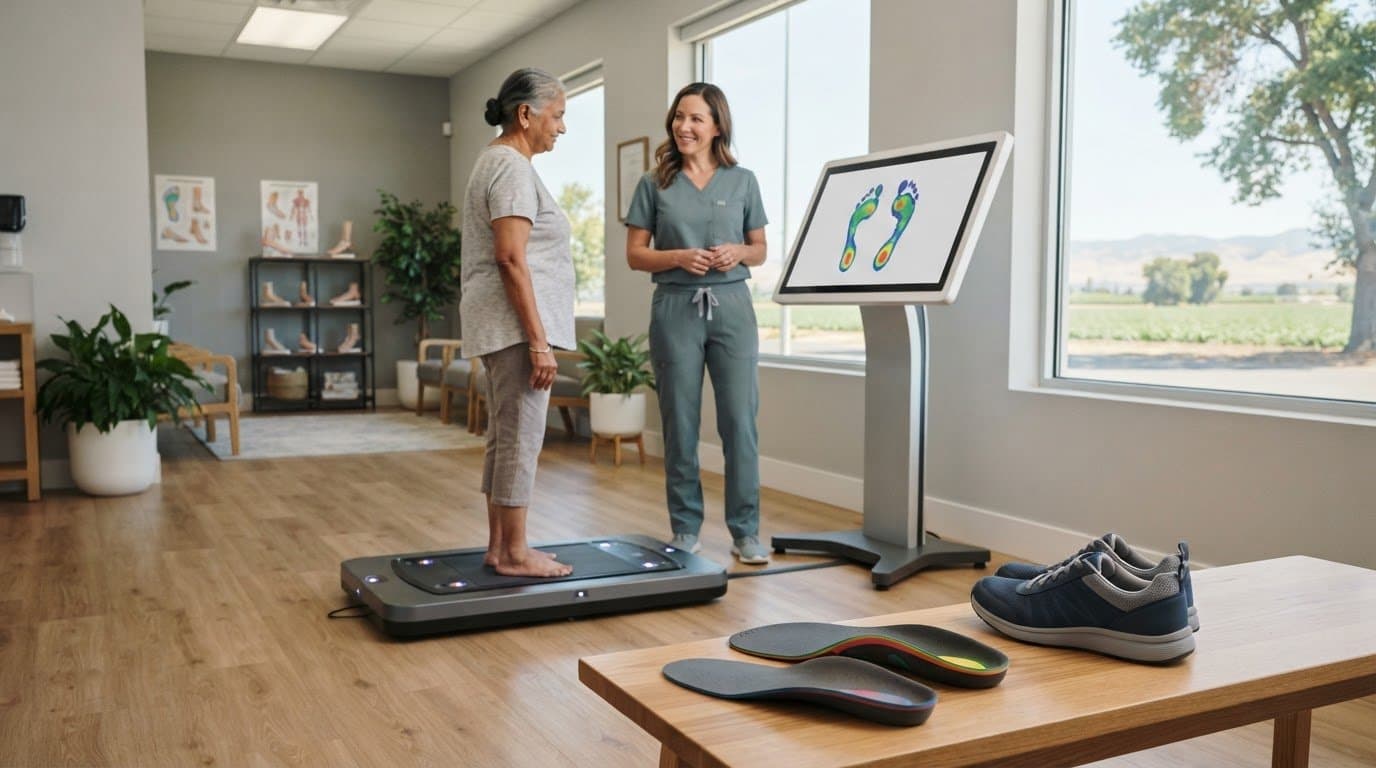
Pedics sensorimotor orthotics are custom insoles, shaped from a scan of your feet and a look at how you stand and walk. Pedics designs them to do more than cushion: to guide how your feet move, which may ease the strain that travels up into your knees, hips and back.
- Scanned, not sized
- Made from a scan of how your feet carry your weight, not from your shoe size.
- Whole-body design
- Pedics designs them with your ankles, knees, hips, pelvis and spine in mind, not just the arch.
- May help with
- plantar fasciitisflat feetback painsports injuries
Do you need more than an insert?
Not everyone needs custom orthotics, and sometimes a store-bought insert is enough. They’re worth a closer look when foot, knee, hip or back pain keeps coming back, or your work keeps you standing all day. Your evaluation looks at how you stand and walk to decide whether they make sense for you.
Worth a look if
- 01Your heel hurts with your first steps out of bed. For plantar fasciitis, orthotics are often paired with SoftWave therapy. Read more on shockwave and orthotics for heel pain.
- 02You have flat feet, or your feet roll inward as you walk.
- 03Knee or hip aches come along with lower back stiffness.
- 04Your shoes wear down faster on the inside or outside edge.
- 05You work long shifts on your feet: in a hospital, a classroom, a warehouse or on a job site.
- 06Your balance feels less sure, or walking tires you out sooner than it used to.
Trace it down to your feet.
Pedics designs these orthotics around the kinetic chain, the line of joints that runs from your feet to your spine. When the foundation shifts, each link above it adjusts to keep you upright. Read it from the top, where strain can show up, down to where it can start.
Posture and balance
How you stand, how steady you feel and how soon you tire all rest on the links below.
Spine
Takes the extra pressure when the pelvis tips forward, especially in the lower back.
Pelvis
Can tip forward, like a bowl spilling water, as the legs turn in beneath it.
Hips
Feel the pull through the hip flexors and thighs when the knees rotate.
Knees
Turn inward when the arch collapses and the foot rolls in.
Ankles
Roll in with the foot, so every step lands a little less steadily.
Feet
Three arches carry your weight. When they flatten or the foot rolls inward, everything above shifts to compensate.
Not just an arch support.
- Most arch supports
- Prop up the arch or cushion it. The support is mainly passive, and firmer ones can feel rigid and restrictive.
- Pedics sensorimotor orthotics
- Pedics builds them to stimulate the muscles of the foot and sharpen how it communicates with your brain, so they guide movement instead of blocking it. Each pair is shaped to your own scan.
What a fitting is like.
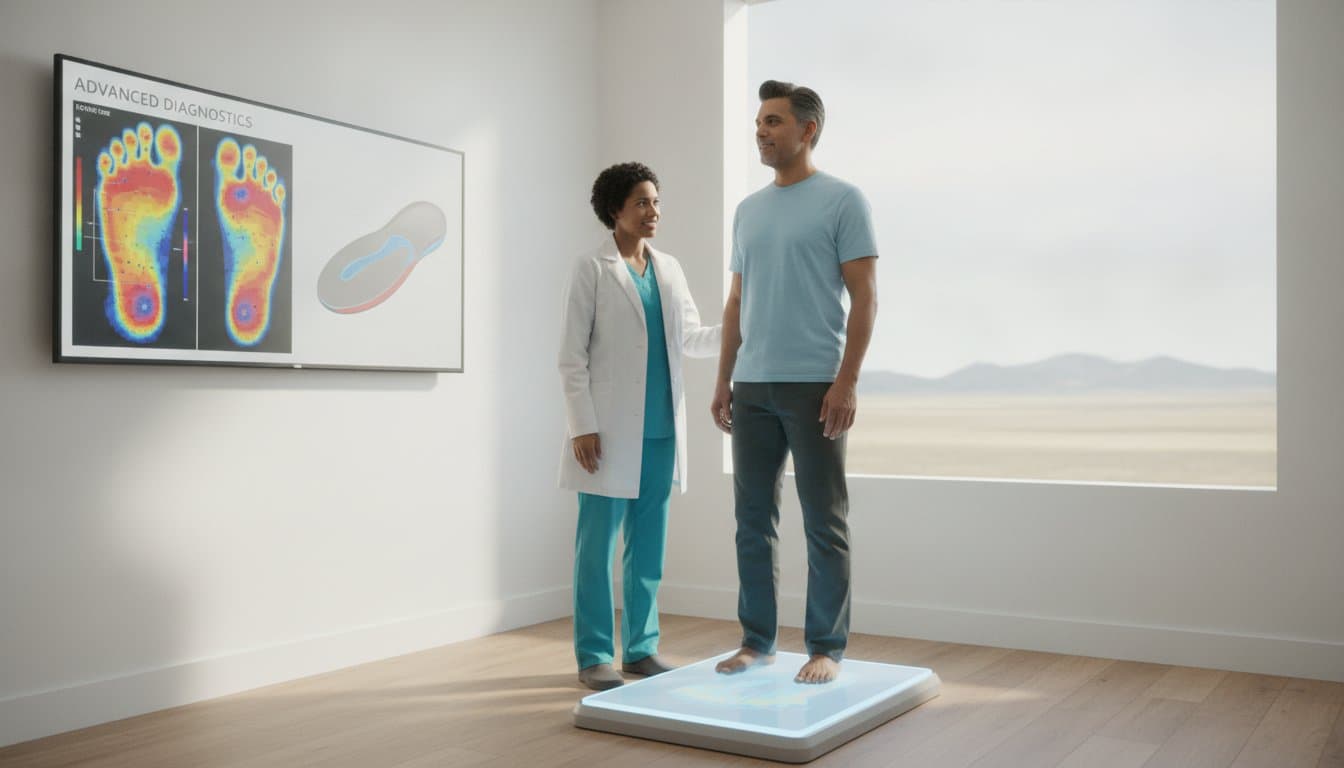
Nothing about it is invasive or painful. You walk, you stand on a scanner for a few minutes, and your orthotics are built from what it finds.
Before you come in
Bring your usual shoes.
Work boots, sneakers, whatever you wear most. Note when your feet, knees or back act up, and what you were doing at the time.
At your evaluation
Posture and gait first.
We watch how you stand and walk, and how your ankles, knees and hips line up with your spine.
A few minutes
Step onto the scanner.
The platform maps how your weight spreads across each foot. Then Dr. Kalay walks you through the color map it draws.
When they’re ready
Fitted, then fine-tuned.
Your pair is made from the scan. We check it in your own shoes and give you a gradual break-in plan. If rubbing or pressure lingers, come back and we’ll adjust the fit.
Questions about custom orthotics

Reviewed by
Dr. Gurj Kalay, DC
Doctor of Chiropractic, Palmer College of Chiropractic West (2014)
General information, not medical advice. Your own exam decides your care.
Can custom orthotics fix my lower back pain?
They don’t cure an underlying condition. What they can do is steady your base. If flat or rolling feet and a forward-tipped pelvis are adding to your back pain, a stable foundation may ease that strain and help your chiropractic adjustments hold longer. Your evaluation is how you find out whether that’s part of your picture.
Do I need new shoes, or orthotics in every pair?
Usually neither. Most custom orthotics are slim enough for work boots, sneakers and everyday shoes once you take out the shoe’s factory insole, and they’re made to move between pairs. Wearing them in the shoes you spend the most time in matters most. A close-fitting dress shoe may not take one, so bring the pairs you wear and ask.
How long do custom orthotics last?
Generally two to five years, where many store-bought inserts lose their support within three to six months. Your gait, weight and activity can change over time, so plan to have them checked every 12 to 18 months, or sooner if your shoes start wearing unevenly or the old aches come back.
What do they cost, and does insurance cover them?
The cost depends on what your feet need, and it typically includes the evaluation, the scan and follow-up adjustments to the fit. Insurance coverage varies by plan and by the medical reason for the orthotics, so check your benefits with your insurer and ask what paperwork they need. Call the office for the details of your own assessment.
Can kids and student athletes wear custom orthotics?
They can, though not every child needs them. It depends on the child’s activities, footwear and development. If a young athlete’s feet, knees or back hurt during sports, or something gets in the way of walking or play, an evaluation is a good place to start.
Why get orthotics from a chiropractor instead of a podiatrist?
A podiatrist focuses mainly on the foot and ankle. Here, the evaluation also takes in your posture, gait and pelvis, and the same office handles your orthotics and your adjustments, so both work toward one plan.

Start with a scan. See how you stand, then decide.
Call or book online for a custom orthotic evaluation, and bring the shoes you wear most. Your first consultation with Dr. Kalay is complimentary.
New patient? Send the new patient form and the team will contact you to set up your first visit.
New patient special437 Century Park Dr Ste A · Yuba City, CA