
ReStora EMS chair in Yuba City A stronger pelvic floor, fully clothed.
The chair uses high-intensity focused electromagnetic energy to make the muscles of your pelvic floor contract deeply, over and over, while you sit for about 30 minutes. Those are the muscles behind bladder control and a steady core. No surgery, no medication, no internal probes, and you go straight back to your day.
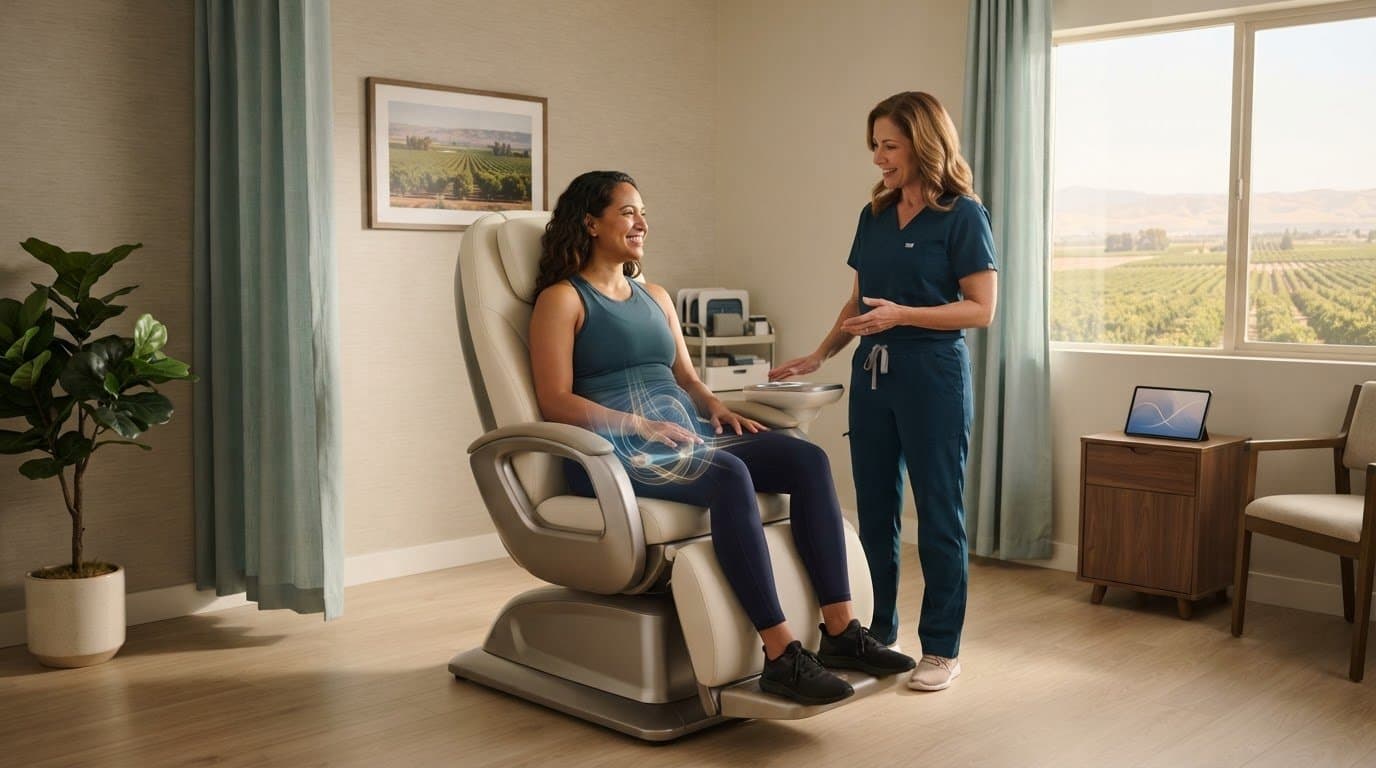
- Fully clothed
- No gown and no internal exam. You sit down as you are.
- Women and men
- Childbirth, menopause and prostate surgery can all weaken the same muscles.
- Best for
- Bladder leaks and urgency, recovery after childbirth, and core weakness.
Is the ReStora chair right for you?
Leaks when you laugh, a sudden rush to the bathroom, a core that hasn’t felt right since having a baby: these are common, in women and in men, and nothing to be embarrassed about. They don’t all have the same cause, though. Dr. Kalay starts with a private conversation about what you’ve noticed and your health history, and recommends the chair when weak pelvic floor muscles are part of the picture.

It may help if
- 01You leak a little when you cough, sneeze, laugh, lift or exercise.
- 02A sudden, strong urge to go sends you looking for the nearest bathroom, or wakes you at night.
- 03Your pelvic floor and core haven’t felt the same since pregnancy and childbirth.
- 04Bladder control has slipped with menopause or with age.
- 05You’re a man whose bladder control changed after prostate surgery or treatment.
- 06You’ve tried Kegels at home but can’t tell if you’re squeezing the right muscles.
It isn’t the right fit if
- You’re pregnant.
- You have a pacemaker or another implanted heart device.
- You have metal implants in or near the pelvis, such as a hip replacement.
- You’ve had a baby recently and haven’t yet been cleared by your own provider, usually at the six-week checkup.
- You have blood in your urine or trouble urinating. See your medical doctor about those first.
Have an IUD, especially a copper one, or any other implant? Mention it at your first visit so it can be reviewed with your history before any session.
What happens in the chair.
Your pelvic floor is a sling of muscle across the base of your pelvis. It holds up your bladder and bowel, tightens when you cough or lift, and forms the floor of your core. The chair is built to make those muscles work hard while you do nothing but sit.
A field rises from the seat.
A focused electromagnetic field passes up through the cushion and your clothes into the pelvis. Nothing is placed on your skin and nothing is internal.
It reaches the nerves.
The field sets off the nerves that control your pelvic floor, so the muscles work without you having to find them or squeeze.
The floor lifts, again and again.
The muscles contract deeply, release and contract again, harder than most people can manage on their own. Repeated over a series of sessions, that is designed to rebuild strength and help nerves and muscles work together again.
Many patients compare one session to thousands of Kegels.
A set of Kegels at home
You squeeze, hold and count. It’s easy to tighten the wrong muscles, and hard to keep the habit.
About 30 minutes in the chair
Thousands of contractions, at a strength you generally can’t produce yourself, while you sit still.
Drawings are illustrations, not to scale. The ReStora uses high-intensity focused electromagnetic (HIFEM) technology, which is different from a TENS unit: TENS works through pads on the skin and mainly targets pain signals.
What a session is like.
It’s simpler than most people expect. You sit, the chair does the work, and the feeling is usually described as a deep tightening or pulsing: strong, but not painful.
Before your first session
A private conversation.
You talk through your symptoms and health history, including pregnancies, surgeries and implants, so Dr. Kalay can confirm the chair is safe for you. There’s no internal exam.
On the day
Dress comfortably.
Loose, everyday clothes are fine, and come well hydrated. There’s nothing to change into.
About 30 minutes
Sit back and let it work.
You’ll feel your pelvic floor tighten and lift in rhythm. Most people read or rest. If anything feels sharp or too strong, say so and the intensity is turned down.
Afterward
Straight back to your day.
There’s no downtime. Your muscles may feel worked, like after a focused workout, and some people feel a little more urgency to use the bathroom for a short while.
Often six sessions twice a week, over about three weeks
That’s the usual starting series, spaced so your muscles can recover between sessions. Your own plan depends on your symptoms and how you respond, and some people need more.
There’s no fixed timeline and no guaranteed result. Some people notice a change within the first few sessions; for others it builds over the series. Keeping a note of when leaks or urgency happen gives you and Dr. Kalay something real to compare.
Questions about ReStora

Reviewed by
Dr. Gurj Kalay, DC
Doctor of Chiropractic, Palmer College of Chiropractic West (2014)
General information, not medical advice. Your own exam decides your care.
Is the ReStora chair FDA-cleared?
Yes. The ReStora EMS chair is FDA-cleared for its intended use, strengthening the pelvic floor muscles. Clearance covers what the device is for; it isn’t a promise of the same result for everyone.
Will my insurance cover it?
Often not. Standard health plans usually treat electromagnetic pelvic floor chairs as elective, but coverage varies, so check with your insurer. You may be able to use a Health Savings Account (HSA) or Flexible Spending Account (FSA), though your plan may ask for a letter of medical necessity first.
Do I need a referral from my doctor?
No. You can book directly. Your first visit includes the assessment that decides whether the chair is safe and suitable for you.
Does the chair replace Kegels and other pelvic floor exercises?
Not automatically. The chair works the muscles for you, which can help when they’re hard to find on your own, but it isn’t a substitute for exercise guidance you’ve already been given. If you do pelvic floor exercises now, keep going and ask how the chair fits in before you change anything.
How long do the results last?
It varies with what caused the weakness, your starting strength and how active you are. Like any muscle, the pelvic floor can lose strength again over time, which is why some patients come back for an occasional maintenance session. Progress is reviewed as you go.
Is the ReStora the same as Emsella?
No. Emsella is a different brand of pelvic floor chair. Yuba Sutter Chiropractic uses the ReStora EMS chair, and settings or claims for one device don’t automatically apply to the other.

Ask about it in private. Fully clothed, start to finish.
Call or book online. When you call, you only need to say you’d like to ask about the ReStora chair. Your first consultation with Dr. Kalay is complimentary.
New patient? Send the new patient form and the team will contact you to set up your first visit.
New patient special437 Century Park Dr Ste A · Yuba City, CA