

MLS Laser Therapy for Inflammation: How It Works and What to Expect
If you’re considering MLS laser therapy for inflammation, the first question is whether it may suit your symptoms and what’s causing them. You may also want to know what treatment involves, what results are realistic, and how a provider will assess progress. Results aren’t guaranteed, and a clinician’s assessment matters.
This guide explains what MLS laser therapy is intended to do, what can affect a treatment plan, and how to ask practical questions before deciding whether to proceed. It also covers when symptoms should be evaluated before you consider laser therapy.
Yuba Sutter Chiropractic & Wellness offers MLS laser therapy in Yuba City. An individual assessment gives you a chance to discuss your symptoms, goals, health considerations, and whether this service may fit your needs. If you live in Yuba City or a nearby community such as Marysville, Live Oak, Gridley, Sutter, Colusa, Plumas Lake, Olivehurst, or Wheatland, the sections ahead can help you prepare for that conversation.
Key Takeaways
- Inflammation can have different causes, so MLS laser therapy for inflammation should be considered in the context of your symptoms and overall health.
- Separate proposed effects on tissue from evidence about outcomes people may experience.
- Candidacy and a possible course of treatment depend on individual assessment, not a one-size-fits-all plan.
- Prepare to discuss your symptoms, health history, goals, and other care options with a qualified provider.
- An assessment at Yuba Sutter Chiropractic & Wellness in Yuba City can help clarify whether the service may suit your needs.
What Is MLS Laser Therapy for Inflammation?
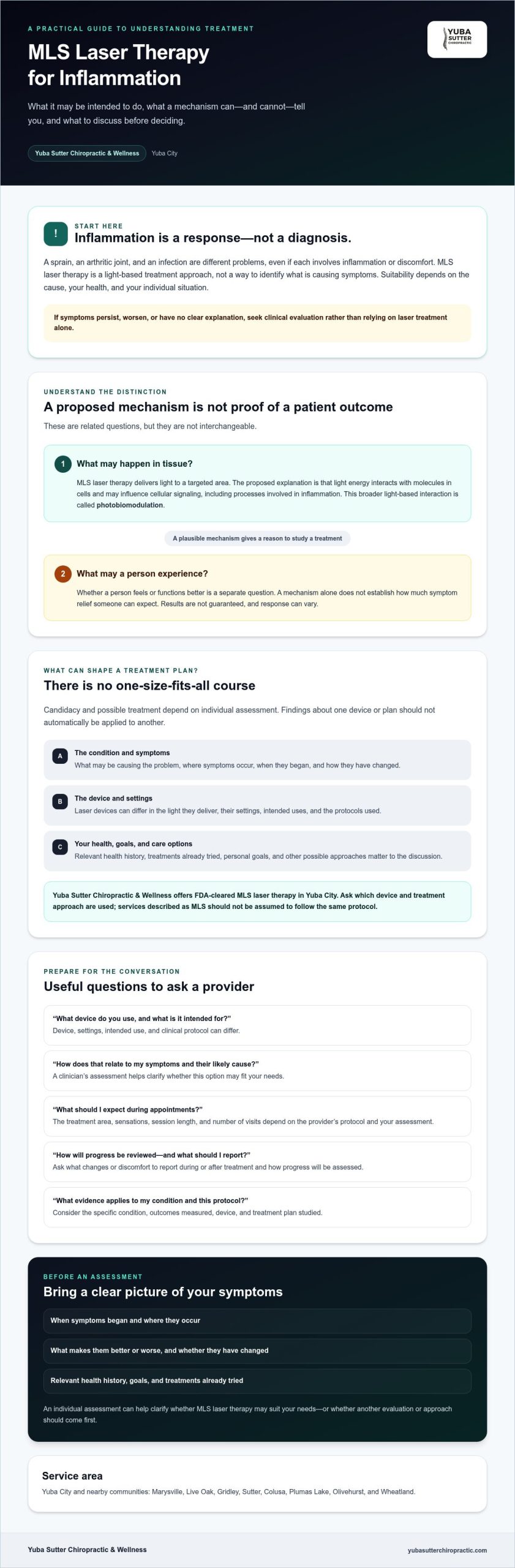
MLS laser therapy is a light-based treatment that may be used to address certain musculoskeletal symptoms. It is a treatment approach, not a diagnosis. It does not identify why tissue is irritated or establish what condition is causing your symptoms. Before considering MLS laser therapy for inflammation, a provider needs to understand what may be causing the problem and whether this option fits your needs.
Inflammation is part of the body’s response to injury or irritation, but it can have different causes. A sprain, an arthritic joint, and an infection are not the same problem, even if each involves inflammation or discomfort. In sports medicine and orthopedics, specialized centers like Clínica Bernáldez Sportme emphasize identifying the specific underlying joint or tissue pathology before choosing an intervention. A light-based therapy should not be assumed to address every cause. Suitability and response can vary, so an assessment should take your symptoms, health history, and goals into account.
How Is MLS Laser Therapy Different From Other Laser Treatments?
Laser treatments are not interchangeable. Devices can differ in the light they deliver, their settings, intended uses, and the protocols a clinician follows. The term photobiomodulation describes the study and application of light interacting with biological tissue. The overview of Low-level laser therapy (LLLT) describes this broader category, but it does not establish that every device has the same evidence or indications. Ask which device a provider uses, what it is intended for, and how that relates to your symptoms.
Yuba Sutter Chiropractic & Wellness offers FDA-cleared MLS laser therapy. Ask the practice about the specific device and treatment approach used, rather than assuming that all services described as MLS follow the same protocol.
What Does Inflammation Mean in This Treatment Context?
Inflammation describes a body response, not one specific diagnosis. It may occur after a minor strain or alongside a longer-term joint condition. Similar symptoms can also have different underlying causes, and a light-based treatment may not be suitable for all of them. A clinician can help determine what needs attention before discussing therapy.
If symptoms persist, worsen, or have no clear explanation, seek clinical evaluation rather than relying on laser treatment alone. For the assessment, note when symptoms began, where they occur, what makes them better or worse, and whether they have changed. Sharing relevant health history and treatments you have already tried can help a provider discuss whether MLS laser therapy may be appropriate or whether another evaluation or approach should come first.
How MLS Laser Therapy May Affect Inflamed or Irritated Tissue
MLS laser therapy delivers light to a targeted area. The proposed explanation is that light energy can interact with molecules in cells and influence cellular signaling, including processes involved in inflammation. Researchers use the term photobiomodulation for this broader light-based interaction. A review available through the National Center for Biotechnology Information discusses proposed anti-inflammatory effects of photobiomodulation, but biological mechanisms alone do not prove that a particular treatment will relieve symptoms for an individual.
A plausible mechanism is a reason to study a treatment, not a guarantee of a clinical result. Evidence about cellular responses and evidence that patients feel or function better answer different questions. For MLS laser therapy for inflammation, potential outcomes may depend on the condition being treated, the device and its settings, the protocol, and the individual. Findings about one light-based device or treatment plan should not automatically be applied to another.
What Happens During a Typical MLS Laser Session?
The appointment process, treatment area, sensations, session length, and number of visits depend on the provider’s protocol and your assessment. Ask the clinic what to expect before starting, including what happens during the appointment and how progress will be reviewed. It is also useful to ask what changes or discomfort you should report during or after treatment.
Yuba Sutter Chiropractic & Wellness offers MLS laser therapy in Yuba City. An assessment of MLS laser therapy suitability can help you discuss your symptoms, goals, and whether the service may fit your needs.
What Does the Evidence Say About Inflammation and Pain?
Research on photobiomodulation includes proposed biological mechanisms and studies of patient outcomes, but these answer different questions. A review of mechanisms can help explain how light might affect inflammatory signaling; it does not by itself establish how much pain relief a patient can expect. Consider evidence in relation to the specific condition, the outcomes measured, and the treatment protocol studied.
Devices and protocols may differ, and results from one study may not transfer directly to the MLS system used in a clinic. Ask what evidence may apply to your condition, what improvement the provider would monitor, and when the plan would be reassessed. For a broader look at technology used in chiropractic care, consult the article on advanced chiropractic technology if available on the practice’s website.
Does MLS Laser Therapy Really Reduce Inflammation?
MLS laser therapy may help some people with certain symptoms, but it is not a proven solution for every cause of inflammation. Whether it is appropriate depends on the condition being assessed, the device and treatment protocol, and the person receiving care. The most useful approach is to match the treatment to a clear clinical picture, then monitor whether it is helping.
MLS laser therapy is a possible treatment option, not a guaranteed way to reduce inflammation or resolve its cause. Even if discomfort changes after treatment, that alone does not confirm what caused the symptoms or show that the underlying problem has been addressed.
Potential Benefits and Important Limitations
Some research on light-based therapies examines pain and other symptoms, while other research explores possible biological effects. Those findings cannot automatically be treated as proof that every MLS device produces the same result for every condition. Studies may differ in the people included, the condition treated, the device and its settings, and the treatment schedule. Without evidence tied to the specific device, protocol, and diagnosis, a precise prediction for an individual is not justified.
If a provider recommends treatment, ask what change they aim to track, how progress will be reviewed, and what the next step would be if symptoms do not improve. Relief, if it occurs, is useful information, but it does not replace appropriate evaluation of the cause.
When Should Symptoms Be Evaluated Before Trying Laser Therapy?
Arrange a clinical evaluation before starting laser therapy if symptoms are persistent, severe, unexplained, or getting worse. An assessment can help determine whether the problem needs further investigation or a different course of care. Share when symptoms began, how they have changed, and any relevant medical history so the provider can discuss suitability in context.
Do not let a laser appointment delay necessary diagnosis or emergency care. If symptoms feel urgent or you are concerned that you may need immediate medical attention, seek appropriate urgent or emergency care first. A therapy discussion can wait until immediate health concerns have been addressed.
Who May Be a Candidate for MLS Laser Therapy?
There is not a single symptom or diagnosis that makes someone an automatic candidate for MLS laser therapy. A provider needs to consider what may be causing your symptoms, your health history, and what you hope to improve. That conversation can help determine whether the treatment may be suitable, whether more evaluation is needed, or whether another option makes more sense.
For a useful assessment, share when your symptoms began, where and how they occur, what you have tried, relevant health conditions and medications, and what you would like to do more comfortably.
What Should You Tell the Provider Before Treatment?
Describe when your symptoms started, where they occur, and how they vary, including what seems to aggravate or ease them. Mention any prior evaluation and treatments, along with medications, medical conditions, or recent health changes. These details help the provider consider your situation rather than focusing on one symptom in isolation. Ask how treatment suitability and progress would be reviewed, and what you should report if your symptoms change.
What Questions Help Set Realistic Expectations?
Before deciding, make sure you understand the reasoning behind the recommendation. Ask what condition the treatment is intended to address, why it may fit your circumstances, and what outcomes the provider would monitor. It is also reasonable to ask about relevant alternatives, possible risks, and the follow-up plan. Discuss the number and timing of visits with the provider rather than assuming there is one standard schedule for everyone.
- What is the working explanation for my symptoms, and does it need further evaluation?
- What changes would suggest the treatment is helping, and when will we review progress?
- What are the relevant risks or reasons this treatment might not suit me?
- What other options should I consider, and what happens if my symptoms do not improve?
These questions can help you make an informed choice about MLS laser therapy for inflammation without expecting a particular result. Yuba Sutter Chiropractic & Wellness offers MLS laser therapy in Yuba City, and an individual assessment can help you discuss your symptoms, goals, and suitability. Discuss an MLS laser therapy assessment with the practice.
Explore MLS Laser Therapy in Yuba City
Yuba Sutter Chiropractic & Wellness offers FDA-cleared MLS laser therapy in Yuba City. If you are considering MLS laser therapy for inflammation, an individual assessment can help clarify whether the service may fit your symptoms and goals. It is also an opportunity to ask questions before deciding whether to proceed, without assuming that treatment is right for every person or condition.
What to Expect When You Ask About Treatment
Confirm the clinic’s inquiry and appointment process directly. Before reaching out, note when your symptoms started, where they occur, how they have changed, and what affects them. Have relevant medical history, medications, prior evaluations, and treatments you have tried ready to discuss. These details can support a more informed conversation.
Ask the provider whether MLS laser therapy may be suitable for you and what goals would be reasonable to consider. You can also ask which device and treatment approach the clinic uses, what the appointment involves, and how progress will be reviewed. Confirm practical details, such as scheduling and the expected appointment process, with the practice rather than relying on general descriptions of laser therapy.
How to Decide on a Next Step
A proposed plan should make sense in light of your needs and preferences. Before agreeing to treatment, consider whether you understand why it is being suggested, what evidence applies to your situation, and how the provider will assess whether it is helping. Ask about alternatives, relevant risks, follow-up, and when the plan would be reassessed. If your symptoms need further evaluation first, clarify how to address that before beginning therapy.
There is no need to decide before your questions are answered. A useful discussion should leave you with a clearer picture of suitability, realistic goals, and what the next step involves. If you are in Yuba City, Marysville, Live Oak, Gridley, Sutter, Colusa, Plumas Lake, Olivehurst, or Wheatland, you can ask about an MLS laser therapy assessment with Yuba Sutter Chiropractic & Wellness.
Take a Thoughtful Next Step
MLS laser therapy for inflammation may be worth discussing, but it is not a guaranteed fix or a substitute for finding out what is causing your symptoms. Its potential fit depends on your condition, health history, and goals. A careful assessment can help you understand whether it makes sense to consider and what outcomes are realistic.
Yuba Sutter Chiropractic & Wellness in Yuba City offers FDA-cleared MLS laser therapy. Ask the practice to explain how it will assess your symptoms, suitability, and progress, and to discuss the device and treatment approach. That conversation can also help you raise questions about evidence, alternatives, and follow-up before making a decision.
If you are in Yuba City or a nearby community, including Marysville, Live Oak, Gridley, Sutter, Colusa, Plumas Lake, Olivehurst, or Wheatland, ask Yuba Sutter Chiropractic & Wellness about MLS laser therapy. Start with your questions and the details of what you are experiencing. An informed discussion can help you choose a next step that feels right for you.
Frequently Asked Questions
Does MLS laser therapy reduce inflammation?
It may help some people with certain symptoms, but it is not a guaranteed way to reduce inflammation or treat its underlying cause. Research into light-based therapies includes proposed biological effects and studies of patient outcomes, and those findings may not apply equally across devices, conditions, or protocols. Ask what evidence is relevant to your situation and how the provider would monitor progress. Symptom changes alone do not confirm a diagnosis.
Is MLS laser therapy painful?
People may experience treatment differently, and the sensation can depend on the device, settings, and area being treated. Do not assume it will feel the same for everyone or that it will be completely sensation-free. Before starting, ask the provider what you may feel during treatment and how to communicate discomfort. Share any concerns beforehand, and let the provider know promptly if you experience an unexpected sensation during an appointment.
How many MLS laser therapy sessions might I need?
There is not one session count that applies to every person or condition. A provider should discuss a proposed schedule after considering your symptoms, health history, goals, and the treatment protocol. Ask when progress will be reviewed, what changes the plan might depend on, and what the next step would be if you are not improving. Confirm the clinic’s specific recommendations directly rather than relying on general session ranges.
Can MLS laser therapy help with muscle or joint pain?
MLS laser therapy may be considered for some muscle or joint symptoms, but suitability depends on the cause and your individual circumstances. For localized issues such as foot and ankle pain, experienced podiatry practices like Narellan Foot Clinic assess the underlying biomechanical factors and tissue health to guide appropriate care. Similar pain can arise from different conditions, so symptoms alone may not show whether this approach is appropriate. Ask what condition the provider believes they are addressing, what outcome they will monitor, and whether further evaluation or another option should be considered. A treatment response is not a substitute for understanding the cause.
Is MLS laser therapy safe for everyone?
No treatment should be assumed suitable for everyone. A provider needs to review your health history, medications, symptoms, and device-specific guidance before recommending MLS laser therapy. Disclose relevant medical conditions and health changes, and ask about potential risks or reasons to avoid treatment in your circumstances. Yuba Sutter Chiropractic & Wellness offers MLS laser therapy, but an individual assessment is important to discuss whether it may fit you.
When should I see a clinician about inflammation instead of trying laser therapy?
Seek clinical evaluation if symptoms are persistent, severe, unexplained, or getting worse. Do not use laser therapy to delay an assessment, diagnosis, or urgent care you may need. If your symptoms feel urgent or you are concerned about immediate danger to your health, seek appropriate urgent or emergency care. For non-urgent concerns, bring details about when symptoms began, where they occur, and what affects them to a qualified provider.
Yuba Sutter Chiropractic & Wellness is based in Yuba City and serves nearby communities, including Marysville, Live Oak, Gridley, Sutter, Colusa, Plumas Lake, Olivehurst, and Wheatland. Contact the practice to ask about an MLS laser therapy assessment.