

DOT Physical Requirements for CDL: 2026 Driver’s Guide
A DOT physical doesn’t have to feel like a threat to your CDL. It’s a medical check-in, and knowing what the examiner will assess can help you prepare. The DOT physical requirements for CDL drivers include specific standards for vision, hearing, blood pressure, and other health factors. Understanding them ahead of time can make the appointment feel more straightforward.
This guide explains what a Certified Medical Examiner (CME) reviews, how health conditions may affect certification, and what to bring to your appointment. It also covers the 2026 medical certification process, so you can organize your paperwork and avoid preventable delays.
Yuba Sutter Chiropractic & Wellness provides DOT physicals in Yuba City for commercial drivers. A CME makes the certification decision under FMCSA standards, but arriving with relevant records, medication details, and any corrective devices you use can help make the evaluation more efficient. Here’s what to expect and how to prepare.
Key Takeaways
- Know the dot physical requirements for cdl, including the vision, hearing, and blood pressure standards examiners assess.
- Learn how a Certified Medical Examiner evaluates health conditions and determines the certification period.
- Use a practical checklist to gather medical records, medication details, and other information before your exam.
- Understand what the National Registry II electronic reporting transition means for medical certification records.
- Find out how to arrange a DOT physical in Yuba City, serving drivers from nearby communities.
What is a DOT Physical and Why Do You Need One?
A DOT physical is a medical exam that helps determine whether a commercial motor vehicle (CMV) driver can safely perform driving duties under federal standards. A Commercial Driver’s License (CDL) authorizes a driver to operate certain commercial vehicles. The medical exam addresses whether the driver is medically qualified to do so. The dot physical requirements for cdl help identify health concerns that could affect safe vehicle operation.
The exam must be performed by a Certified Medical Examiner (CME) listed on the FMCSA’s National Registry. The examiner reviews your health history and assesses whether you meet the applicable medical standards. A Medical Examiner’s Certificate, Form MCSA-5876, records the certification decision and its expiration date.
The Goal of the FMCSA Medical Standard
Driving requires sustained attention and the ability to respond physically and mentally, whether you make local deliveries or drive long distances. The exam looks for safety-sensitive conditions that could cause sudden impairment, such as loss of consciousness or difficulty controlling a vehicle. A diagnosis doesn’t automatically disqualify you. The CME considers your individual health and how the condition is managed under FMCSA standards.
Who Needs a DOT Physical?
Federal medical qualification rules generally apply to drivers operating CMVs in interstate commerce. Vehicle weight, passenger capacity, and cargo can determine whether the rules apply. A medical exam is generally required when driving:
- A vehicle with a gross vehicle weight or weight rating of 10,001 pounds or more.
- A vehicle designed to transport 9 to 15 passengers, including the driver, for compensation, or 16 or more passengers regardless of compensation.
- A vehicle transporting hazardous materials that require placards.
Requirements can differ for intrastate driving. The rules that apply depend on the type of operation and relevant state requirements.
How Often Must You Be Re-Certified?
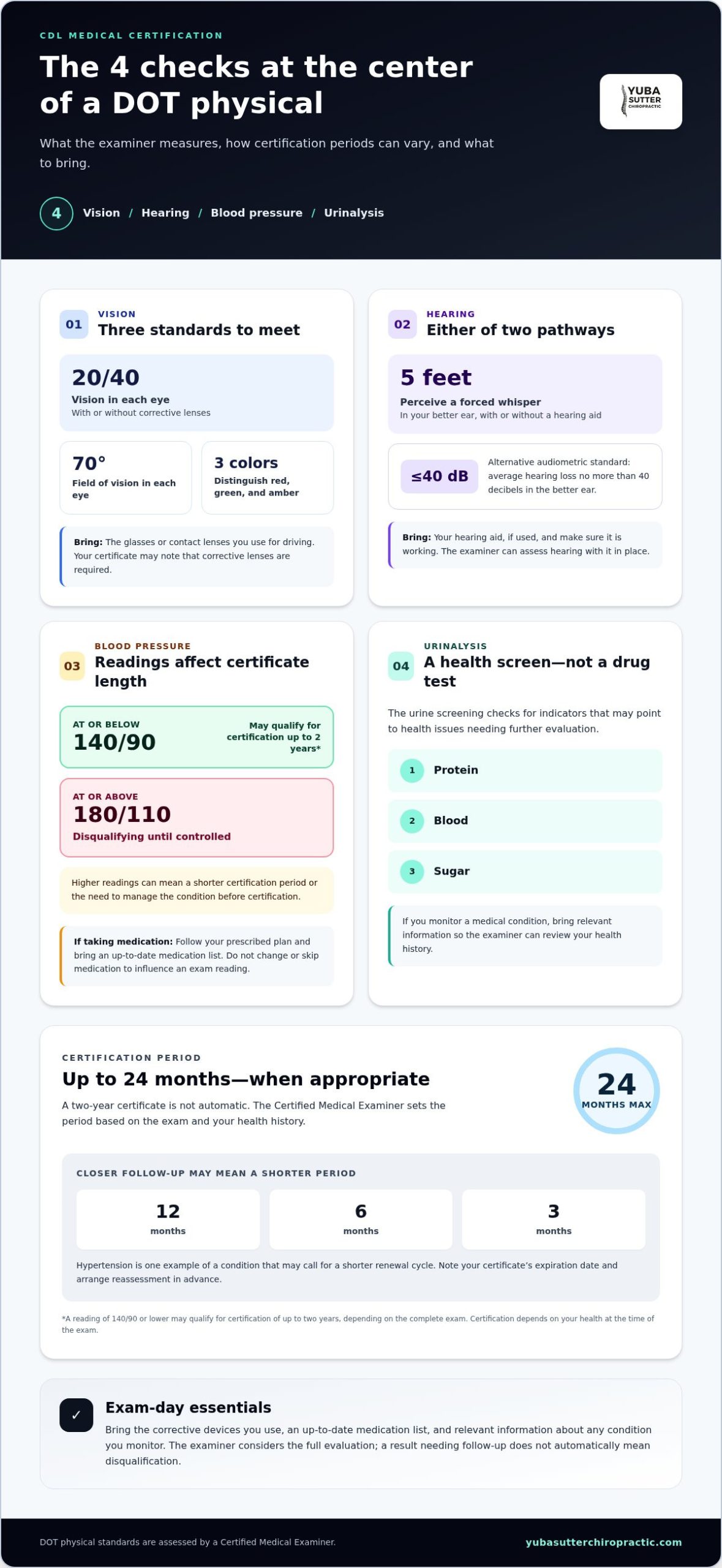
A medical certificate may be issued for up to 24 months if the examiner determines that you meet the standards and don’t need more frequent monitoring. A two-year certificate isn’t automatic. The CME sets the certification period based on the exam and your health history.
A condition that needs closer follow-up may result in a shorter certification period, such as 12, 6, or 3 months. Hypertension is one example. A driver with managed high blood pressure may receive a shorter renewal cycle so the examiner can monitor the condition. Note your certificate’s expiration date and arrange a reassessment in advance. Certification depends on your health at the time of the exam.
Core DOT Physical Requirements: The 4 Main Health Checks
The core dot physical requirements for cdl include vision, hearing, blood pressure, and a urinalysis. These checks help the medical examiner assess health factors that could affect safe driving. A result that needs follow-up doesn’t automatically mean disqualification. The examiner considers the full evaluation and applies FMCSA standards.
Vision and Hearing: Can You Use Corrective Devices?
Drivers must have at least 20/40 vision in each eye, with or without corrective lenses, a field of vision of at least 70 degrees in each eye, and the ability to distinguish red, green, and amber traffic signals. Bring the glasses or contact lenses you use for driving, and wear them during the exam if needed. Your certificate may note that corrective lenses are required.
For hearing, you must be able to perceive a forced whisper from 5 feet away in your better ear, with or without a hearing aid. Alternatively, an audiometric test must show average hearing loss of no more than 40 decibels in the better ear. If you use a hearing aid, bring it and make sure it’s working. The examiner can assess your hearing with the device in place.
Blood Pressure Thresholds and Certification Lengths
Blood pressure can affect how long your medical certificate is valid. A reading of 140/90 or lower may qualify for certification of up to two years, depending on the complete exam. Higher readings can lead to a shorter certification period or a need to manage the condition before certification. A reading at or above 180/110 is disqualifying until controlled.
A hypertension stage label alone doesn’t determine your certificate length. The examiner considers your measured blood pressure, treatment, and overall health. If you take blood pressure medication, follow your prescribed plan and bring an up-to-date medication list. Don’t change or skip medication to influence an exam reading.
Urinalysis: What the Test Checks
The urinalysis screens for indicators such as protein, blood, and sugar. These findings can point to health issues that may need further evaluation, but the urine screening itself isn’t a drug test. If you’ve been told to monitor a medical condition, bring relevant information so the examiner can review your health history.
For details on the administrative requirement to maintain a valid Medical Examiner’s Certificate, consult the FMCSA’s medical certification guidance. Drivers preparing for an exam in the Yuba-Sutter area can arrange a Yuba City DOT physical with Yuba Sutter Chiropractic & Wellness.
Disqualifying Conditions and the 2026 Regulatory Landscape
A health diagnosis doesn’t automatically end a driving career. Under the dot physical requirements for cdl, the Certified Medical Examiner (CME) considers the condition, its treatment, and any risk it could pose behind the wheel. Some conditions may prevent certification unless they’re controlled or qualify for an FMCSA exemption or another pathway. Review the Official FMCSA Medical Examination Requirements for federal standards and details about the certification process.
Seizure disorders, some respiratory or cardiovascular conditions, and uncontrolled diabetes may require careful evaluation. Untreated sleep apnea can also raise safety concerns. The examiner makes an individual decision based on the medical information available. Bring relevant records and explain your treatment clearly rather than assuming a diagnosis means automatic disqualification.
Managing Chronic Conditions: Diabetes and Sleep Apnea
Drivers with insulin-treated diabetes may need documentation on Form MCSA-5870 from their treating clinician for the CME to review. If sleep apnea or another breathing concern is relevant, the examiner may ask for additional assessment, such as sleep-study information or evidence of treatment use. Bring records that show how your condition is managed. The CME determines whether you meet the standard and what certification period applies.
FMCSA medical variances may provide a route for some drivers with vision, hearing, diabetes, or seizure-related conditions who don’t meet a standard through the usual process. Drivers with certain limb impairments may also be evaluated for a Skill Performance Evaluation (SPE), which assesses their ability to operate a commercial vehicle safely with the impairment. These pathways have specific eligibility and evaluation requirements, and approval isn’t automatic.
The Move to Electronic Medical Certificates
The National Registry II (NRII) is changing how exam results move from the medical examiner to state licensing agencies. As of October 2026, examiners are required to submit results to the FMCSA National Registry by the next calendar day, and the FMCSA transmits the information to state licensing agencies. The electronic process is intended to streamline recordkeeping and reduce paper-based errors. Keep your own paperwork organized during the transition.
A temporary FMCSA waiver allows drivers to use a paper Medical Examiner’s Certificate as proof of medical certification for up to 60 days after issuance through October 11, 2026, during the system transition. Keep the certificate provided after your exam and check your state licensing record if your medical status doesn’t appear as expected. Electronic updates and state records may not be reflected at the same moment.
The Driver’s Preparation Checklist: How to Pass Your Exam
Preparation helps the examiner review your health history and complete the exam. The dot physical requirements for cdl don’t change based on how you prepare, and no checklist can guarantee certification. Still, bringing clear records, the corrective devices you use, and an accurate medication list can help avoid delays and give the examiner useful context.
What to Bring to Your Appointment
Gather your documents before the appointment. Bring:
- Your valid driver’s license and current Medical Examiner’s Certificate, if you have one.
- Relevant medical records for heart conditions, diabetes, sleep apnea, or other ongoing health concerns.
- Specialist notes or records related to a recent surgery or chronic condition, if available.
- A complete medication list with each medication’s dose and prescribing clinician.
- Your glasses or contact lenses, hearing aids, and CPAP compliance information, if applicable.
Include recent test results or treatment information that explains how a condition is managed. Keep your medication list current rather than relying on memory when describing medication names and doses.
The 24-Hour Pre-Exam Protocol
Keep your routine steady before the appointment. Drink water as you normally would and choose regular meals rather than unusually salty foods. Avoid energy drinks, and consider limiting caffeine and nicotine close to the exam, since stimulants can affect how you feel and may influence a blood pressure reading. Don’t skip or change prescribed medication to try to alter your results. Take it as directed unless your prescribing clinician has given you different instructions.
If you’re prone to “white coat” nerves, give yourself a few quiet minutes before the exam. Try this simple routine:
- Pause: Sit comfortably and let your shoulders drop.
- Breathe: Take a few slow, steady breaths, breathing out gently for longer than you breathe in.
- Focus: Review your documents and remind yourself that the exam is a health assessment, not a judgment.
If you feel tense, mention it to the examiner. Taking a moment to settle in can make the visit more comfortable, and the examiner can interpret your reading in context. To arrange a local appointment, schedule a DOT physical with Yuba Sutter Chiropractic & Wellness in Yuba City.
Stress-Free DOT Physicals at Yuba Sutter Chiropractic & Wellness
A DOT physical is a required medical evaluation, but the process can be clear and organized. Yuba Sutter Chiropractic & Wellness provides DOT physicals for commercial drivers in Yuba City and surrounding communities, including Marysville and Sutter. Certified Medical Examiners review your health and determine certification according to FMCSA standards. No provider can guarantee a pass, but arriving prepared can help you understand the evaluation and any next steps.
A Community-Focused Approach to Driver Health
Drivers in the Yuba-Sutter basin have demanding schedules and benefit from local access to care. Bring your medical records and medication details to support the examiner’s review. The examiner completes the certification paperwork as part of the medical process and bases the decision on applicable FMCSA requirements.
Long hours behind the wheel can also place strain on your back and posture. Chiropractic care is separate from the DOT certification decision, but it can be part of broader attention to spinal health and everyday comfort. Learn more about spinal alignment for health and how regular chiropractic adjustments may support your overall wellness.
Support can extend beyond the exam, too. The Blueprint Metabolics program offers an option for drivers seeking help with long-term health goals. Your DOT certification still depends on the CME’s evaluation, while ongoing wellness care can help you stay attentive to your health between renewals.
Booking Your Exam in Yuba City
At your appointment, expect to review your health history and complete the required medical assessment with a Certified Medical Examiner. Bringing documents and devices relevant to your health can help keep the visit focused. Yuba Sutter Chiropractic & Wellness serves drivers in Yuba City and nearby communities, including Marysville, Live Oak, Gridley, Sutter, Colusa, Plumas Lake, Olivehurst, and Wheatland.
To arrange your visit, schedule your DOT physical with Yuba Sutter Chiropractic & Wellness. Preparing your records and medication details is a practical step toward understanding your health status and maintaining your commercial driving qualifications.
Prepare With Confidence for Your Next DOT Physical
Understanding the dot physical requirements for cdl helps you arrive prepared. The exam checks vision, hearing, blood pressure, and overall health. Your records and medication information help the examiner assess your individual circumstances. Certification is based on the Certified Medical Examiner’s evaluation under FMCSA standards, so no clinic can guarantee a specific result.
Yuba Sutter Chiropractic & Wellness provides DOT physicals with Certified Medical Examiners in Yuba City. Drivers from Marysville, Live Oak, Gridley, Sutter, Colusa, Plumas Lake, Olivehurst, and Wheatland can arrange an appointment close to home.
Take the next step with a local team serving commercial drivers in the Yuba-Sutter area. Schedule your DOT physical in Yuba City and arrive with the information you need for your evaluation.
Frequently Asked Questions
Does a DOT physical include a drug test?
No. The urine test during a DOT physical checks for health indicators such as protein, blood, and sugar. It isn’t a drug test. DOT drug testing is a separate process with its own requirements, such as pre-employment testing for covered safety-sensitive work. Keep the medical exam separate from employer or testing-program requirements so you can prepare for each process.
Can I pass a DOT physical with high blood pressure?
Possibly. A reading above 140/90 may lead to a shorter certification period or require the condition to be managed before certification. A reading at or above 180/110 is disqualifying until controlled. The examiner considers your actual reading and health history, so a hypertension diagnosis doesn’t automatically mean you can’t qualify. Follow your prescribed treatment plan and bring an accurate medication list to help the CME assess the dot physical requirements for cdl.
What happens if I fail my DOT physical?
If the examiner determines that you don’t meet the medical standard, you may not receive a Medical Examiner’s Certificate at that visit. Depending on the reason, the examiner may need more medical information, or you may need to manage a condition and be evaluated again. Ask the examiner to explain the finding and what documentation or follow-up may help. The decision is based on FMCSA standards, and certification isn’t guaranteed.
Do I need to bring my CPAP machine to the exam?
Usually, the useful item to bring is documentation about your sleep apnea treatment, such as a recent CPAP compliance report, rather than the machine itself. Bring relevant clinician records and details about your treatment, too. The CME may review this information when assessing your condition and fitness for duty. Follow any specific instructions you’ve received about what to bring so the examiner has the information needed for your evaluation.
Can I go to any doctor for a DOT physical?
No. A DOT physical for FMCSA medical certification must be performed by a Certified Medical Examiner listed on the FMCSA National Registry. A regular doctor can provide medical records or treatment information, but that alone doesn’t qualify them to issue the DOT certificate. Yuba Sutter Chiropractic & Wellness provides DOT physicals with Certified Medical Examiners in Yuba City for drivers across the surrounding Yuba-Sutter communities.
How long does a DOT physical take at your Yuba City office?
The appointment length can vary based on your health history, exam findings, and whether the examiner needs to review additional records. Bringing your medication list, relevant medical documents, and any requested treatment reports can help keep the visit organized. Yuba Sutter Chiropractic & Wellness provides DOT physicals in Yuba City for drivers from Marysville, Live Oak, Gridley, Sutter, Colusa, Plumas Lake, Olivehurst, and Wheatland.
What if my medical certificate expires before I get a new one?
Don’t assume you can keep operating a commercial vehicle that requires medical certification after your certificate expires. Arrange your renewal before the expiration date and check with your state licensing agency about your status if there’s a gap. During the 2026 transition, a temporary waiver allows a paper certificate to serve as proof for up to 60 days after it’s issued. That allowance doesn’t extend a certificate past its expiration date.
Are there exemptions for drivers with monocular vision?
Potentially. Drivers who don’t meet the standard vision requirement with one eye may be eligible to apply through an FMCSA vision exemption process. Eligibility and certification depend on the applicable requirements and an individual review. An exemption isn’t automatic. Share your vision history and relevant records with the Certified Medical Examiner, who can explain how the medical standard applies to your exam and what information may be needed for further consideration.