

Finding a Peptide Therapy Doctor Near Me in Yuba City
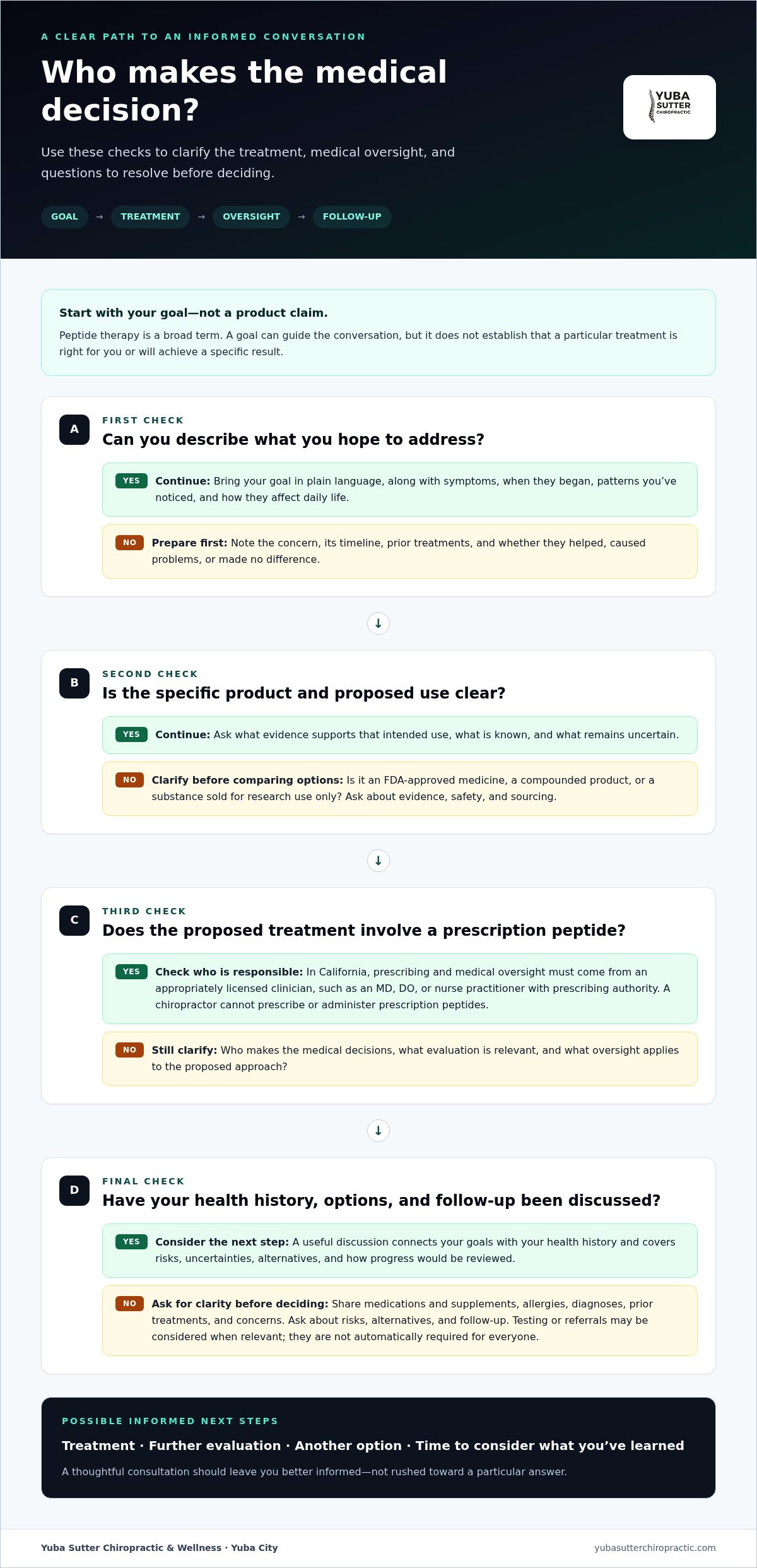
When finding a peptide therapy doctor near me, the most important question may not be which treatments are on the menu, but who is responsible for the medical decisions. It’s reasonable to want clear answers about what a peptide is, what evidence supports its use, and whether it fits your health goals. Yuba Sutter Chiropractic & Wellness offers peptide therapies in Yuba City. In California, a chiropractor cannot prescribe or administer prescription peptides. Prescribing and medical oversight must come from an appropriately licensed clinician, such as an MD, DO, or nurse practitioner with prescribing authority.
A careful next step starts with understanding the difference between FDA-approved peptide medicines, compounded products, and substances sold for research use only. This guide explains how to consider whether peptide therapy aligns with your goals, understand the role of medical evaluation and follow-up, and prepare useful health information for a consultation. You’ll also learn what to look for in local care around Yuba City, so you can make an informed decision without feeling rushed.
Key Takeaways
- When finding a peptide therapy doctor near me, look beyond broad treatment claims and consider whether the approach fits your health goals.
- Peptide therapy covers different products and uses, so clarify what treatment is being discussed before making a decision.
- A thoughtful consultation should consider your health history, medications, prior treatments, and questions before recommendations are made.
- Learn how FDA-approved medicines differ from compounded or investigational products, and consider evidence, safety, sourcing, and follow-up.
- Yuba Sutter Chiropractic & Wellness offers peptide therapies in Yuba City. Use the guidance in this article to prepare for a conversation about the service.
Finding a Peptide Therapy Doctor Near Me: Start With Your Goals
Searching for peptide care close to home can feel confusing. One clinic may use “peptide therapy” as a broad wellness term, while another may describe a specific medicine or proposed use. Those phrases don’t necessarily refer to the same treatment. Before comparing options, clarify what you hope to address and what kind of care is being discussed.
Peptide therapy is a broad term for using peptide-based treatments in a health plan. It doesn’t guarantee a particular result or mean a treatment is right for you. The specific substance, intended use, supporting evidence, and medical oversight all matter. Your goal can guide a conversation, but it can’t establish that a peptide will meet that goal.
What are you hoping to address?
Begin with your own experience, not a product claim. Write down the concern you want help with, when it began, how it affects daily life, and what you’ve already tried. Include relevant health conditions and prior care so a clinician can consider your situation as a whole.
- Describe your main goal in plain language, such as wanting to discuss a change in energy or recovery.
- Note your symptoms, when they occur, and any patterns you’ve noticed.
- List prior treatments and whether they helped, caused problems, or made no difference.
Keep your personal goal separate from claims about what a particular peptide can do. Bring claims you’ve encountered to the appointment as questions rather than assuming they apply to you. A useful discussion should set realistic expectations and consider alternatives, including the possibility that peptide treatment may not be the best fit.
Why location matters for ongoing care
For care that may involve follow-up, a nearby location can make appointments easier to fit into daily life. It can also support continuity by giving you a place to return with updates, questions, or changes in your health. Convenience doesn’t replace sound medical judgment, but access and clear communication can make the care process more manageable.
For people in Yuba City and nearby communities, Yuba Sutter Chiropractic & Wellness offers peptide therapies as part of its wellness services. If a proposed treatment involves a prescription peptide, prescribing and medical oversight must come from an appropriately licensed medical clinician. As you explore local care, consider whether the discussion starts with your goals and health history, explains the specific approach clearly, and gives you time to consider the next step. That’s a more useful measure of fit than a list of broad promises.
What a Responsible Peptide Therapy Consultation Should Cover
A consultation should help you understand whether a proposed approach makes sense for your situation, not simply move from a goal to a product. The conversation can vary by clinician and individual needs, but it should give you room to share relevant details, understand how a recommendation is being considered, and ask questions before deciding.
An individualized assessment matters because the same treatment may not be appropriate for every person, even when their goals sound similar. A discussion can clarify what is known, what remains uncertain, and whether another option may better fit your circumstances. Testing or referrals may be considered when the clinician believes they’re relevant. They aren’t automatically required for everyone.
Health history, goals, and clinical fit
Expect the discussion to connect your health goals with your broader health picture. Before the visit, gather information that can make the conversation specific and useful. Include current medications and supplements, allergies, relevant diagnoses, prior treatments, and any concerns or changes you’ve noticed. A clear timeline can help you explain what you’ve tried and what matters most to you now.
Sharing these details supports a more informed conversation, but it doesn’t guarantee eligibility or a particular recommendation. Be clear about what you hope will change and what you’re comfortable considering.
Evidence, options, and follow-up
Ask for a plain-language explanation of the proposed treatment, the evidence relevant to its intended use, and the limits of what’s known. A responsible discussion should also cover potential risks, uncertainties, and alternatives, including choosing not to proceed. If anything is unclear, ask the clinician to explain it in everyday terms before you decide.
Follow-up deserves attention, too. Discuss how progress would be reviewed, what changes or concerns should prompt another conversation, and how you’ll know whether the plan still fits. The details depend on your circumstances and the clinician’s judgment. A general online protocol can’t replace an individualized discussion.
To make the appointment more productive, bring a short written list of questions. Ask what the treatment is intended to address, what evidence supports that use, what risks or alternatives to consider, and what follow-up could involve. You don’t need to arrive with a preferred answer. A thoughtful consultation should leave you better informed, whether the next step is treatment, further evaluation, another option, or time to consider what you’ve learned.
If you’re finding a peptide therapy doctor near me, use the quality of this conversation as one measure of fit. Yuba Sutter Chiropractic & Wellness offers peptide therapies in Yuba City. You can explore the practice’s peptide therapy services as you prepare your questions and consider next steps.
How to Assess Peptide Therapy Claims, Safety, and Provider Fit
Clear information helps you judge whether a proposed treatment deserves further discussion. Marketing claims, testimonials, and lists of possible benefits don’t establish that a peptide is effective for a particular use, suitable for you, or safe in your circumstances. Look for explanations that distinguish established evidence from uncertainty and connect recommendations to an individualized medical evaluation.
Peptide medicines don’t all fall into the same regulatory category. Some are FDA-approved for specific uses. Compounded products are not FDA-approved drugs, and compounding does not make a product equivalent to an FDA-approved medicine. Investigational products may be under study, but research alone doesn’t establish that they’re approved or appropriate for routine treatment. FDA guidance explains the limits and oversight associated with compounded drugs. The National Library of Medicine’s research resources can help locate studies, but a published study is not by itself proof of effectiveness for every use.
Compare the details, not just the promises
| What to assess | What clear information should address |
|---|---|
| Evidence | What research relates to the specific product and intended use? What remains uncertain? |
| Clinician oversight | Who evaluates your health, makes treatment decisions, and provides medical oversight? |
| Sourcing | What is the product’s status, and how is its source described? A “research use only” label is not a basis for human treatment. |
| Risks and alternatives | What potential harms or limitations are relevant, and what other options could be considered? |
| Follow-up | How will progress or concerns be reviewed, and how can you raise questions during care? |
Questions that reveal clarity and transparency
In a peptide therapy discussion, ask how the evidence applies to the proposed use, what’s not yet known, and what risks or alternatives deserve consideration. Ask who is responsible for medical oversight and how follow-up is handled. In California, a chiropractic license alone doesn’t authorize a chiropractor to prescribe or administer prescription peptides. Prescribing and medical oversight must come from an appropriately licensed medical clinician with prescribing authority.
When a claim deserves extra scrutiny
Pause over guarantees, statements that a treatment works for everyone, or pressure to start immediately. These claims don’t replace evidence or an assessment of your personal health needs. Product status and sourcing matter because the FDA distinguishes approved drugs from compounded products, and products sold for research use aren’t intended for human treatment. A careful conversation should make room for questions, limitations, and an unpressured decision about next steps.
Prepare for a Peptide Therapy Visit in Yuba City
A little preparation can make a local appointment more focused. Before your visit, jot down what you hope to discuss and gather information that gives the clinician a clearer picture of your health. You don’t need to arrive with a treatment decision already made. The purpose is to have a useful conversation and understand what next steps may fit your circumstances.
Bring useful information to the conversation
Keep your notes practical and easy to review. Bring a current medication and supplement list, including doses when you know them. Add relevant diagnoses, allergies, previous treatments, and a short description of your goals or symptoms. If you’ve noticed patterns or changes over time, note those too. A written record can help you remember details and explain what matters most.
- Your current medications and supplements, with doses when known
- Relevant health conditions, allergies, and prior treatments
- Your main goals, concerns, or symptoms and when they began
- Questions about evidence, potential risks, alternatives, and follow-up
Consider bringing information about prior care if it helps explain what you’ve already tried. You can also write down terms or claims you’ve encountered online. This gives you a chance to ask how they relate to your situation instead of relying on general promises.
Set clear expectations for next steps
Before leaving, make sure you understand what was discussed and what remains undecided. Appointment details, any recommended testing or referrals, and clinical recommendations depend on individual circumstances and the clinician’s judgment. There isn’t one schedule or plan that fits everyone.
Ask how follow-up will work if you have questions, how progress would be reviewed, and what changes or concerns should be shared. If a recommendation is made, it’s reasonable to ask what it’s intended to address and what alternatives you can consider. Clear answers can reduce uncertainty without creating pressure to commit before you feel informed.
For readers in Yuba City and nearby communities, planning ahead can help you use appointment time well. If you’re finding a peptide therapy doctor near me, bring your notes and leave space for an open discussion. Broader wellness goals may also involve other kinds of care. Yuba Sutter Chiropractic & Wellness offers peptide therapies in Yuba City, alongside separate wellness services such as the Blueprint Metabolics program. These offerings have distinct roles, so discuss each in relation to your own goals rather than assuming one is part of the other.
Ready to explore peptide therapy as part of your wellness conversation? Learn about peptide therapy at Yuba Sutter Chiropractic & Wellness.
Explore Peptide Therapy at Yuba Sutter Chiropractic & Wellness
If you’re exploring peptide care in the Yuba City area, Yuba Sutter Chiropractic & Wellness offers peptide therapies as part of its wellness services. This gives local readers a nearby place to learn about the service and consider how it relates to their personal health goals. Exploring an offering is a starting point for a conversation, not a promise that a particular treatment will be recommended or produce a specific result.
A local starting point for a care conversation
Your health history and priorities matter. Bring the questions you’ve gathered, explain what you hope to address, and share relevant medications, supplements, diagnoses, allergies, and prior care. That context can make the discussion more useful and grounded in your circumstances. You can also ask what information would help you understand the treatment approach, including its intended use, evidence, potential risks, and alternatives.
A calm, collaborative conversation should leave space to ask questions and consider what you’ve learned. You don’t need to arrive certain that peptide therapy is right for you. The goal is to understand the option clearly and decide on a thoughtful next step based on your individual circumstances.
Choose a clear next step
Yuba Sutter Chiropractic & Wellness also offers the Blueprint Metabolics program as a separate wellness service. It isn’t the same offering as peptide therapy, and each should be considered on its own terms in relation to your goals. If you’re comparing wellness options, keeping those distinctions clear can help you focus your questions and avoid assuming that one service automatically includes or replaces another.
For people finding a peptide therapy doctor near me, local access can make it easier to start an informed conversation close to home. Before reaching out, note the main goal you’d like to discuss and any questions about the service. You can ask about the next step in exploring peptide therapy without assuming that you’re eligible for a particular treatment or that a specific outcome is assured.
Take the next step at your own pace. Contact Yuba Sutter Chiropractic & Wellness to discuss peptide therapy and the questions you’d like to bring to the conversation.
Take the Next Step at Your Own Pace
Deciding whether peptide therapy belongs in your health plan doesn’t have to happen all at once. Give yourself room to reflect on your priorities, consider what you’ve learned, and bring any remaining questions into a conversation. A thoughtful next step is one that leaves you feeling informed, not rushed, and takes your individual health needs into account.
If you’re finding a peptide therapy doctor near me, Yuba Sutter Chiropractic & Wellness offers peptide therapies in Yuba City and serves nearby Northern California communities. The practice’s wellness services include peptide therapies, giving local readers a place to continue exploring their questions. No particular treatment or result is guaranteed, and your own circumstances matter.
When you’re ready, contact Yuba Sutter Chiropractic & Wellness to discuss your next step. A clear, unhurried conversation can help you decide what feels right for your health journey.
Frequently Asked Questions
Is peptide therapy FDA-approved?
Not as one blanket category. Some peptide medicines have FDA approval for specific uses, while “peptide therapy” doesn’t describe a single approved treatment. Compounded products and investigational substances have different statuses and shouldn’t be treated as interchangeable with approved medicines. FDA information can change, so consult current FDA resources and discuss the exact product, intended use, and available evidence with a qualified clinician before making a decision.
Can peptide therapy cause side effects?
Yes, side effects can occur, and the risks depend on the specific substance, route, dose, and your health circumstances. There isn’t one side-effect list that applies to every peptide. Before considering treatment, tell a qualified clinician about your diagnoses, allergies, and medications, and ask which warning signs need prompt attention. Don’t stop or adjust a prescribed medication unless the clinician managing it advises you to.
Can peptide therapy interact with medications or supplements?
Potential interactions depend on the specific peptide and the medicines or supplements you use, so a general online list may not answer your situation. Share a complete, current list with the clinician before any treatment decision, including occasional or nonprescription products. Ask whether product-specific interaction information is available and how concerns would be handled. Don’t stop, skip, or change prescribed medicines on your own. Discuss changes with the clinician who prescribed them.
How long does peptide therapy take to work?
There’s no single timeline because products, intended uses, supporting evidence, and individual circumstances differ. A response isn’t guaranteed, and a schedule that applies to one treatment may not fit another. Before starting, discuss what changes would be assessed, when progress would be reviewed, and what might lead the clinician to reconsider the plan. These questions can help set clear expectations without relying on a standard treatment duration.
Does insurance cover peptide therapy?
Coverage can vary with the specific treatment, its indication, your plan, and how care is billed. Review your plan documents and discuss billing details with the practice before making financial decisions. Don’t assume coverage based on another person’s experience. If you’re considering a visit from Yuba City, Marysville, Live Oak, Gridley, Sutter, Colusa, Plumas Lake, Olivehurst, or Wheatland, reviewing your own benefits can help you plan for local care.
Is peptide therapy right for everyone?
No. Suitability depends on your health history, goals, the specific product, and a clinician’s assessment. Some people may need another approach or additional medical review before deciding. If you’re finding a peptide therapy doctor near me, use the discussion to understand possible benefits, uncertainties, risks, and alternatives rather than assuming a treatment will fit. A clinician can help you consider those factors, but an initial conversation doesn’t guarantee eligibility or a particular recommendation.