

Chiropractic Care for Scoliosis in Wheatland and Pain Relief
Chiropractic care may be part of a symptom-focused approach to scoliosis, but expectations about changing the curve should remain cautious. For people considering chiropractic care for scoliosis in Wheatland, the key distinction is between easing symptoms and changing the curve: chiropractic treatment doesn’t consistently reduce the Cobb angle.
It’s understandable to hope that adjustments could correct the curve as well as help you feel better. A practical care plan focuses on what treatment can support, including comfort, mobility, and everyday activity, while keeping expectations clear.
This guide explains how adjustments, massage, and exercise may fit into scoliosis care, what can affect the approach, and why age, symptoms, and curve severity matter. You’ll also learn when pain relief is the main goal and what to consider as you explore care in the Wheatland area.
Key Takeaways
- Understand why chiropractic care may focus on easing discomfort and supporting daily movement rather than changing a structural spinal curve.
- Learn how adjustments, massage, and exercise can play different roles in a scoliosis care plan.
- Recognize how curve shape, symptoms, and individual needs affect the approach to care.
- Explore practical ways to stay active and support flexibility and mobility alongside professional care.
- See when chiropractic care may be a helpful next step for managing scoliosis-related pain.
Can chiropractic straighten scoliosis?
No. Chiropractic care is generally best viewed as a way to address scoliosis-related symptoms rather than as a way to change the spinal curve. Its role is better understood as symptom management: a treatment plan can focus on pain, mobility, and daily function rather than promising a straighter spine. Scoliosis is diagnosed when the curve measures at least 10 degrees by Cobb angle.
Posture changes can offer clues, but they don’t establish a diagnosis on their own. Common signs include uneven shoulders, one hip sitting higher, or a rib hump that becomes clearer when bending forward. Back or neck pain can also occur. Some people report shoulder or buttock discomfort, recurring injuries, or sciatica. Severe scoliosis can affect lung and heart capacity and may contribute to physical disability or painful menstruation.
Are there chiropractors in Wheatland, California who treat scoliosis? Chiropractic care is available near Wheatland, including in Yuba City, and can focus on scoliosis-related symptoms and function. If you’re seeking chiropractic care for scoliosis in Wheatland, it helps to distinguish pain relief from curve correction.
How can I find a qualified chiropractor for scoliosis near Wheatland? Look for an approach that includes a detailed health history, posture and gait assessment, and review of relevant imaging. A careful evaluation connects symptoms and daily limitations with a practical treatment plan instead of relying on posture alone.
Adult scoliosis can involve different concerns than scoliosis in a growing child. Degenerative changes, including osteoporosis, can be associated with adult scoliosis, while back pain may interfere with walking, work, sleep, or household tasks. Treatment planning should connect care goals to specific activities, such as standing comfortably or getting through a normal workday.
What questions should I ask a chiropractor before starting scoliosis treatment? Ask what the treatment is intended to improve, how progress will be assessed, and how the plan accounts for your curve and symptoms. Ask how adjustments, if used, fit alongside exercise and what effects to expect. Spinal manipulation can cause temporary soreness and stiffness; rare serious complications have been reported.
- Ask whether the goal is symptom relief, improved function, or curve monitoring.
- Describe which activities trigger pain, such as walking, sitting, or lifting.
- Discuss how examination findings and imaging inform the plan.
- Clarify how progress and any change in symptoms will be reviewed.
These details help keep expectations grounded. You can then judge whether the proposed care addresses the problems that matter most in daily life, while recognizing that easing discomfort does not mean the structural curve has straightened.
Spinal adjustments, massage, and exercise therapy
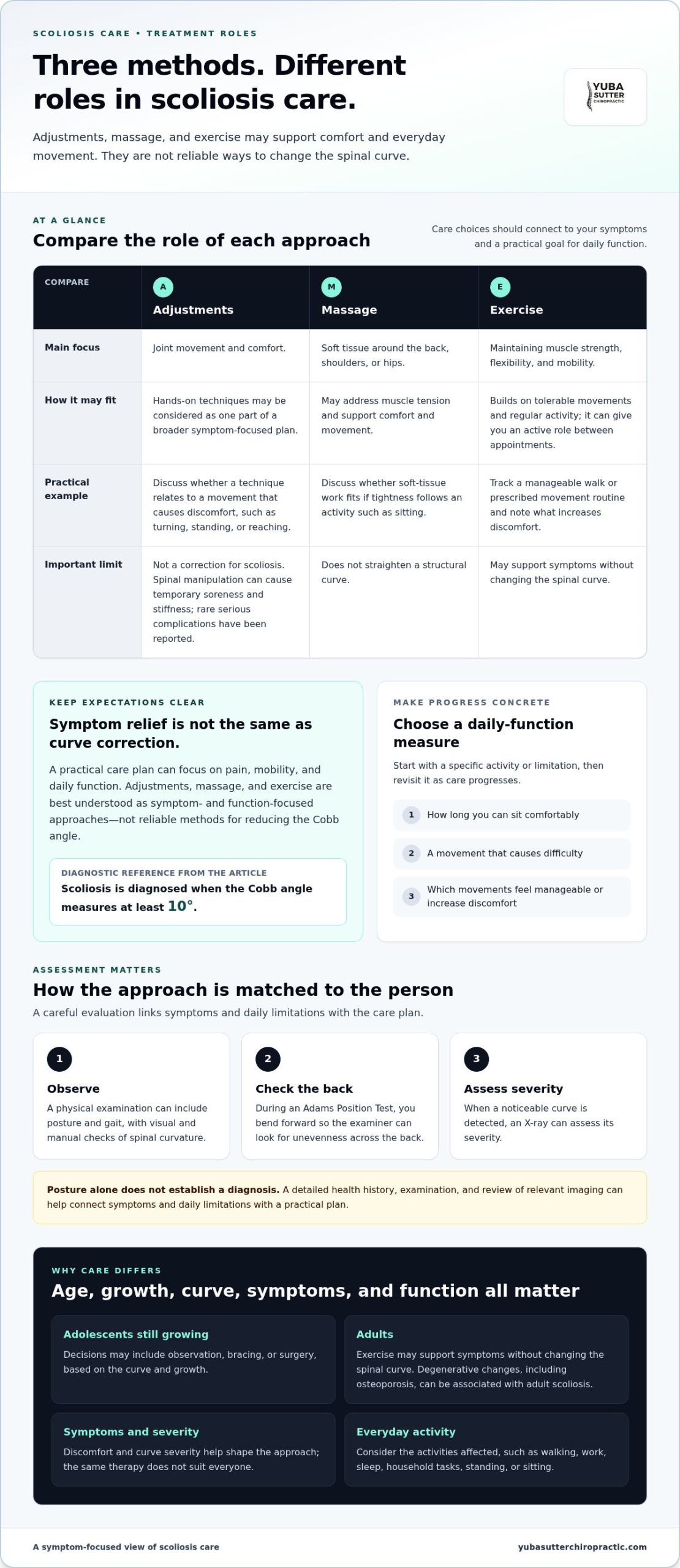
Scoliosis care may combine spinal adjustments, massage, and exercise, with each approach serving a different purpose. Adjustments use hands-on techniques intended to address joint movement and comfort. Massage works with surrounding soft tissue, while exercise helps maintain muscle strength, flexibility, and mobility. These methods focus on symptoms and function, not reliably changing the spinal curve.
An assessment helps determine which methods fit your concerns. A physical examination can include observing posture and gait, then using visual and manual checks of spinal curvature. During an Adams Position Test, you bend forward so the examiner can look for signs such as unevenness across the back. When a noticeable curve is detected, an X-ray can assess its severity.
Adjustments should be discussed as one part of a broader plan, not as a correction for scoliosis itself. A treatment goal might be to ease discomfort during a specific movement, such as turning, standing, or reaching. Spinal manipulation can cause temporary soreness and stiffness, and rare serious complications have been reported. Ask how the proposed technique relates to your symptoms and what changes should prompt a review.
Massage may address muscle tension around the back, shoulders, or hips. For example, if you feel tightness after sitting, discuss whether soft-tissue work fits alongside other care. Massage does not straighten a structural curve. Its role is comfort and movement, judged by whether ordinary activities become easier to manage.
Exercise gives you an active role between appointments. A plan can build on tolerable movements and regular activity, with the aim of maintaining strength, flexibility, and mobility. A short walk or prescribed movement routine can be easier to track than a broad goal like “improve posture.” Record which movements feel manageable and which increase discomfort, then share that pattern during reassessment.
What chiropractic treatments are offered for scoliosis in Wheatland? Scoliosis care may include spinal adjustments, massage, and exercise, selected around symptoms and functional goals. Chiropractic care is best framed as support for comfort and movement, rather than a way to straighten the spinal curve.
To make the plan practical, agree on a clear starting point, such as how long you can sit comfortably or which daily movement causes difficulty. Revisit that measure as care progresses. If you’re exploring chiropractic care options, consider how an evaluation can connect your symptoms with a realistic focus on relief and everyday function.
What Makes Scoliosis Complex to Treat?
Scoliosis care must account for more than a visible curve. Age, growth, curve severity, discomfort, and everyday function all shape the plan. For an adolescent who is still growing, decisions may include observation, bracing, or surgery based on the curve and growth. For an adult, exercise may support symptoms without changing the spinal curve. The same exercise or therapy approach does not suit everyone.
Scoliosis-specific exercises and physical therapy can focus on strength, flexibility, balance, and movement control. A therapist may tailor movements to your posture and comfort, then adjust them as you learn the technique. For example, an exercise could involve maintaining a balanced position while moving an arm or leg. The purpose is to support muscular function and daily movement, not promise structural realignment.
In-office therapy can help you learn movements with guidance. A useful session connects each exercise to a practical goal, such as bending to dress, walking comfortably, or sitting through a meal. The clinician can observe how you move and modify a position if it causes discomfort. At home, regular activity helps maintain muscle strength, flexibility, and mobility.
Keep the routine manageable. Choose an exercise you can perform with steady form, then note whether it affects a specific activity, such as reaching overhead or standing from a chair. Share that observation at your next appointment. This makes progress easier to discuss than a general goal like “fix alignment.” For adults with scoliosis, exercise can help symptoms even when the curve remains unchanged.
Stretching and massage may also be considered for comfort and muscular tension. For example, a gentle stretch after prolonged sitting can help you notice how stiffness affects movement. Massage may ease soft-tissue tension, but neither should be presented as a way to straighten a structural curve. The key is whether the approach supports a defined functional goal.
Sleep habits are another practical part of daily management. The guidance in this article is to avoid sleeping on your stomach and choose a firm, high-quality mattress when possible. Comfort still matters, so notice whether a sleep position leaves your back more uncomfortable in the morning. Pair these observations with regular exercise and discuss persistent changes during care.
Scoliosis is managed through a combination of choices, not one corrective exercise. Your age, growth status, curve, symptoms, and response to movement help determine the appropriate focus. Clear goals make the plan more useful: support mobility, maintain muscular strength, and make daily activities easier to manage.
Scoliosis as a structural, three-dimensional spinal condition
Scoliosis involves more than a sideways bend, so care depends on the curve’s structure, severity, and effect on function. Understanding how the curve is measured helps clarify what different treatments can and cannot do.
Scoliosis Definition and Spinal Curvature
Scoliosis is diagnosed when a spinal curve measures at least 10 degrees by Cobb angle. The condition is structural and three-dimensional, so an X-ray measurement helps assess curvature rather than relying on posture alone. Mild scoliosis measures 10 to 25 degrees, moderate scoliosis measures 25 to 40 degrees, and severe scoliosis measures 40 degrees or more.
That distinction matters when comparing care. Physical therapy and chiropractic care can support symptoms and function, while bracing may help limit worsening in a child who is still growing. Orthopedic care considers curve severity, growth, and whether surgical options need discussion. These approaches have different aims; symptom support is not the same as changing structural alignment.
Curve Progression and Research
Chiropractic treatment does not consistently produce measurable Cobb angle reduction, and it cannot reverse a structural spinal curve. For adults, exercise may help symptoms without changing the curve. Keep expectations realistic: consider chiropractic care for symptom management, and assess curve progression separately through appropriate clinical evaluation and imaging.
Traditional monitoring can include reassessment every 3, 6, or 12 months. For children, observation, bracing, or surgery are considered according to the curve and the child’s growth. The Scoliosis Research Society describes conservative care, including chiropractic, physical therapy, and bracing, as playing a role in managing curves under 40 to 45 degrees. Spinal fusion may be recommended when scoliosis reaches the severe classification at 40 degrees or the very-severe classification at 80 degrees or more.
How does chiropractic care compare with physical therapy, bracing, or orthopedic care for scoliosis? Chiropractic care and physical therapy can address symptoms and movement, while bracing can help limit worsening during a child’s growth. Orthopedic care evaluates curve progression and surgical considerations; the appropriate role depends on age, curve, and goals.
Spinal manipulation can cause temporary soreness and stiffness, and rare serious complications have been reported. Discuss the technique, expected effects, and alternatives before beginning care, especially if symptoms change after treatment.
Does health insurance cover chiropractic care for scoliosis in California? Coverage depends on your policy’s chiropractic benefits and terms for scoliosis-related care. The plan details determine which services and patient costs apply.
Chiropractic care and pain relief
Pain relief is a practical goal when scoliosis-related discomfort interferes with daily life. A sideways spinal curve may be associated with back, neck, shoulder, or buttock discomfort, recurring injuries, and sciatica. For adults, consider how symptoms affect activities, not only how the curve looks. Sitting through work, walking, sleeping, or lifting groceries can each reveal where support is needed.
Discomfort can have more than one contributing factor. Muscles may work differently around a curved spine, while stiffness or reduced mobility can make routine movements harder. Adult scoliosis may also be associated with degenerative conditions such as osteoporosis. An assessment should connect your history, symptoms, and movement limits before setting a care goal.
Chiropractic care may focus on comfort and everyday function rather than changing the spinal curve. A reasonable treatment plan identifies a specific concern first. For example, you might track discomfort while getting out of a chair, turning to reach a seat belt, or standing during meal preparation. This makes it easier to discuss whether care supports the activity that matters to you.
Use a simple symptom record between appointments. Note the activity, where discomfort occurs, and whether it changes your movement or rest. Add relevant context, such as a long period of sitting or a recurring bout of sciatica. These details can help guide reassessment and adjust the focus of care. They also distinguish a general sense of pain from a clear functional change.
Relief should not be confused with structural correction. Chiropractic care does not consistently produce measurable Cobb angle reduction, and exercise may help adult symptoms without changing the curve. That distinction matters when pain feels debilitating: comfort and movement are meaningful goals, even when the curve remains. A care plan should state those goals plainly and explain how progress will be discussed.
Some symptoms call for prompt medical attention rather than routine symptom management. Severe scoliosis can reduce lung and heart capacity and may cause physical disability. New or worsening difficulty with breathing, major changes in function, or escalating pain deserve timely clinical evaluation. The nature and severity of your symptoms matter when deciding what care is appropriate.
Before treatment, describe the movements that trigger discomfort and what you want to do more comfortably. Ask how the proposed approach relates to that goal, how progress will be reviewed, and what symptoms should prompt reassessment. If you’re ready to discuss a pain-focused plan, connect about chiropractic care and pain relief.
Yuba Sutter Chiropractic & Wellness: Auto Injury Relief
Yuba Sutter Chiropractic & Wellness offers Chiropractic Care for people seeking support with discomfort and everyday movement. Scoliosis-related care can focus on symptom relief, not straightening a structural spinal curve. If pain followed a vehicle collision, Auto Injury Relief may be relevant; describe when symptoms began and which movements are affected.
For a conversation about scoliosis-related discomfort, share your symptoms, activity limits, and care goals. This helps keep the discussion focused on function and realistic expectations. Contact Yuba Sutter Chiropractic & Wellness to discuss how its Chiropractic Care may fit your needs.
Take the Next Step Toward a Personal Care Plan
Choose your next step around the outcome that matters most to you, such as moving more comfortably or managing pain during daily activities. If you’re considering chiropractic care for scoliosis in Wheatland, discussing your symptoms, goals, and expectations can help clarify whether chiropractic care aligns with your needs.
Yuba Sutter Chiropractic & Wellness offers Chiropractic Care, Auto Injury Relief, and DRX9000 Decompression. These services address different concerns, so discuss your symptoms and the purpose of care rather than assuming every option is intended for scoliosis. A clear discussion can help you understand how a proposed approach relates to your priorities.
Contact Yuba Sutter Chiropractic & Wellness to talk about your care goals. Taking an informed, practical next step can help you move forward with greater clarity and confidence.
Frequently Asked Questions
Can scoliosis cause pain even if the curve is mild?
Yes, someone with a mild curve can still experience discomfort, although not everyone does. Pain can affect the back, neck, shoulders, or buttocks and may become more noticeable during a particular task. For example, note whether carrying a bag, sitting at a desk, or walking brings on symptoms. The pattern and effect on daily function matter alongside the curve measurement.
Do I need X-rays for scoliosis care?
An X-ray is used to assess scoliosis severity when an examination detects a noticeable curve. The image helps measure the curve using the Cobb angle, which supports decisions about monitoring and care. It isn’t the only part of an assessment: posture, movement, and health history also provide useful context. Keep previous imaging available so measurements can be compared over time.
How Is Scoliosis Identified?
Scoliosis identification can begin with a physical examination of posture, gait, and spinal shape. During an Adams Position Test, the person bends forward while the examiner looks for unevenness across the back. A scoliometer can help assess trunk rotation, and an X-ray can measure a detected curve. Scoliosis is diagnosed when the curve measures at least 10 degrees by Cobb angle.
Should my child be screened for scoliosis?
The U.S. Preventive Services Task Force finds insufficient evidence to recommend for or against routine scoliosis screening for children ages 10-18. That is not a recommendation to ignore a visible change. If you notice uneven shoulders, a higher hip, or a rib prominence while your child bends forward, share the observation during a healthcare visit. Growth and physical changes help guide assessment.
What Are The Consequences Of Scoliosis?
Consequences vary with the curve and your symptoms. Scoliosis may be associated with back, neck, shoulder, or buttock discomfort, and pain can affect daily activity. Severe scoliosis can reduce lung and heart capacity and may contribute to physical disability or painful menstruation. To understand its practical impact, track changes in breathing, mobility, sleep, and routine tasks.
What are the symptoms of scoliosis?
Possible signs include uneven shoulders, one hip higher than the other, or a rib hump visible when bending forward. Some people also experience discomfort in the back, neck, shoulders, or buttocks. Symptoms vary, and posture alone cannot confirm scoliosis. Note when a change appears and whether clothing hangs unevenly or movement feels different, then share those observations during an assessment.
Can chiropractic care correct scoliosis or only relieve pain?
Chiropractic care may support pain relief and everyday movement, but it cannot reverse a structural spinal curve. It also does not consistently produce measurable Cobb angle reduction. That distinction helps set a useful goal: discuss a specific activity affected by discomfort, such as sitting comfortably or turning while driving. Curve monitoring and symptom management are separate parts of care, even when addressed together.
What are the risks of chiropractic adjustments for people with scoliosis?
Spinal manipulation may cause temporary soreness and stiffness, and rare serious complications have been reported. Before an adjustment, discuss your scoliosis history, current symptoms, and any changes in sensation or function. Ask what technique is proposed and how it relates to your symptoms. If discomfort or other symptoms noticeably worsen after treatment, report the change before continuing with the same approach.