Class 4 is a safety class, not a type of treatment or a measure of results. It covers lasers with a continuous output above 500 milliwatts, an immediate eye and skin hazard from the direct or reflected beam, so eye protection is required. In therapy it means more power than Class 3B low-level lasers, and reviews rate the evidence that this helps pain as low to moderate certainty.
What does a laser’s class actually measure?
A class rates how dangerous the beam is to eyes and skin, not whether it treats anything. Federal rules sort every laser product into Class I, IIa, II, IIIa, IIIb or IV by how much radiation a person can be exposed to, and the FDA lists the roughly equivalent international classes from the IEC 60825-1 standard beside them.
| Class (FDA / IEC) | Output power | Hazard | Typical examples |
|---|---|---|---|
| Class I / 1, 1M | Low enough to be considered non-hazardous | Hazard rises only if viewed through magnifiers, binoculars or telescopes | Laser printers, CD and DVD players |
| Class II, IIa / 2, 2M | Visible light, not above 1 mW | Hazard increases when viewed directly for long periods | Bar code scanners |
| Class IIIa / 3R | 1 to 5 mW | Can be momentarily hazardous when viewed directly | Laser pointers, which are limited to 5 mW |
| Class IIIb / 3B | 5 to 500 mW | Immediate skin hazard from the direct beam and immediate eye hazard viewed directly | Low-level therapy lasers, which WALT’s dose tables list as Class 3B |
| Class IV / 4 | Above 500 mW | Eye and skin hazard from the direct or reflected beam; may be a fire hazard | Medical lasers for eye surgery or skin treatments, and high-intensity laser therapy |
So a Class 4 label tells you the device needs more safety controls, not that it works better. The class and the treatment are separate questions.
How is a Class 4 therapy laser different from a Class 3B laser?
| Class 3B (low-level) | Class 4 (high-intensity) | |
|---|---|---|
| Output power | 5 to 500 mW | Above 500 mW |
| Heat | Power densities below those needed to heat tissue | Can warm tissue: light absorbed by water and melanin generates heat |
| Time to deliver a dose | 20 to 300 seconds per point in WALT’s tables | Higher doses in shorter exposure times |
| Eye protection | Eyewear for the specific laser and a controlled area | Eyewear for the specific laser and a controlled area |
| Common names | Low-level laser therapy, “cold laser”, photobiomodulation | High-intensity laser therapy (HILT), high-powered photobiomodulation |
Both kinds work through the same proposed mechanism, photobiomodulation. A 2017 review identifies an enzyme in the mitochondria, cytochrome c oxidase, as the main light absorber, with red and near-infrared light freeing nitric oxide from it and raising the cell’s energy supply (ATP).
Dose and wavelength matter more than the class label. WALT’s dose recommendations are set in joules per treatment site, at 780 to 860 nm for example, and treat doses outside a window of about 50% either side as inappropriate. Research on the biphasic dose response finds that low doses often help more than high ones, so more power is not automatically more effect.
Device makers describe their lasers by these parameters, not only by class. The therapy laser we use, the MLS (Multiwave Locked System), emits two wavelengths and synchronizes them: 808 nm continuous and 905 nm pulsed.
Does more power mean better pain relief?
Not reliably. A 2023 meta-analysis of 48 trials with 3,107 participants, rated the certainty of its findings low to moderate and called the large differences between trial results an important limitation.
- Knee osteoarthritis. A 2020 review of 6 trials called the effect on pain, stiffness and function promising but limited by the small number of studies. A 2022 network meta-analysis of 10 studies and 580 participants found high-intensity laser may be more effective than other physical therapy, but not clearly for stiffness, and noted small samples and moderate study quality.
- Low back pain. A 2023 meta-analysis favored high-intensity laser over control groups for pain intensity, based on three trials.
- Neck pain. A 2023 review of 8 trials said it may be considered as an add-on treatment. A 2024 review of 20 studies found less pain and disability, mostly when laser was added to exercise, with low certainty because results varied and some trials had a risk of bias.
A result from one device or protocol does not automatically carry over to another. The Cochrane review of low-level laser for back pain could not pool trials with different populations, doses and comparison groups, and a 2012 review notes that a poor choice of settings can reduce how well treatment works. Our post on laser therapy for back pain goes through the back pain evidence in detail.
What are the risks of a Class 4 laser?
Temporary warmth, redness or mild tingling where you were treated are the common responses after therapy laser, and a burn is never an expected one. Heat is the reason power has limits: light absorbed by water and melanin generates heat, which can cap the tolerable power, particularly in darker skin.
Eye injury is the serious risk, and the reason for the safety rules. A Class 4 beam is an immediate eye hazard even when reflected, so the OSHA guidance for healthcare lasers calls for eyewear matched to the laser’s wavelengths and warning signs on the doors of the treatment area.
A 2010 guideline on electrophysical agents lists where low-level laser should not be used: over the eyes, over a confirmed or suspected cancer, over the low back, abdomen or pelvis during the first 35 weeks of pregnancy, over actively bleeding tissue or a blood clot, and over the testes. It adds caution over the front of the neck and in people with light-sensitive conditions. One laser maker’s labelling warns that tattoo ink can absorb a higher-power beam and get hot.
FDA status is a narrower claim than it sounds. MLS laser therapy is FDA-cleared, and a 510(k) clearance means the FDA found a device substantially equivalent to one already on the market. Clearance applies to a specific device and its stated uses, and it is not the same as approval.
What safety steps should a laser session include?
- A history first. Guidelines tie the risks to where and on whom a laser is used. Before Dr. Gurj Kalay, DC, starts laser, share your symptoms, diagnoses, medications and supplements, and any reaction you’ve had to treatment before.
- Eye protection. Eyewear matched to the laser is the standard. You sit or lie comfortably and put on protective glasses.
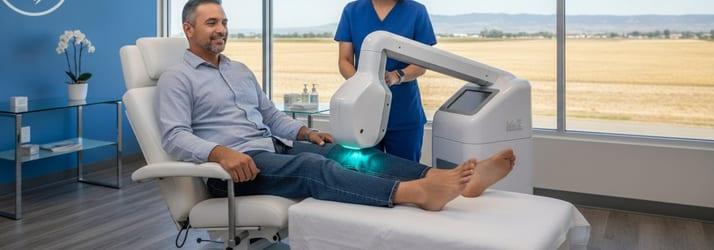
- Controlled delivery. With the therapy laser we use, the head sits on a robotic arm a few inches above the treatment area and moves on its own along a programmed path, and sensors built into the system guard against overexposure.
- Short sessions you can stop. A session takes about 15 minutes. If you feel uncomfortable heat or pain at any point, say so straight away rather than waiting it out.
- A planned course. Laser runs as a course of 6 to 12 sessions rather than a single visit, so how you respond is checked as you go.
When should you see a doctor before trying laser?
Laser is a treatment, not a diagnosis, so the cause of the pain comes first. For back pain, MedlinePlus says to contact a provider right away if you have a history of cancer, loss of bladder or bowel control, pain that wakes you at night, redness or swelling on the back, unexplained fever, weakness or numbness in the buttocks or legs, or pain after a severe fall. Unintended weight loss, or pain lasting longer than four weeks, is also a reason to call.
Is Class 4 laser therapy the same as cold laser therapy?
No. “Cold laser” describes low-level laser therapy, named for power densities lower than those needed to heat tissue. Class 4 lasers run above 500 mW, and one review draws the line between low-level and high-powered photobiomodulation at 0.5 W.
Does Class 4 laser therapy feel hot?
It can feel warm. Light absorbed by water and melanin in the skin generates heat, and that heat limits how much power is tolerable, particularly in darker skin. Heat that becomes uncomfortable is a reason to stop and tell the clinician.
What is high-intensity laser therapy (HILT)?
HILT is therapy with a high-power, Class IV laser, used for its greater depth of penetration and its ability to deliver higher doses in less time. A 2023 meta-analysis of 48 trials rated the evidence for it in musculoskeletal pain low to moderate in certainty.
Can Class 4 laser therapy be used over tattoos?
Mention any tattoo over the area first. One laser maker’s labelling warns that treating over a tattoo with a higher-irradiance laser may cause pain as the ink absorbs the energy and gets hot. A 2010 guideline notes that red light is strongly absorbed by melanin, the skin’s own pigment.
Is Class 4 laser therapy safe during pregnancy?
Not over the pregnancy. A 2010 guideline says laser should be avoided over the low back, abdomen and pelvis during the first 35 weeks of pregnancy. Tell the clinician if you are or may be pregnant before any session.
To see how the therapy laser we use works and what a session involves, read our MLS laser therapy page, or book a consultation. Our blog has more on pain and its care.
Sources
- “Laser Products and Instruments.” U.S. Food and Drug Administration. fda.gov
- “Important Information for Laser Pointer Manufacturers.” U.S. Food and Drug Administration. fda.gov
- 21 CFR 1040.10, “Laser products.” Code of Federal Regulations, via Legal Information Institute. law.cornell.edu
- OSHA Technical Manual, Section III, Chapter 6: “Laser Hazards.” Occupational Safety and Health Administration. osha.gov
- “Hospitals eTool: Surgical Suite, Laser Hazards.” Occupational Safety and Health Administration. osha.gov
- Hamblin MR. “Mechanisms and applications of the anti-inflammatory effects of photobiomodulation.” AIMS Biophys, 2017;4(3):337–361. PMC5523874
- Chung H et al. “The Nuts and Bolts of Low-level Laser (Light) Therapy.” Ann Biomed Eng, 2012;40(2):516–533. PMC3288797
- Huang YY et al. “Biphasic Dose Response in Low Level Light Therapy.” Dose Response, 2009;7(4):358–383. PMC2790317
- “Recommended treatment doses for Low Level Laser Therapy: 780–860 nm.” World Association for Photobiomodulation Therapy (WALT), 2010. waltpbm.org
- Penberthy WT, Vorwaller CE. “Utilization of the 1064 nm Wavelength in Photobiomodulation: A Systematic Review and Meta-Analysis.” J Lasers Med Sci, 2021;12:e86. PMC8837867
- Arroyo-Fernández R et al. “High-Intensity Laser Therapy for Musculoskeletal Disorders: A Systematic Review and Meta-Analysis of Randomized Clinical Trials.” J Clin Med, 2023;12(4):1479. PubMed 36836014
- Song HJ, Seo HJ, Kim D. “Effectiveness of high-intensity laser therapy in the management of patients with knee osteoarthritis: A systematic review and meta-analysis of randomized controlled trials.” J Back Musculoskelet Rehabil, 2020;33(6):875–884. PubMed 32831189
- Wu M et al. “Is high intensity laser therapy more effective than other physical therapy modalities for treating knee osteoarthritis? A systematic review and network meta-analysis.” Front Med (Lausanne), 2022;9:956188. PMC9520262
- Abdildin Y et al. “High-intensity laser therapy in low back pain management: a systematic review with meta-analysis.” Lasers Med Sci, 2023;38(1):166. PubMed 37493840
- Xie YH et al. “The effectiveness of high-intensity laser therapy in individuals with neck pain: a systematic review and meta-analysis.” Physiotherapy, 2023;121:23–36. PubMed 37812850
- de la Barra Ortiz HA, Arias M, Liebano RE. “A systematic review and meta-analysis of randomized controlled trials on the effectiveness of high-intensity laser therapy in the management of neck pain.” Lasers Med Sci, 2024;39(1):124. PubMed 38709332
- Yousefi-Nooraie R et al. “Low level laser therapy for nonspecific low-back pain.” Cochrane Database Syst Rev, 2008;CD005107. cochrane.org
- Houghton PE, Nussbaum EL, Hoens AM. “Electrophysical Agents: Contraindications and Precautions.” Physiother Can, 2010;62(5). PMC3031347
- “Contraindications.” THOR Photomedicine (manufacturer). thorlaser.com
- “Premarket Notification 510(k).” U.S. Food and Drug Administration. fda.gov
- “Low back pain: acute.” MedlinePlus, U.S. National Library of Medicine. medlineplus.gov