

Cost of SoftWave Therapy Sessions: 2026 Pricing Factors & Value Guide
The most expensive healthcare route often isn’t advanced regenerative medicine; it’s the endless loop of recurring co-pays for temporary symptom relief. If you’re dealing with persistent pain, evaluating the real cost of SoftWave therapy sessions means looking past single appointments and examining how genuine tissue restoration changes your long-term health budget.
It’s completely normal to feel frustrated by vague clinic pricing structures and hesitant about spending money on treatments that might not stick. You deserve total transparency before taking your next step. This guide explains the specific clinical factors that shape care protocols, how comprehensive treatment packages operate, and how cellular repair compares directly to invasive surgeries or ongoing injections. We’ll outline what determines your overall protocol investment, clear up common insurance questions, and show you how to choose the right clinical approach for lasting relief.
Key Takeaways
- Learn how advanced electrohydraulic technology stimulates genuine cellular repair rather than simply masking chronic joint and soft-tissue pain.
- Discover the specific clinical variables that dictate the overall cost of SoftWave therapy sessions, from injury chronicity to anatomical complexity.
- Understand your coverage options, including how Health Savings Accounts (HSA) and Flexible Spending Accounts (FSA) can be applied toward restorative care.
- Compare the long-term economic and physical value of non-invasive acoustic wave protocols against recurring injections and costly surgical procedures.
- Find out how diagnostic biofeedback mapping works during an initial evaluation to pinpoint damaged tissues before building a personalized care plan.
Understanding the Cost of SoftWave Therapy Sessions and Technology
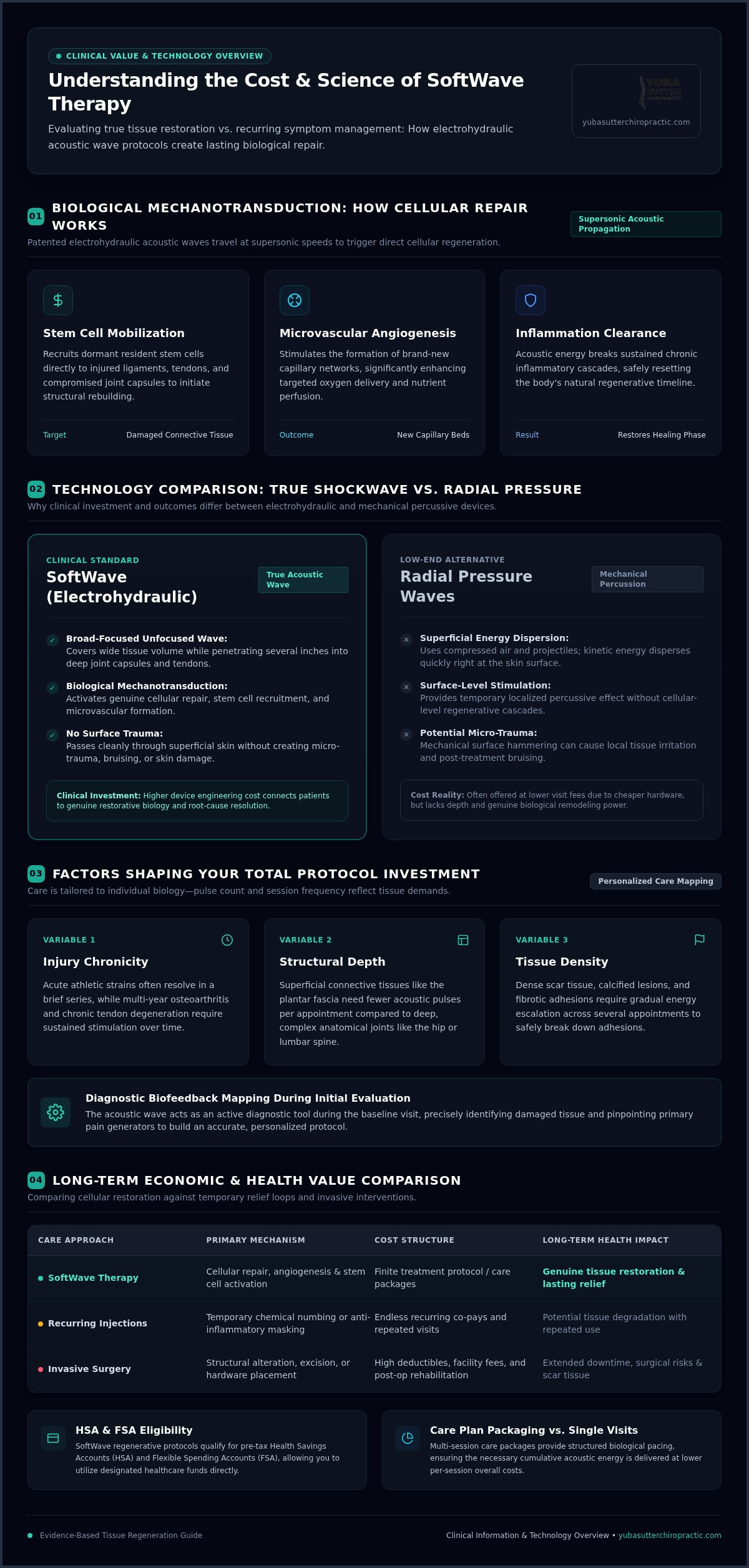
When you evaluate the cost of SoftWave therapy sessions, understanding the specialized engineering behind the device provides critical clarity. SoftWave tissue regeneration relies on patented electrohydraulic technology to produce genuine, unfocused acoustic waves. Unlike localized treatments that target isolated symptoms, this broad-focused delivery covers a wider surface area and reaches deep into compromised connective tissues. Medical providers must invest significantly in clinical-grade electrohydraulic systems to deliver this level of care, which naturally shapes the overall protocol investment.
The broader category of Extracorporeal shockwave therapy (ESWT) includes several delivery methods, but true acoustic shockwaves function differently from basic therapeutic equipment. By initiating true biological mechanotransduction, these acoustic waves prompt cellular repair mechanisms rather than delivering a transient numbing effect. That distinction is why patients seeking lasting recovery often look past recurring short-term expenses and prioritize non-invasive tissue regeneration.
The Technology Behind Electrohydraulic Acoustic Waves
True electrohydraulic sound waves move through tissue at supersonic speeds. This rapid acoustic propagation initiates immediate cellular signaling:
- Stem cell mobilization: The acoustic waves recruit dormant resident stem cells to migrate directly to damaged joints or ligaments.
- Microvascular stimulation: Acoustic pulses promote angiogenesis, forming new capillary networks to deliver vital oxygen and nutrient flow.
- Inflammation management: The mechanical energy clears sustained inflammatory cascades, kickstarting the body’s natural regenerative timeline.
Achieving these outcomes requires rigorous clinical standards. The precision required to produce consistent electrohydraulic energy demands sophisticated hardware, ensuring every pulse delivers therapeutic value deep beneath the skin without harming superficial structures.
SoftWave Versus Low-End Radial Pressure Wave Devices
Many clinics promote radial pressure wave units as equivalent therapy, yet the underlying physics are fundamentally distinct. Radial devices use compressed air to drive a mechanical projectile against an applicator tip, generating superficial percussive force. While radial waves disperse energy immediately at the skin surface, true electrohydraulic shockwaves penetrate several inches into joint capsules and chronic tendon lesions without creating micro-trauma or skin bruising.
Because mechanical radial devices feature much lower manufacturing and operational expenses, clinics often charge less per visit for them. However, they lack the cellular-level regenerative capabilities of electrohydraulic systems. Investing in the genuine cost of SoftWave therapy sessions connects you with true restorative biology, addressing root physical dysfunction rather than settling for surface-level percussion.
Key Factors That Determine Your Total SoftWave Care Investment
Teaser promotional rates often leave patients wondering what a complete plan of care actually requires. When evaluating the total cost of SoftWave therapy sessions, you quickly find that pricing isn’t one-size-fits-all. Instead, protocol design reflects biological need. The number of acoustic pulses, the frequency of appointments, and the overall scope of care depend entirely on tissue condition, healing capacity, and personal functional goals.
Injury Severity, Chronicity, and Anatomical Target
Tissue damage that developed over decades behaves very differently than an acute athletic strain. Protocol duration usually follows these physiological factors:
- Injury chronicity: An acute ankle sprain often resolves in a short series of visits, while multi-year osteoarthritis or chronic tendon degeneration demands sustained acoustic stimulation to trigger remodeling.
- Structural depth: Superficial soft tissue like the plantar fascia requires fewer acoustic pulses per visit than deep, complex joints like the hip or lumbar spine.
- Tissue density: Dense scar tissue and calcified fibrotic lesions require progressive energy escalation over several sessions to break down adhesions safely.
Clinicians use real-time diagnostic mapping during your baseline visit to locate specific pain generators, ensuring the proposed plan directly matches your tissue’s cellular responsiveness.
Single Session Pricing Versus Care Plan Packages
Most clinical practices structure fees around two distinct models: pay-as-you-go visits or comprehensive multi-session care plans. Single appointments can work well for isolated maintenance check-ins or an initial diagnostic map. However, resolving entrenched chronic inflammation usually requires an uninterrupted biological sequence.
Multi-session packages bundle the necessary acoustic volume over consecutive weeks, reducing the effective rate per visit while ensuring the cellular repair cycle reaches completion. Once tissue remodeling stabilizes, optional periodic check-ins help maintain joint mobility and prevent symptom recurrence.
Synergistic Modalities Within a Comprehensive Care Plan
True restorative medicine rarely relies on a single tool. In advanced physical medicine settings, pairing shockwaves with complementary therapies accelerates joint recovery and enhances the long-term return on your health investment. Integrating targeted chiropractic adjustments restores structural alignment, ensuring that newly rejuvenated connective tissues don’t face abnormal biomechanical stress. Exploring how advanced chiropractic technology supports tissue repair can help you better understand this multi-tiered approach.
Systemic healing matters just as much. Cellular repair requires adequate systemic fuel, which is why examining how metabolic health affects healing often provides the missing piece for treatment longevity. If you’re ready to explore an individualized protocol designed around root-cause recovery, connecting with the experienced team at Yuba Sutter Chiropractic is an excellent starting point.
Insurance Realities, HSA/FSA Eligibility, and Payment Options
Facing healthcare costs is easier when there are no surprise billing statements arriving months down the road. Unlike hospital systems where unexpected facility fees and separate physician bills show up weeks after a visit, physical medicine practices generally operate with clear, upfront fee schedules. While major medical insurance plans typically consider acoustic wave technology an elective service, straightforward pricing lets you plan the total cost of SoftWave therapy sessions with complete financial clarity.
Why Traditional Health Insurance Classifies Shockwave as Elective
Most commercial insurance carriers and government programs like Medicare focus on conventional treatment algorithms. These carriers build reimbursement models around pharmaceutical pain management, recurring steroid injections, and surgical joint replacements. Because insurance coding guidelines can take years to recognize cutting-edge regenerative medicine, acoustic shockwave treatments remain categorized as self-pay services.
This direct-pay structure actually offers distinct clinical benefits for patients:
- No arbitrary visit caps: Your protocol length depends on true cellular healing and mobility goals, not on limits set by an insurance claims adjuster.
- Total pricing transparency: You know your financial commitment before treatment begins, eliminating hidden facility charges or surprise co-insurance balance bills.
- Immediate clinical access: You avoid the weeks or months of administrative delays required to satisfy complex insurance pre-authorization rules.
Maximizing Pre-Tax Healthcare Accounts and Financing Plans
Even though standard health insurance excludes acoustic wave therapy from direct coverage, patients have reliable methods to offset out-of-pocket expenses. Health Savings Accounts (HSA) and Flexible Spending Accounts (FSA) routinely permit shockwave therapy as an eligible medical expense. Utilizing pre-tax healthcare dollars reduces your real-world expenditure by your personal income tax rate, delivering immediate financial savings.
Practices regularly assist this process by providing detailed superbills and treatment summaries, making account verification seamless for your benefits manager. Additionally, structured healthcare installment programs allow patients to spread comprehensive care programs across manageable monthly installments. Breaking your recovery plan into predictable monthly payments ensures that addressing chronic pain remains fully accessible without straining your household budget.
SoftWave Therapy vs Injections and Surgery: Long-Term Value Comparison
Evaluating the true financial impact of injury recovery requires looking past the first appointment. When assessing the cost of SoftWave therapy sessions against conventional medical models, the real difference lies in biological preservation. Surgical procedures and pharmaceutical injections often carry substantial hidden expenses, extended physical downtime, and structural compromises that compound over time.
The True Cost of Cortisone and Temporary Injections
Cortisone delivers quick pain suppression by blunting localized inflammation, but that relief is usually brief. Repeated corticosteroid injections can weaken structural collagen, accelerate articular cartilage loss, and increase the risk of tendon tears. Patients often find themselves caught in a recurring cycle of specialist visits, prescription co-pays, and diminishing clinical returns every three to four months. Acoustic waves stimulate biological cellular repair and neovascularization instead of masking symptoms, protecting joint integrity over the lifespan.
Evaluating Surgical Deductibles, Facility Fees, and Downtime
Joint and spinal surgeries represent major financial commitments. Even with private insurance, patients often exhaust steep annual deductibles while absorbing out-of-pocket costs for surgical center facility fees, anesthesiology, and post-operative rehabilitation. The indirect costs hit just as hard; taking weeks away from employment results in significant lost household wages. Exploring conservative options like non-invasive care for herniated disc leg pain relief demonstrates how physical medicine restores function without surgical complications.
| Treatment Path | Primary Mechanism | Hidden Expenses & Downtime | Long-Term Tissue Impact |
|---|---|---|---|
| Cortisone Injections | Chemical inflammation suppression | Recurring specialist copays; repeat injections required | Progressive tendon softening; accelerated cartilage wear |
| Orthopedic Surgery | Mechanical reconstruction or excision | Hospital facility fees, anesthesia bills, weeks off work | Permanent tissue alteration; structural scar tissue |
| SoftWave Therapy | Acoustic cellular regeneration | Zero downtime, zero prescriptions, zero missed work | Stimulates organic repair and improved blood supply |
Choosing regenerative acoustic protocols protects both your joint health and your personal schedule. If you want to explore non-surgical restorative care for persistent joint dysfunction, schedule a consultation at Yuba Sutter Chiropractic to evaluate your recovery options.
What to Expect at Your Initial SoftWave Consultation in Yuba City
Walking into a new clinic can feel daunting when you’ve already spent months seeking answers. At Yuba Sutter Chiropractic & Wellness, the introductory appointment removes the guesswork from both your recovery pathway and your budget. Before you decide on a full protocol, this initial visit establishes clear clinical baselines so you understand exactly how the technology works and what the total cost of SoftWave therapy sessions will entail for your unique condition.
Comprehensive Health History and Orthopedic Evaluation
Your visit begins with a thorough conversation about your physical history. Our clinical team reviews previous imaging reports, past surgical interventions, and how chronic discomfort currently limits your daily routine. We conduct targeted orthopedic and neurological assessments alongside functional movement screening. This examination reveals secondary movement compensations and confirms whether you are an ideal candidate for regenerative acoustic care before any treatment begins.
The Acoustic Biofeedback Mapping Session
The hallmark of your first appointment is real-time acoustic biofeedback mapping. As the clinician glides the applicator across the symptomatic region, the acoustic waves interact differently with healthy versus compromised tissues:
- Targeted biofeedback: Passing over healthy muscle and connective tissue creates negligible sensation.
- Identifying damaged tissue: When the waves encounter inflamed, calcified, or degenerated fibers, you’ll feel a distinct, temporary ache that pinpoints the root pain generator.
- Immediate functional feedback: Many patients notice increased joint range of motion and reduced muscle guarding right after the mapping sequence concludes.
Creating Your Customized Care Plan and Next Steps
Once tissue mapping is complete, your provider sits down with you to review the findings and outline a personalized recovery roadmap. You’ll receive clear recommendations detailing your estimated visit frequency, expected protocol length, and long-term stabilization goals. We believe in complete transparency, so you will review the full cost of SoftWave therapy sessions and payment options before scheduling subsequent visits.
Take control of your mobility today. Schedule your consultation at Yuba Sutter Chiropractic & Wellness to discover how targeted regenerative care can support your path to lasting physical relief.
Invest in Lasting Recovery and Reclaim Your Active Life
True healthcare value isn’t found in recurring temporary fixes; it’s built on genuine tissue restoration. When evaluating the overall cost of SoftWave therapy sessions, you’re choosing a restorative approach that prioritizes root-cause cellular healing while sidestepping the hidden facility fees, extensive downtime, and physical risks associated with surgery or repetitive steroid injections.
At Yuba Sutter Chiropractic & Wellness, our advanced multi-modality center serves Yuba City, Marysville, and Sutter County with genuine electrohydraulic SoftWave technology. We eliminate financial and clinical guesswork through personalized diagnostic biofeedback mapping, giving you complete clarity about your tissue response before you commit to an extended care protocol.
Take the next step toward renewed joint function and comfort. Schedule your initial SoftWave discovery session at Yuba Sutter Chiropractic & Wellness today, and discover what targeted regenerative care can do for your quality of life.
Frequently Asked Questions
How much does a single SoftWave therapy session cost on average?
Pricing for individual appointments depends largely on the geographic region, provider credentials, and the anatomical complexity of the condition being addressed. While single-session rates fluctuate across physical medicine clinics, most practices encourage multi-visit care packages to lower the per-visit rate. In Yuba City and surrounding Sutter County communities, initial consultations often feature special evaluation pricing to help patients experience acoustic biofeedback mapping before committing to a complete protocol.
Is SoftWave therapy covered by private health insurance or Medicare?
Major health insurance carriers and Medicare currently categorize electrohydraulic acoustic wave therapy as an elective, cash-pay service. Because insurance reimbursement models historically focus on conventional surgery and prescription pain medications, coverage guidelines lag behind modern regenerative breakthroughs. However, paying directly eliminates unexpected facility balance bills, prior authorization delays, and arbitrary visit limitations, giving providers complete clinical freedom to design care around your actual physical progress.
Can I pay for my SoftWave therapy sessions using an HSA or FSA card?
Yes, you can typically use Health Savings Accounts (HSA) and Flexible Spending Accounts (FSA) to cover the cost of SoftWave therapy sessions. Because acoustic wave protocols treat diagnosed musculoskeletal conditions, joint inflammation, and chronic connective tissue injuries, most benefit administrators recognize them as qualified medical expenses. Clinics readily provide itemized superbills and diagnostic documentation upon request to make tax-advantaged account verification simple and straightforward.
How many SoftWave therapy sessions are typically needed to see lasting results?
Most patients require an initial protocol spanning between six and twelve visits to trigger deep cellular remodeling. Acute sports injuries or mild tendinopathies often resolve on the shorter end of that spectrum, whereas degenerative joint conditions or multi-year nerve complaints demand longer stimulation cycles. Acoustic waves initiate biological stem cell migration and blood vessel formation that continues healing tissue for weeks after your active protocol concludes.
What happens during an initial SoftWave discovery and mapping visit?
Your initial visit combines a thorough orthopedic evaluation with real-time acoustic biofeedback mapping. After reviewing your medical imaging and mobility limitations, the provider applies the acoustic applicator over the symptomatic area. Healthy connective tissues experience minimal sensation, while inflamed or damaged structures produce a noticeable biofeedback ache that reveals the exact injury source. Patients often experience immediate improvements in joint mobility directly following this first assessment.
Are there payment plans or healthcare financing options available for treatment packages?
Many modern clinics offer flexible healthcare financing options to make comprehensive treatment packages manageable for any budget. Structured installment platforms allow patients to divide the total cost of SoftWave therapy sessions into predictable monthly payments rather than paying all at once. Transparent financial consultations ensure that patients across Yuba City, Marysville, and Sutter County fully understand their care investment options before beginning an active restorative plan.
How does the total investment in SoftWave therapy compare to joint surgery?
Non-invasive shockwave protocols are significantly more economical than invasive orthopedic operations. Even with comprehensive insurance, surgical deductibles, facility fees, anesthesiologist bills, and months of post-operative physical therapy quickly reach substantial sums. In contrast, acoustic regenerative therapy requires zero downtime, no prescription pain medications, and no lost workplace wages. It preserves your native anatomy while resolving chronic pain without hospital bills or prolonged physical immobility.