

Deep Tissue Laser Therapy for Arthritis in Sutter (2026)
Could laser therapy ease arthritis symptoms without replacing the care you already rely on? If you’re searching for deep tissue laser therapy for arthritis Sutter, it’s reasonable to want clear answers before considering another option. Ongoing pain and stiffness can make everyday tasks harder, and it can be difficult to sort through questions about evidence, safety, and whether a treatment fits your situation.
Laser therapy may be considered as an addition to arthritis care, but it doesn’t cure arthritis, reverse joint changes, or suit everyone. Yuba Sutter Chiropractic & Wellness in Yuba City offers MLS laser therapy, a specific service that shouldn’t automatically be treated as interchangeable with every deep-tissue laser. Whether it’s appropriate for you is a question to discuss with a provider.
This article explains what laser therapy is intended to do, what evidence can and can’t tell you, and what to ask about candidacy, precautions, and how treatment might fit alongside your current care. You’ll also find practical ways to discuss your symptoms, goals, and treatment history with a local provider, so you can consider your options without pressure or unrealistic expectations.
Key Takeaways
- Learn how therapeutic laser treatment differs from surgery, imaging, and cosmetic laser procedures.
- Understand why evidence can vary by arthritis condition, device, treatment approach, and outcome measured.
- Use a consultation checklist to clarify your diagnosis, goals, care history, and how you’ll track changes.
- If you’re researching deep tissue laser therapy for arthritis Sutter, know what to ask a Yuba City provider about MLS laser therapy, suitability, and precautions.
What does deep tissue laser therapy for arthritis mean in Sutter?
Arthritis pain and stiffness can make walking, climbing stairs, or opening a jar harder than they used to be. If you’re looking into deep tissue laser therapy for arthritis Sutter, start by finding out what the treatment involves, what the name does and doesn’t tell you, and how it might fit with care guided by a clinician.
Therapeutic laser treatment uses directed light applied to the body as a non-surgical therapy. It isn’t surgery, an imaging test, or a cosmetic laser procedure, and it doesn’t cure or reverse arthritis. The term “deep tissue laser” is commonly used in searches, but it doesn’t identify a particular device or establish that a treatment is appropriate for a specific joint or diagnosis. Don’t use it as a replacement for your arthritis care plan.
Low-level laser therapy, also discussed under the broader concept of photobiomodulation, describes the therapeutic use of light. That general overview can help explain the terminology, but it can’t establish the evidence or suitability of a particular clinic’s device and treatment approach.
How is MLS laser therapy different from “deep tissue laser”?
Laser systems may differ in wavelengths, operating modes, and protocols. Those details can affect how a device is used, so don’t assume that every therapy marketed as “deep tissue laser” works the same way as MLS laser therapy. Yuba Sutter Chiropractic & Wellness in Yuba City lists MLS laser therapy as a service. Ask the provider to confirm the device specifications and intended use before drawing conclusions about treatment depth, mechanism, or parameters. The clinic’s stated FDA clearance should not be taken to mean that arthritis itself is a cleared indication.
Which arthritis symptoms might lead someone to ask about laser therapy?
Persistent joint pain, stiffness, or difficulty with activities may prompt someone to ask whether laser therapy is worth discussing. These experiences are reasons to seek an assessment, not a diagnosis. Osteoarthritis involves changes in a joint, while inflammatory arthritis involves inflammation related to an immune-system condition. Identifying the type matters because care needs can differ.
Suitability depends on the confirmed diagnosis, health history, symptoms, and clinician assessment. Ask what the provider knows about the device’s indication, precautions, and evidence for your situation. A conversation in Yuba City can help clarify whether MLS laser therapy merits discussion as one possible part of care, without assuming it will be appropriate or effective for everyone.
How might laser therapy fit into arthritis care?
Photobiomodulation is the proposed biological basis for some therapeutic laser approaches. Research has explored whether light can influence cellular activity and signaling linked with pain and inflammation. These are proposed mechanisms, not proof that treatment will meaningfully reduce symptoms for a particular person. A review titled The Nuts and Bolts of Low-level Laser (Light) Therapy discusses these mechanisms and clinical research, but general findings shouldn’t be treated as a guarantee for a specific device or arthritis diagnosis.
What does current evidence say about laser therapy for arthritis?
Evidence needs to be considered in context. Results for one joint or arthritis type may not apply to another. Studies can also differ in the device, wavelength, treatment settings, schedule, comparison group, and outcome measured. Pain scores, stiffness, and ability to complete daily activities are distinct outcomes. A broad review of low-level laser therapy can’t by itself confirm that a particular MLS device or protocol is effective for arthritis.
Research may suggest whether a specific laser approach affects measured symptoms in a studied group. Without evidence that matches the diagnosis, device, protocol, and outcome, it cannot establish that deep tissue laser therapy for arthritis Sutter will help an individual or change the underlying course of arthritis. Ask which evidence applies to your diagnosis and the exact device being discussed, and whether the claim concerns symptom management or something more.
Can laser therapy replace medication, exercise, or other care?
It shouldn’t be treated as a replacement for an established arthritis care plan. Medication, appropriate movement or exercise, and other care may each serve a different purpose. Decisions about changing them belong with you and your medical clinician or care team. Don’t stop prescribed medication or discontinue an established treatment because you’re considering laser therapy.
If a clinician believes it may be appropriate, laser therapy can be discussed as a possible add-on, with a clear goal such as tracking a particular activity or symptom. Ask how progress would be assessed, what precautions apply to your health history, and when the plan would be reviewed. If you’re exploring the option locally, you can review MLS laser therapy in Yuba City and discuss whether it fits alongside your current care.
Laser therapy for arthritis: how to weigh benefits, limits, and alternatives
Choosing arthritis care isn’t a contest between treatments. Each option may have a different purpose, and what makes sense depends on your diagnosis, health history, symptoms, and care plan. Laser therapy is non-invasive, but that alone doesn’t mean it’s suitable, risk-free, or proven to help everyone. Treat it as an option to evaluate, not a guaranteed shortcut.
| Care option | General purpose and possible role | Questions to discuss | Evidence limitations |
|---|---|---|---|
| Therapeutic laser | May be discussed as an additional approach focused on symptoms. | Which exact device and indication apply? What outcome would we track? | Evidence may not apply across different devices, diagnoses, protocols, or outcomes. |
| Movement or exercise | May support mobility and everyday function as part of an appropriate plan. | What activities are suitable for my condition and current ability? | The right approach and tolerance vary by person and diagnosis. |
| Medication | May be used to manage symptoms or address a condition, depending on the treatment prescribed. | What benefits, risks, and alternatives apply to me? | Effects and risks depend on the medication and individual circumstances. |
| Hands-on care | May be considered for specific symptoms or movement concerns within an individualized plan. | What is the goal, and is this approach appropriate for my diagnosis? | One type of hands-on care shouldn’t be assumed to suit every arthritis condition. |
Compare options with your care team
Use the table to guide a conversation with your treating clinician, not to rank treatments or choose one on your own. A clinic’s chiropractic services don’t establish that adjustments treat every form of arthritis. For a general overview of the clinic’s approach, see advanced chiropractic technology and root-cause care, then discuss whether any option fits your individual plan.
Ask about safety before a session
Before considering deep tissue laser therapy for arthritis Sutter, ask the provider to review the specific device’s precautions and contraindications, explain what eye protection is needed, and clarify the intended use. Device details matter, so don’t assume safety guidance is identical across laser systems.
Share relevant health information, including medications, implanted devices, pregnancy, and active health concerns, so a qualified clinician can review them. Ask what to expect, what symptoms should be reported, and how the provider will decide whether to proceed. Your medical clinician or care team can help weigh laser therapy alongside other options. No treatment should be presented as risk-free or universally appropriate.
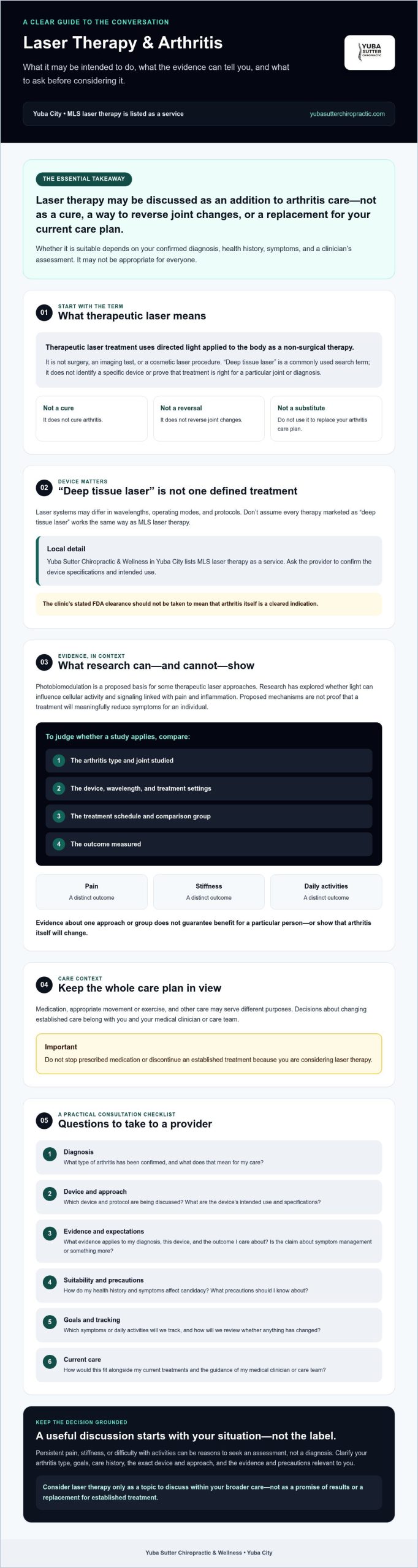
How to decide whether arthritis laser therapy is worth discussing
A useful consultation starts with your needs, not a promise about a particular treatment. This five-step checklist can help you decide whether to ask about laser therapy and keep the conversation focused on your arthritis care.
- Confirm the diagnosis. If you don’t know what’s causing your joint symptoms, ask a medical clinician whether further evaluation is needed. Different conditions can require different approaches.
- Define your goal. Choose a specific activity or symptom to discuss, such as walking farther, getting up from a chair more comfortably, or managing stiffness during your morning routine.
- Review your care history. Note treatments you’ve tried, what helped or didn’t, and any changes in your health or medications.
- Ask about fit. If you’re exploring deep tissue laser therapy for arthritis Sutter, clarify whether the provider is discussing MLS laser therapy or another device, and why it may be relevant to your diagnosis and goal.
- Agree on reassessment. Before starting, ask how and when you’ll review your response, and what might lead the provider to change or stop the plan.
What should you bring up at a consultation?
Consultation checklist: Bring the affected joint, symptom history, diagnosis if known, previous treatments, current medications and health concerns, and one or two specific goals.
Ask which device is proposed, why it’s being recommended, what evidence applies to your situation, what risks or precautions to consider, and what alternatives you could discuss. Find out how progress will be measured and whether coordination with your primary care clinician or specialist is appropriate. Request a clear explanation of the proposed plan, including what would prompt a change or stop. Yuba Sutter Chiropractic & Wellness in Yuba City offers MLS laser therapy. A discussion can help clarify whether the service may fit your circumstances.
How can you tell whether a plan is realistic?
A thoughtful plan should connect your diagnosis and goals to a clear rationale, acknowledge uncertainty, and explain how you and the provider will review progress. Track a relevant symptom and a daily activity before and during care, such as stiffness or ease with a routine task. Changes can be useful to discuss, but tracking doesn’t guarantee a response or prove what caused it.
Be cautious of cure claims, guaranteed results, or pressure to stop prescribed medication or established care. New, severe, or rapidly worsening symptoms deserve medical evaluation rather than an assumption that laser therapy is the next step. For readers near Sutter, discuss MLS laser therapy in Yuba City as one option to review, without committing before your questions are answered.
Discuss MLS laser therapy for arthritis with a Yuba City provider
Yuba Sutter Chiropractic & Wellness, based in Yuba City, offers MLS laser therapy. For people in Sutter and nearby communities, asking about the service can be a practical way to learn whether it merits further discussion. The clinic’s named offering is MLS laser therapy, so don’t assume it is identical to every treatment described online as “deep tissue laser.”
An initial conversation should focus on your situation, not a preset promise. Share which joint is affected, your symptoms and goals, your diagnosis if known, relevant health history, and the care you’ve already tried. Ask whether the provider evaluates your particular concern and whether a medical clinician who knows your arthritis should also be involved. The purpose is to understand fit and possible next steps, not to assume treatment is appropriate.
What to ask about the service
Ask which device is used, what its intended use is, and why the provider thinks it may fit your goals. Request a clear explanation of precautions, possible alternatives, and how the plan would be reviewed. The clinic describes its MLS laser therapy as FDA-cleared, but clearance alone doesn’t establish that arthritis is a cleared indication or that the treatment will help your symptoms. Confirm device-specific details rather than relying on a general “deep tissue laser” label.
If you’re considering deep tissue laser therapy for arthritis Sutter, ask how it might fit alongside your existing care rather than replace it. Broader care discussions may include different approaches. This overview of regular chiropractic adjustments and long-term health offers context, but it doesn’t establish that adjustments are suitable for every arthritis condition.
A low-pressure local next step
Bring your questions and any relevant treatment history. Ask what information the provider needs to assess your circumstances, what would make the approach unsuitable, and what options to consider if MLS laser therapy isn’t a fit. Confirm current service details directly with the clinic, since the device, precautions, and appropriate next steps should be discussed for your individual situation.
If you’re in Yuba City, Sutter, or a nearby community, contact Yuba Sutter Chiropractic & Wellness to ask whether a discussion about MLS laser therapy is appropriate for you. There’s no need to decide before you understand the rationale, limitations, and alternatives.
Make your next arthritis-care decision with clarity
Laser therapy is best approached as a question to explore, not a promised solution. The right discussion starts with your diagnosis, symptoms, goals, and current care plan. Evidence and suitability can vary by condition and device, so ask what the provider can responsibly say about your situation. Laser therapy doesn’t cure arthritis or replace care from your medical clinician.
For readers researching deep tissue laser therapy for arthritis Sutter, Yuba Sutter Chiropractic & Wellness in Yuba City lists MLS laser therapy as a service. The clinic describes it as FDA-cleared, but that doesn’t establish that arthritis is a cleared indication. Ask about the specific device, its intended use, relevant precautions, and whether an evaluation is appropriate for you.
If you’d like to learn more, contact Yuba Sutter Chiropractic & Wellness to ask about MLS laser therapy. A clear, low-pressure conversation can help you understand your options and decide on a next step that fits your needs.
Frequently Asked Questions
Can deep tissue laser therapy help arthritis?
It may be discussed as an add-on for symptom-related goals, but whether it helps depends on the arthritis diagnosis, specific device, treatment protocol, and outcome being measured. It isn’t a cure and shouldn’t replace prescribed care. If you’re considering deep tissue laser therapy for arthritis Sutter, ask a qualified clinician whether the particular treatment fits your situation and what current clinical evidence supports the claims being made.
Is MLS laser therapy the same as deep tissue laser therapy?
Not necessarily. These terms shouldn’t automatically be treated as interchangeable because laser systems can differ in design, settings, and treatment protocols. Yuba Sutter Chiropractic & Wellness lists MLS laser therapy. Ask which device the clinic uses and how it relates to the treatment you searched for. Request device-specific details before relying on claims about treatment depth, mechanism, or indication.
Can laser therapy reverse arthritis or repair cartilage?
You shouldn’t assume laser therapy reverses arthritis or rebuilds cartilage. It may be discussed for symptom-related goals, but claims about changing the disease or repairing tissue need strong evidence specific to the condition and treatment. Ask what outcome the provider considers realistic, how it would be measured, and whether supporting evidence applies to your diagnosis and the device proposed.
Is laser therapy safe for everyone with arthritis?
No, one treatment isn’t appropriate for everyone. Safety depends on the specific device, treatment area, health history, and relevant precautions or contraindications. Share your diagnoses, medications, implanted devices, pregnancy, and other health concerns with the clinician for review. Ask what safeguards are used and whether you should consult your medical clinician before adding treatment to your care plan.
How many laser therapy sessions are needed for arthritis?
There’s no universal session count that applies to every person or type of arthritis. A proposed plan may depend on the device, treatment goal, symptoms, and clinician assessment. Ask the provider to explain the plan, how progress will be evaluated, and when it would be reconsidered. Be cautious of guaranteed timelines or promises that everyone will have the same response.
Can I use laser therapy alongside arthritis medication or physical activity?
It may be possible to discuss laser therapy as an add-on, but your care team should review how it fits with your medication, movement plan, and other treatments. Don’t stop or change prescribed medication based on an article or treatment promotion. Tell your clinician about your health history and ask whether any device-specific precautions apply before making changes to your arthritis-care routine.
Where can I ask about MLS laser therapy for arthritis near Sutter?
Yuba Sutter Chiropractic & Wellness is based in Yuba City and lists MLS laser therapy among its services. The clinic serves nearby communities, including Marysville, Live Oak, Gridley, Sutter, Colusa, Plumas Lake, Olivehurst, and Wheatland. Contact the clinic to confirm current service details and ask whether an evaluation may be appropriate. Bring your diagnosis, symptom history, and questions, and continue coordinating arthritis care with your medical clinician.