

Failing a DOT Physical: 2026 Guide for Drivers
You’ve spent years mastering the road, yet a fifteen-minute exam just put your career on hold because your blood pressure spiked the moment you sat in the clinic chair. It’s a stressful situation that many professional drivers face, leading to immediate questions about what happens if you fail a dot physical and how it impacts your CDL. With the 2026 electronic reporting requirements now fully active, the margin for error feels smaller than ever, leaving many worried about their future livelihood.
We understand the deep anxiety that comes with a medical disqualification. It’s natural to worry about lost income or the complexity of federal paperwork. However, a failed exam is often a temporary hurdle rather than a career-ending event. This guide provides a clear roadmap to help you understand your options, from addressing specific health markers to navigating the latest FMCSA standards with confidence. You don’t have to navigate this process alone.
You’ll learn the vital steps to take immediately after a failure, which conditions allow for a quick re-test, and how to manage “white coat syndrome” effectively. We also highlight how a community-focused examiner in Yuba City can support your journey toward re-certification. Let’s look at how you can turn a medical setback into a proactive plan for long-term health and compliance.
Key Takeaways
- Understand exactly what happens if you fail a dot physical and follow a clear, professional path toward re-certification.
- Navigate the 2026 transition to fully electronic reporting and learn how it impacts your medical history and CDL compliance.
- Review the specific vision, hearing, and blood pressure standards that determine your eligibility for a medical certificate.
- Prepare a comprehensive checklist of medical records and medications to minimize stress and prevent unnecessary delays during your exam.
- Discover how integrated wellness support, including chiropractic care and metabolic programs, helps you manage your health naturally and stay on the road.
What is a DOT Physical and Why Do You Need One?
A DOT physical is a mandatory health assessment required by the Federal Motor Carrier Safety Administration (FMCSA). It ensures that every driver operating a commercial motor vehicle is physically fit to handle the rigors of the road. This exam is a cornerstone of public safety, designed to prevent accidents caused by sudden medical emergencies. To maintain a valid Commercial driver’s license, you must pass this evaluation periodically.
Only a Certified Medical Examiner (CME) listed on the National Registry can perform these exams. These professionals act as your partners in health, ensuring you can stay on the road safely and efficiently. By 2026, the electronic reporting system will be fully integrated across all states. This means your results are shared instantly with federal and state authorities, making it essential to address health concerns before you step into the exam room.
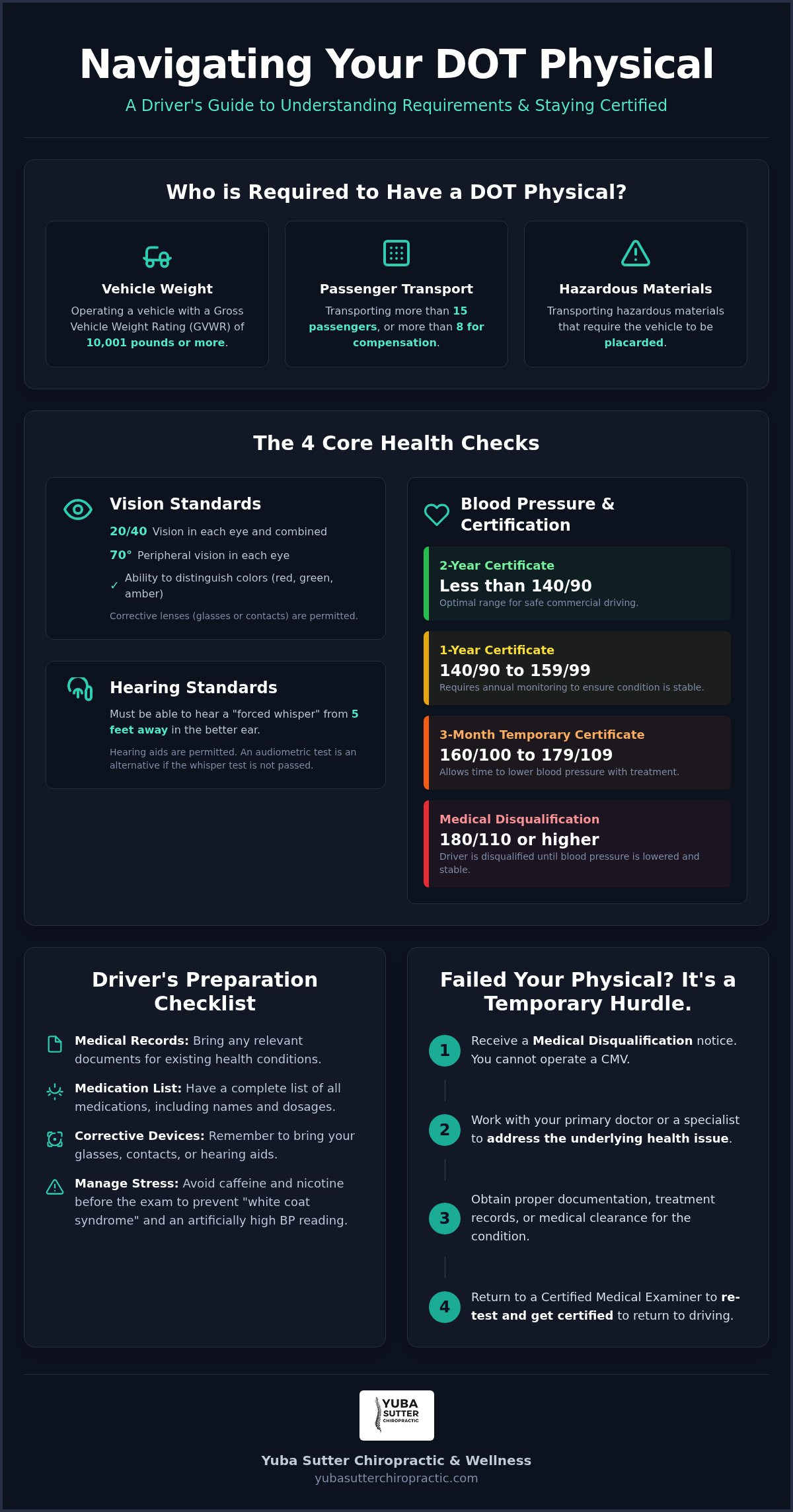
The law requires a DOT physical for any driver who operates a vehicle that meets specific criteria. You must have a current medical card if you drive a vehicle that fits these descriptions:
- A gross vehicle weight rating (GVWR) or gross combination weight of 10,001 pounds or more.
- A vehicle designed to transport more than 15 passengers, or more than 8 passengers for compensation.
- Any vehicle used to transport hazardous materials that require the vehicle to be placarded.
The Goal of the FMCSA Medical Standard
Drivers often worry about what happens if you fail a dot physical, but the primary goal of the standard is safety, not disqualification. The exam identifies safety-sensitive conditions, such as uncontrolled high blood pressure or respiratory issues, that could lead to sudden impairment. The Medical Examiner’s Certificate (Form MCSA-5876) is the official document provided to a driver who meets the physical qualification standards to operate a commercial motor vehicle.
How Often Must You Be Re-Certified?
Most healthy drivers receive a certificate valid for two years. However, if you have a chronic condition that requires monitoring, your CME may issue a shorter card. Common durations include one year, six months, or even a three-month temporary certificate. This is often the case for drivers managing hypertension who need regular check-ins to ensure their blood pressure remains stable. Understanding what happens if you fail a dot physical starts with knowing these tiers. A failure usually means you don’t meet the minimum criteria for even a short-term card, requiring you to work with a provider to resolve the underlying health issue before returning to work.
Core DOT Physical Requirements: The 4 Main Health Checks
The DOT physical focuses on four primary health checks designed to ensure you can safely navigate heavy traffic and long hours. While the exam is thorough, it’s a practical assessment meant to keep you working by identifying manageable health issues before they become hazards. By understanding these requirements, you can arrive at your appointment feeling prepared and confident.
Vision and Hearing: Can You Use Corrective Devices?
Safety on the road starts with your senses. Drivers must have at least 20/40 vision in each eye and both eyes combined. You also need a peripheral vision of 70 degrees in each eye and the ability to distinguish between red, green, and amber. If you use glasses or contacts, bring them to your appointment. You can pass while wearing corrective lenses, but your medical card will reflect this requirement. If you can’t meet these basic benchmarks, you might wonder what happens if you fail a dot physical. Usually, this means you’ll need an updated prescription from your eye doctor before we can finalize your certification.
Hearing is equally vital. The standard test involves hearing a forced whisper from five feet away in your better ear. If you struggle with the whisper test, an audiometric test provides a specialized alternative. Drivers who use hearing aids are welcome to use them during the exam. The FMCSA Medical Examiner’s Handbook provides detailed guidance for examiners on how to handle these accommodations fairly and accurately.
Blood Pressure Thresholds and Certification Lengths
Your cardiovascular health directly impacts how long your medical card remains valid. We look for a blood pressure reading below 140/90 to issue a full 2-year certificate. If your numbers are higher, the FMCSA requires more frequent check-ins to ensure your safety. Stage 1 hypertension, ranging from 140/90 to 159/99, usually results in a 1-year certificate. If you hit Stage 2, which is 160/100 to 179/109, you may receive a one-time 3-month certificate to give you time to lower those numbers.
Knowing what happens if you fail a dot physical because of high blood pressure can ease your anxiety. A reading of 180/110 or higher is considered Stage 3 and is a disqualifying condition. In these cases, we work with you to find a path toward management so you can return to the road as soon as your health stabilizes. Consistent medication and metabolic support are vital for drivers in Yuba City to avoid these disruptions.
Every DOT physical includes a urinalysis. It’s important to clarify that this is not a drug test. Instead, the CME checks for protein, blood, and sugar. These markers help identify underlying conditions like kidney disease or diabetes. Finding sugar in the urine doesn’t mean an automatic failure, but it does require further investigation into your metabolic health. If you’re feeling anxious about these checks, scheduling a DOT physical in a supportive environment helps lower stress and leads to more accurate readings.
Disqualifying Conditions and the 2026 Regulatory Landscape
The regulatory environment for commercial drivers is changing quickly. While certain health issues like epilepsy, severe respiratory disorders, or uncontrolled diabetes can lead to a disqualification, these outcomes are rarely permanent. The 2026 transition to the National Registry II (NRII) system marks a major shift in how health data is handled. In this new era, results are transmitted to federal authorities instantly. This transparency helps maintain high safety standards, but it also means drivers often ask what happens if you fail a dot physical when their medical history is now visible to the DMV in real-time. It’s no longer possible to simply visit a different clinic if you’re unhappy with a result; instead, the focus has shifted toward proactive health management.
Medical variances offer a path forward for drivers who don’t meet every standard but can still operate a vehicle safely. The FMCSA provides specific exemptions for vision, hearing, or seizure disorders, provided you meet their strict alternative criteria. Additionally, the Skill Performance Evaluation (SPE) program allows drivers with limb impairments or mobility challenges to demonstrate their competency through a practical driving test. These programs ensure that physical differences don’t automatically end a career, provided the driver can prove they are safe behind the wheel.
Managing Chronic Conditions: Diabetes and Sleep Apnea
Chronic conditions are among the most common reasons for medical concern, but they don’t have to be roadblocks. For drivers with insulin-treated diabetes, the MCSA-5870 form is an essential tool. It requires your treating specialist to certify that your condition is stable and well-managed. Similarly, if you have sleep apnea, you’ll need to provide CPAP compliance data showing consistent use. We often help drivers bridge these gaps through the Blueprint Metabolics Program, which focuses on stabilizing blood sugar and improving overall metabolic health. Most conditions that once caused an automatic disqualification are now manageable with the right documentation and clinical support.
The Move to Electronic Medical Certificates
By 2026, the move to fully electronic filing will significantly reduce the paper-based errors that often cause delays at the DMV. Once your CME enters your results into the system, your license status updates automatically. You can verify your certificate status through the official License Eligibility application online to ensure everything is current. Despite this digital shift, you should still keep a hard copy of your MCSA-5876 certificate in your cab for at least the first 15 days of 2026. This protects you during the final stages of the system rollout. Understanding what happens if you fail a dot physical under these new rules is vital for career longevity, as it allows you to address health markers before they are permanently logged in the national database.
The Driver’s Preparation Checklist: How to Pass Your Exam
Preparation is the best defense against a medical disqualification. When drivers ask what happens if you fail a dot physical, they are often surprised to learn that many “fails” are actually just “incomplete” statuses caused by missing paperwork or temporary spikes in blood pressure. By following a structured checklist, you can ensure your exam goes smoothly and reflects your true health. Arriving prepared shows the examiner that you take your health and your career seriously.
What to Bring to Your Appointment
Being organized saves time and prevents the stress that leads to elevated heart rates. You must bring a valid driver’s license and your current medical examiner’s certificate. If you manage chronic conditions, you’ll need specialist clearance letters. For example, if you’ve had a recent heart surgery or have a history of diabetes, your CME needs documentation from your treating physician stating you’re stable. Bringing these documents upfront prevents your certification from being placed on hold.
- Corrective lenses or hearing aids if you use them for driving.
- A complete list of medications with dosages and prescribing doctor information.
- CPAP compliance reports showing at least 70% usage over the last 30 days if you have sleep apnea.
- Medical records regarding any recent surgeries or hospitalizations.
The 24-Hour Pre-Exam Protocol
Your habits in the hours leading up to the exam significantly impact your results. Avoid energy drinks and excessive caffeine, as these can cause temporary blood pressure spikes. These spikes might trigger a shorter certification period or a temporary failure. Choose water instead. Proper hydration helps with the required urinalysis and keeps your system stable. To learn more about maintaining high-quality water in your home, you can discover Simple Plumbing Inc for expert guidance. Additionally, skip high-sodium foods the night before your exam to avoid fluid retention and elevated readings.
Don’t skip your regular medications. Some drivers mistakenly stop taking blood pressure meds on the day of the exam, which is a primary reason for failing a dot physical. Take your prescriptions exactly as scheduled to maintain stability. If you suffer from ‘white coat syndrome’, use this 3-step calming routine:
- Arrive 15 minutes early to avoid the stress of rushing.
- Practice deep, rhythmic breathing while in the waiting area.
- Keep your feet flat on the floor and your arm at heart level during the blood pressure reading.
At Yuba Sutter Chiropractic & Wellness, we specialize in making this process as comfortable as possible. Our team provides a supportive environment that helps you stay calm and focused on your career goals. Book your DOT physical today to experience a stress-free certification process with examiners who understand the driver’s journey.
Stress-Free DOT Physicals at Yuba Sutter Chiropractic & Wellness
Drivers in Yuba City and Marysville often feel like they’re just another number at large, corporate medical centers. At Yuba Sutter Chiropractic & Wellness, we take a different approach. We believe that a medical exam shouldn’t be a source of dread. Our team provides FMCSA-certified DOT physicals in a welcoming environment that prioritizes your comfort and your career. By choosing a local partner, you gain access to examiners who understand the unique demands of the Yuba-Sutter basin’s trucking community.
The clinical advantage of visiting a chiropractic office for your certification is significant. Long hours behind the wheel take a toll on your musculoskeletal system. We don’t just check your vitals; we understand how the benefits of regular chiropractic adjustments can improve your long-term driving comfort and spinal health. This holistic perspective helps you stay on the road longer without the chronic pain that often leads to health complications.
We also look beyond the immediate exam. If you’re worried about what happens if you fail a dot physical due to rising blood sugar or blood pressure, our Blueprint Metabolics program offers a clear path forward. This metabolic support helps you manage these conditions naturally, ensuring that your next renewal is a simple, stress-free process. We’re committed to your long-term CDL compliance and overall well-being.
A Community-Focused Approach to Driver Health
Our practice is deeply rooted in the local community. We know that your CDL is your livelihood. That’s why we focus on removing barriers to care and providing a steady hand throughout your health journey. With the 2026 electronic reporting requirements, the technical side of certification has become more complex. Our team handles the electronic filing to the National Registry II (NRII) system with precision. This ensures your records update at the DMV without frustrating delays or paperwork errors.
Booking Your Exam in Yuba City
We provide efficient scheduling to accommodate the busy lives of commercial drivers. Whether you’re an independent operator or part of a local fleet in the Sutter area, we offer quick turnaround times that respect your schedule. When you walk into our Yuba City office, you can expect a streamlined process and a team that values transparency. We guide you through every step, ensuring you feel empowered rather than overwhelmed. Don’t let the fear of what happens if you fail a dot physical keep you off the road. Schedule your stress-free DOT physical today! and partner with a team that’s invested in your success.
Stay on the Road with Confidence
Navigating the medical requirements of a commercial driving career can feel overwhelming, especially with the 2026 shift toward instant electronic reporting. However, most medical setbacks are manageable with the right preparation and clinical support. By focusing on consistent health monitoring and arriving at your exam with the necessary documentation, you can protect your livelihood and your long-term well-being.
Understanding what happens if you fail a dot physical is the first step toward reclaiming your medical certificate and getting back behind the wheel. Our team at Yuba Sutter Chiropractic & Wellness has served the Yuba-Sutter community for years, providing a steady hand through the certification process. With Certified Medical Examiners on-site and comprehensive wellness support for CDL holders, we help you address health markers like blood pressure and blood sugar naturally.
You don’t have to face the stress of a medical exam alone. We are here to partner with you in maintaining your health and your career. Schedule Your DOT Physical in Yuba City today to experience a supportive, thorough, and efficient certification process. Your journey toward a healthier, more stable career starts with a single proactive step.
Frequently Asked Questions
Does a DOT physical include a drug test?
A standard DOT physical does not include a drug test. While the exam requires a urinalysis, this test specifically screens for underlying medical conditions like diabetes or kidney disease by checking for sugar, protein, and blood. If your employer or the FMCSA requires a drug screen, that is a separate procedure with its own documentation. We focus on your physical health and qualification during your visit to our Yuba City office.
Can I pass a DOT physical with high blood pressure?
You can pass with high blood pressure, but your reading determines how long your medical certificate remains valid. Readings below 140/90 usually earn a 2-year card. If your blood pressure falls between 140/90 and 159/99, you typically receive a 1-year certificate. Higher readings may result in a shorter 3-month temporary card. Our Blueprint Metabolics program helps drivers in Marysville manage hypertension naturally to secure longer certifications and maintain their CDL status.
What happens if I fail my DOT physical?
If you’re wondering what happens if you fail a dot physical, it is usually treated as a temporary disqualification rather than a permanent one. You must address the specific medical issue identified by the examiner, such as uncontrolled blood pressure or high blood sugar. Once your condition is stabilized and documented by a specialist, you can return for a re-examination. We work with drivers throughout the Yuba-Sutter basin to create a clear path toward re-certification, often recommending resources like WJW Counselling & Mediation to help manage the stress and anxiety that can accompany a medical disqualification.
You don’t need to bring the physical CPAP machine to your appointment. Instead, you must provide a compliance report covering the last 30 to 90 days. The FMCSA generally looks for at least 70% usage for four hours or more per night. Bringing a printed report or having digital access to your usage data ensures our Certified Medical Examiners can verify your treatment status quickly. This helps avoid delays in issuing your new medical card.
Can I go to any doctor for a DOT physical?
You cannot use your regular family physician unless they are listed on the FMCSA National Registry of Certified Medical Examiners. Only a CME has the specific training to evaluate drivers against federal safety standards. At Yuba Sutter Chiropractic & Wellness, our staff includes certified examiners who are authorized to perform these physicals. We ensure your results are filed correctly under the 2026 electronic reporting rules, keeping you compliant with both state and federal laws.
How long does a DOT physical take at your Yuba City office?
A typical DOT physical at our Yuba City clinic takes approximately 30 to 45 minutes to complete. This timeframe depends on whether you have your documentation ready, including medication lists and specialist clearance letters. We value the busy schedules of commercial drivers in the Gridley and Live Oak areas. By offering efficient, streamlined exams, we help you get back on the road quickly while ensuring all federal health requirements are thoroughly met.
What if my medical certificate expires before I get a new one?
If your medical certificate expires, your CDL is no longer valid for commercial operation. The DMV will eventually downgrade your license if a new certificate isn’t filed. This is similar to what happens if you fail a dot physical, as you lose the legal right to drive commercial vehicles. We recommend scheduling your exam in Yuba City early to ensure your electronic filing is completed well before your current card expires.
Are there exemptions for drivers with monocular vision?
Drivers with monocular vision can still qualify for a medical certificate through the federal vision exemption program. You must meet specific alternative standards and provide an evaluation from an ophthalmologist or optometrist. Our examiners can guide you on the necessary steps to apply for this variance. This process ensures that drivers in Sutter and Colusa who have vision in only one eye can still safely operate commercial vehicles while remaining fully compliant with safety regulations.