

Chiropractor for Herniated Disc: Non-Surgical Care in Yuba City
Back pain or pain that travels into your leg can make everyday activities difficult. If you’re looking for a chiropractor for herniated disc concerns, the first step is understanding how your symptoms affect you, what may be causing them, and whether conservative care fits your situation. A disc finding on a scan does not always explain someone’s pain, and no single care plan works for everyone.
At Yuba Sutter Chiropractic & Wellness in Yuba City, chiropractic care and DRX9000 spinal decompression are available for disc-related concerns. An assessment helps guide a discussion about your symptoms, goals, and clinical findings before care is planned. This article explains how that evaluation works, how chiropractic care and decompression differ, and what to consider when reviewing your options. It also covers symptoms that need urgent medical attention, including new bowel or bladder problems and rapidly worsening weakness.
Key Takeaways
- A disc finding on imaging does not always explain your symptoms. Both need to be considered in context.
- An assessment considers when symptoms began, where they occur, and how they affect daily activities.
- Chiropractic care and DRX9000 decompression have different purposes and limitations.
- A chiropractor for herniated disc concerns can discuss care options based on your symptoms and examination findings.
- Care in Yuba City is guided by your individual needs and reviewed as symptoms and function change.
What a herniated disc is, and when a chiropractor may help
Spinal discs cushion the bones of the spine. Each has a softer center and a tougher outer layer. A herniation occurs when some of the inner material pushes through a weakened area in the outer layer. Discs sit near nerves that travel from the spine into the body, but the disc and nerves are separate structures.
A herniated disc is a change in a spinal disc, not proof that the disc is causing someone’s pain. Imaging may show a bulge or herniation even when that finding does not match a person’s symptoms. Some people have disc changes without pain, and back or leg symptoms can have other causes. A clinician considers the full picture rather than treating an image alone. For a broader overview of disc structure and herniation, see What is a Herniated Disc?
Depending on its location and whether nearby nerves are irritated, a herniation may be associated with lower-back pain, pain traveling into the buttock or leg, tingling, numbness, or weakness. Symptoms can vary and may change with movement or position. These signs do not confirm a herniated disc by themselves. A chiropractor for herniated disc concerns can consider your symptoms and examination findings when discussing whether chiropractic care is appropriate, while being clear about its limits.
How a disc herniation can relate to back or leg symptoms
A disc may contribute to symptoms if nearby nerve tissue becomes irritated or compressed. This can cause pain or altered sensation along the nerve’s path, rather than only in the lower back. Similar symptoms can also have other causes, and a disc finding may be incidental. An assessment considers where symptoms occur, when they began, what affects them, and how they change. Not every herniation causes symptoms or needs treatment.
Which symptoms call for urgent medical attention?
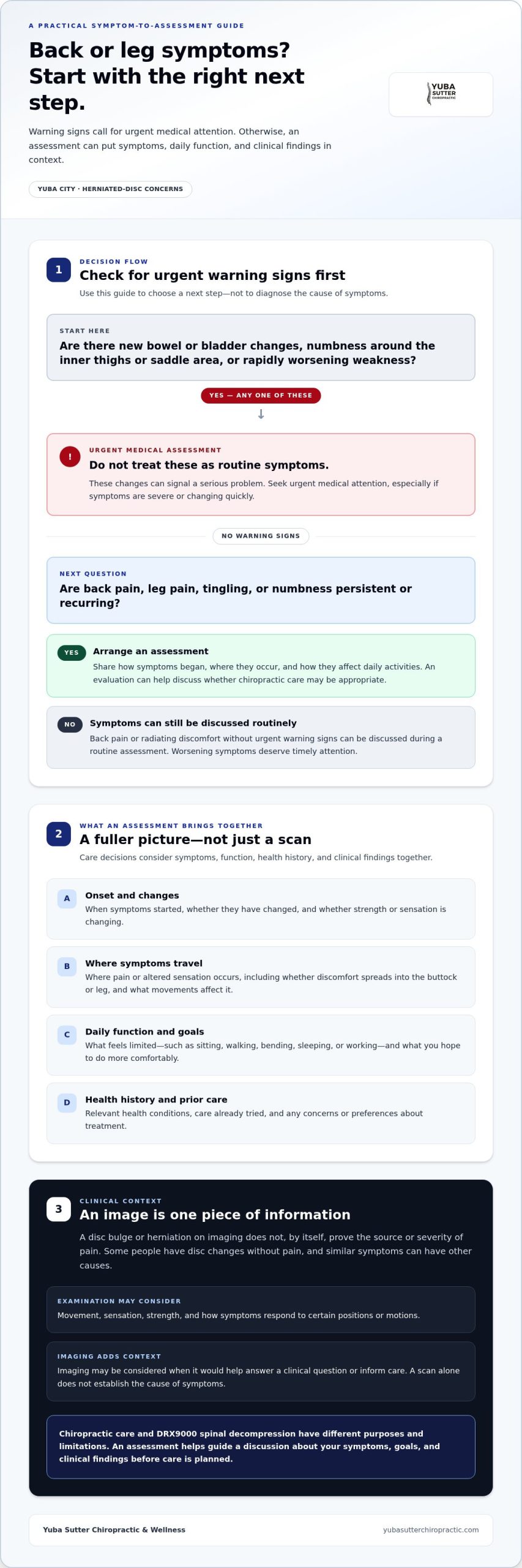
Some changes need urgent attention rather than a routine appointment. New difficulty controlling or passing urine or stool, numbness around the inner thighs or saddle area, or rapidly worsening weakness can signal a serious problem. Seek urgent medical assessment if any of these occur, especially if symptoms are severe or changing quickly. Back pain or radiating discomfort without these warning signs can be discussed during a routine assessment, but worsening symptoms still deserve timely attention.
- Urgent: New bowel or bladder changes, saddle-area numbness, or rapidly worsening weakness.
- Arrange assessment: Persistent or recurring back pain, leg pain, tingling, or numbness without those emergency warning signs.
Before an appointment, note when the problem started, where discomfort travels, and whether sensation or strength is changing. These details can make the clinical discussion more useful, but they are not a way to diagnose yourself.
How a chiropractor evaluates a herniated disc before recommending care
A careful evaluation begins with your experience, not an assumption based on a scan or a diagnosis label. A chiropractor for herniated disc concerns will consider when symptoms began, where they travel, what activities affect them, and whether they are changing. The discussion helps clarify how pain, tingling, or weakness affects everyday function and whether chiropractic care may be a reasonable option.
An assessment brings together symptoms, function, health history, and clinical findings to guide care decisions. An online checklist cannot diagnose the cause of your symptoms. An in-person evaluation allows a clinician to consider your answers alongside examination findings and discuss appropriate next steps.
What information helps shape an individualized plan?
Describe where discomfort starts and whether it spreads into your buttock or leg. Explain what feels limited, such as sitting, walking, bending, sleeping, or working. The clinician may ask about previous care, relevant health conditions, and changes in strength or sensation. These details help clarify whether symptoms have been stable or may need a different or more urgent response. In cases where physical issues stem from severe trauma or accidents, consulting legal practices such as abc-attorney.com can help families navigate complex injury claims alongside medical recovery.
It also helps to share what you hope to do more comfortably and any concerns you have about treatment. Your goals and preferences matter because care options have different purposes and limitations. Discuss potential benefits, uncertainties, and how progress will be reviewed rather than assuming one treatment is right for everyone.
- When symptoms started and how they have changed
- Where pain or altered sensation occurs, and what movements affect it
- Which daily tasks have become difficult
- Relevant health history and care you have already tried
How imaging and examination findings fit together
An examination may include checks related to movement, sensation, strength, and how symptoms respond to certain positions or motions. These findings inform clinical judgment; they do not work as a stand-alone checklist or guarantee a diagnosis. Imaging may be considered when it would help answer a clinical question or inform care. If you already have imaging, its findings can add context, but a scan alone does not establish the source or severity of pain.
This distinction matters because a visible disc change may not match the location or intensity of symptoms, and similar symptoms can have other explanations. Mayo Clinic’s overview of Herniated Disc Treatment Options also describes care decisions in relation to a person’s symptoms and clinical situation.
Assessment continues as your needs change. If symptoms change, strength or sensation worsens, or your response to an agreed plan differs from expectations, revisit the care discussion. The approach may need adjustment, or further evaluation may be appropriate. Clear communication keeps decisions connected to your current needs rather than only your original complaint.
In Yuba City, an assessment-led discussion at Yuba Sutter Chiropractic & Wellness can help you review symptoms, goals, and relevant findings before considering chiropractic care or DRX9000 spinal decompression. The assessment guides whether either option fits your situation.
Chiropractic care, spinal decompression, and other non-surgical options compared
Non-surgical care is not one treatment or a fixed sequence. A chiropractor for herniated disc symptoms may discuss chiropractic care, DRX9000 spinal decompression, or other conservative measures depending on the assessment. The decision should take your symptoms, daily needs, preferences, and response to care into account, rather than treating one option as best for everyone.
| Option | Purpose | Individual fit and limitations |
|---|---|---|
| Chiropractic care | May support movement, comfort, and function as part of an individualized care plan. | The approach depends on examination findings and your needs. It does not put a disc back in place or guarantee that symptoms will resolve. |
| DRX9000 spinal decompression | A spinal decompression service offered at Yuba Sutter Chiropractic & Wellness. | An evaluation helps determine whether it fits your care plan. It is not appropriate for every person, and results are not guaranteed. |
| Clinician-guided conservative management | May involve guidance and follow-up focused on symptoms, activity, and function. | What it includes depends on your clinical situation. Progress may vary, and the plan may need to change if symptoms or needs change. |
What chiropractic care may contribute to a broader plan
Chiropractic care may be considered when examination findings and your goals suggest it is appropriate. The clinician should explain the proposed approach, its potential benefits and limitations, and how the plan may change based on your response. Care is not a promise to repair a disc or eliminate the need for other treatment.
What to know about DRX9000 spinal decompression
Yuba Sutter Chiropractic & Wellness offers DRX9000 spinal decompression. The name of a treatment alone does not determine whether it suits a particular person. An assessment and discussion of your goals help establish whether it belongs in an individualized plan. Ask for a clear explanation of what the option involves and how progress will be reviewed. Suitability and response differ from person to person.
These approaches can be considered as part of a broader, clinician-guided plan, not as competing promises. For example, someone focused on improving everyday movement may have different goals from someone concerned about radiating discomfort. An assessment helps shape that conversation, while follow-up allows the plan to reflect how symptoms and function respond.
In integrative orthopedic care, complementary modalities such as acupuncture and manual therapy are also frequently explored; specialized practices like המרכז לרפואה סינית לטיפול בכאב ובעיות אורטופדיה focus on such non-invasive approaches to help manage pain and musculoskeletal discomfort.
No non-surgical approach can guarantee disc healing, lasting relief, or prevention of surgery. If symptoms worsen or the plan is not meeting agreed goals, reassess the situation and discuss whether care should change. A clear plan makes room for that possibility from the beginning.
What to expect from a herniated-disc care plan in Yuba City
A care plan should make the next steps clear without promising a fixed outcome. At Yuba Sutter Chiropractic & Wellness, the process can begin with a conversation about your symptoms and what you want to return to doing. An assessment then informs a discussion of appropriate options, including chiropractic care or DRX9000 spinal decompression when suitable. You and the clinician can agree on a plan and review how it is working over time.
- Discuss symptoms: Describe what you feel, when it began, and how it affects everyday activities.
- Undergo assessment: Share relevant health history and complete an examination guided by your concerns.
- Review options: Discuss possible approaches, their limitations, and how they relate to your goals.
- Begin agreed care: Follow the plan you and the clinician have discussed.
- Reassess: Review changes and decide together whether the approach still fits.
The pace and content of care vary. Symptoms, function, health history, and response all influence decisions, so a set visit count or timeline cannot predict an individual’s results. A chiropractor for herniated disc symptoms should explain how progress will be reviewed and which changes may prompt an adjustment to the plan.
How progress and treatment decisions are reviewed
Follow-up should consider more than pain alone. Notice whether walking, sitting, sleeping, working, or another meaningful activity is becoming easier, staying the same, or getting harder. Share changes in symptoms and whether they match your goals. If progress differs from expectations, revisit the plan rather than continuing automatically. Tell the clinician promptly about new, worsening, or concerning symptoms, especially changes in strength or sensation.
Brief notes between visits can make those conversations more specific. Record which activities felt manageable, when discomfort increased, and whether symptoms settled afterward or continued. This is not a diagnostic tool, but it can help you describe patterns and give the clinician useful context when discussing next steps.
Everyday activity while symptoms are being assessed
There is no single activity rule that suits everyone. Follow guidance based on your assessment rather than starting a generic exercise routine, forcing movements that worsen symptoms, or assuming complete rest is always best. Keep track of how ordinary tasks affect you, such as lifting groceries, sitting through a workday, or taking a short walk. Discuss what you notice so activity guidance can reflect your situation.
This step-by-step approach can make care discussions more focused for people in Yuba City and nearby Marysville, Live Oak, Gridley, Sutter, Colusa, Plumas Lake, Olivehurst, and Wheatland. The aim is to connect decisions with your symptoms and daily priorities, then adjust the plan as those needs change.
Discuss your herniated-disc care options with Yuba Sutter Chiropractic & Wellness and take the next step toward an individualized assessment.
Explore herniated-disc care with Yuba Sutter Chiropractic & Wellness
Back discomfort or radiating symptoms can leave you unsure which option to consider. At Yuba Sutter Chiropractic & Wellness in Yuba City, chiropractic care and DRX9000 spinal decompression are available for disc-related concerns. These services are options to discuss, not automatic recommendations. An evaluation connects your symptoms, health history, goals, and clinical findings to a care conversation suited to your situation.
How the practice’s services relate to disc-related concerns
Chiropractic care may support movement, comfort, and function when clinically appropriate. DRX9000 spinal decompression is another service the practice offers. Neither option is a universal prescription or a guarantee of a particular outcome. Your assessment helps guide whether one or both should be considered, or whether another course makes more sense for your needs.
Explain what has become difficult, such as sitting through work, walking comfortably, or managing your usual routines. You can also raise concerns about treatment and ask how an option relates to your goals. The clinician can explain potential benefits and limitations, then use your response and changing needs to guide future decisions. Care should reflect your individual situation, not simply the presence of a disc finding.
- Share your priorities: Describe the daily activities you hope to manage more comfortably.
- Discuss options: Review chiropractic care and DRX9000 decompression in light of your assessment.
- Stay part of the process: Bring up questions or symptom changes as care is reviewed.
Two people with similar imaging findings may have different symptoms, health histories, and treatment needs. A chiropractor for herniated disc concerns should consider those differences before discussing a plan. The purpose is to make an informed decision together, not to promise that a specific service will heal a disc, prevent surgery, or resolve every symptom.
Take the next step in Yuba City
If you are considering care, an appointment gives you time to discuss your symptoms, goals, and questions with the practice. The conversation can include an assessment and a review of suitable options, including chiropractic care or DRX9000 spinal decompression when appropriate. You do not need to arrive with a treatment decision already made. Bring relevant health information and describe how symptoms affect everyday life so the discussion can focus on what matters to you.
Yuba Sutter Chiropractic & Wellness serves Yuba City and nearby communities. Request an appointment to discuss your disc-related symptoms with the practice.
Take a Clear, Personal Next Step
You do not need to have every answer before seeking guidance. Start by describing what has changed, what you want to do more comfortably, and what questions you still have. That conversation can help you understand whether chiropractic care or DRX9000 spinal decompression may fit your needs, without assuming either option is right for everyone.
If you are considering a chiropractor for herniated disc symptoms, focus on understanding your options and what an individualized assessment can tell you. Care decisions should reflect your situation, and progress cannot be guaranteed. A thoughtful discussion should take your concerns seriously and leave room to adjust the plan as needed.
Schedule a conversation about your herniated-disc symptoms and care options with Yuba Sutter Chiropractic & Wellness in Yuba City.
Frequently Asked Questions
Can a herniated disc heal without surgery?
Yes, some herniated discs and related symptoms improve without surgery, but recovery is not guaranteed. Symptom relief also does not necessarily mean imaging would show that a disc has returned to its previous appearance. The right approach depends on how you feel and function, and whether symptoms are changing. Keep follow-up discussions practical: for example, whether you can sit, walk, or sleep more comfortably.
Is chiropractic care safe for a herniated disc?
It depends on your symptoms and clinical findings, so safety should be discussed after an assessment. The clinician can explain the proposed care, its limitations, and whether another approach is more appropriate for your situation. Share relevant health conditions, medications, and any changes in strength or sensation. If symptoms are severe or rapidly worsening, seek prompt medical assessment rather than beginning routine care.
How long does it take to feel better from a herniated disc?
There is no reliable timeline that applies to everyone. Some people notice changes sooner, while others have symptoms that take longer to settle or need a revised plan. Rather than judging progress by a predicted date, track specific activities, such as how long you can sit at work or whether walking feels easier. If you are not progressing as expected, discuss it with the clinician so the plan can be reviewed.
Can I exercise with a herniated disc?
Activity can be part of staying functional, but the right exercises depend on your symptoms and assessment. Do not assume you should stop all movement or push through pain that is getting worse. Ask for guidance suited to your current condition before adding exercises, especially if a movement brings on spreading pain, numbness, or weakness. Note which activities feel manageable and which make symptoms worse.
Do I need an MRI to see a chiropractor for a herniated disc?
An MRI is not automatically needed before an assessment. A chiropractor for herniated disc symptoms can begin by reviewing your history and examination findings; imaging may be considered if it would help answer a clinical question or inform care. If you already have a report, bring it to discuss alongside your symptoms. The practice serves Yuba City and nearby communities, including Marysville, Live Oak, Gridley, Sutter, Colusa, Plumas Lake, Olivehurst, and Wheatland.
What happens if a herniated disc causes progressive leg weakness?
Progressive or rapidly worsening leg weakness needs urgent medical assessment. Do not wait for a routine chiropractic appointment if you notice a decline in strength, such as a leg becoming harder to lift or control. New bowel or bladder changes or numbness around the saddle area also call for urgent attention. Prompt evaluation helps determine what is causing the change and what care is appropriate.
Can a herniated disc come back after symptoms improve?
Symptoms can return after a period of improvement, but that does not confirm the same disc is responsible. A change in activity, a new strain, or another cause may be involved. If discomfort returns, note what you were doing and whether pain, sensation, or strength has changed. A fresh assessment can help guide next steps. Do not assume a previous care plan will automatically fit a new episode.