

How Many MLS Laser Sessions Are Needed? What Shapes Your Treatment Plan
What if the best answer to “how many MLS laser sessions are needed” is an individualized plan rather than a fixed number? It’s reasonable to want a clear timeline before starting treatment, but a session count that fits one person may not fit another. Your plan should reflect the concern being assessed, your goals, and how progress is reviewed.
The number of sessions can depend on whether a concern is recent or ongoing, its severity, your overall health, and your response to treatment. Progress matters, too. A clinician can review changes in symptoms and day-to-day function with you to decide whether the plan should continue or be adjusted.
This article explains why MLS laser therapy plans differ, which details can shape session frequency, and how to track changes between appointments. You’ll also find practical questions to discuss with a clinician, so you can better understand the time commitment and what to expect from an individualized plan.
Key Takeaways
- There isn’t one session count that fits everyone. A clinician can shape a plan around your needs and response.
- To understand how many MLS laser sessions are needed, consider the treatment goal and the area or concern being assessed.
- Track relevant changes in symptoms and daily activities between appointments to support useful progress conversations.
- Prepare to describe your concern, relevant health history, and current care so you can take an active role in planning.
- Yuba Sutter Chiropractic & Wellness offers FDA-cleared MLS laser therapy in Yuba City.
How many MLS laser sessions are needed? Why there is no single answer
There isn’t one session count that applies to everyone. How many MLS laser sessions are needed depends on the treatment goal, the concern being assessed, and your individual circumstances and response. A clinician should assess whether MLS laser therapy is appropriate for you and, if so, recommend a plan based on that assessment.
MLS stands for Multiwave Locked System. It’s a type of laser therapy within the broader category of low-level laser therapy (LLLT). Low-level laser therapy (LLLT) is a general term for approaches that use low-level light. Information about the broader category does not determine what a particular person needs or how many sessions they should have.
An individualized treatment plan is guided by your needs and clinical progress, not by a universal session count. That distinction can help you assess treatment discussions realistically. A general explanation of how therapy is used is not a personal recommendation, and no particular number of appointments can guarantee a specific result. This principle is standard across clinical laser practices; for instance, providers like Couture Dermatology & Laser Beverly Hills emphasize that laser protocols must be tailored to individual evaluations and treatment goals rather than rigid schedules.
Why a fixed session number can be misleading
A fixed number can sound reassuring, but it may overlook important differences between people. The treatment goal, area or concern being evaluated, and your response can all affect planning. Two people considering MLS laser therapy may have different symptoms, health histories, and day-to-day concerns, so their plans may not match.
That’s why a general session count shouldn’t be treated as a prescription. Even if a number appears in educational material, it cannot determine whether MLS fits your circumstances or predict what you’ll experience. A useful treatment discussion explains the reasoning behind a proposed plan and allows for reassessment as appropriate.
What a clinician considers before recommending sessions
Planning starts with understanding what you want to address and gathering relevant context. A clinician may ask about your symptoms, when they began, how they affect your routine, and what care you’re currently receiving. They may also review relevant health history and assess the area or concern in relation to your treatment goal.
These details inform clinical judgment. They don’t mean every symptom or diagnosis is suitable for MLS laser therapy. The clinician considers your circumstances when deciding whether this approach is appropriate and whether a session plan makes sense. Be open about symptom changes, other health concerns, and treatments you’ve tried or are using now. Clear information supports a more useful discussion.
You can ask what the proposed plan is intended to address, how progress will be reviewed, and what might prompt a change in approach. These questions help you understand the reasoning behind a recommendation rather than relying on a promise. Your plan should be explained in language you understand, with an opportunity to discuss concerns before deciding on next steps.
What factors can change an MLS laser therapy treatment plan?
An MLS laser therapy plan isn’t based on the treatment name alone. A clinician considers why you’re seeking care, what area or concern is being assessed, your relevant health history, and how MLS may fit with your broader care. Those details help shape a recommendation for your circumstances instead of applying a preset schedule.
The treatment goal, area being assessed, health history, other care, and practical needs can all inform a plan, but none determines a guaranteed session schedule. If you’re wondering how many MLS laser sessions are needed, these factors explain why the answer depends on an individual assessment.
Condition, treatment goal, and individual history
The reason you’re considering therapy influences what the clinician needs to understand before recommending an approach. They may discuss the concern you want addressed, its effect on daily activities, and what you hope to change. The area involved also matters to the assessment. The aim is to connect the treatment discussion to a clear goal, not to assume every concern calls for MLS.
Your health history adds important context. Share relevant diagnoses, previous injuries or procedures, medications, and other factors that may affect care. This information does not automatically determine whether MLS is appropriate. It helps the clinician consider your circumstances and discuss whether the proposed approach makes sense for you. Be specific about what you know, and mention anything you’re unsure about.
Other care and practical considerations
MLS may be considered as part of a broader care plan. A clinician can take into account other therapies you’re receiving, what they’re intended to address, and how different parts of your care fit together. This doesn’t mean MLS replaces a medical assessment or other care that may be necessary. It means the recommendation should reflect the full picture rather than treating one therapy in isolation.
Before your appointment, make a clear note of your current care and any changes you’ve noticed. If you’re also receiving chiropractic care or another therapy, explain what it involves and who is coordinating it. That context helps the clinician consider how your care fits together without assuming that combining treatments guarantees a better outcome. Yuba Sutter Chiropractic & Wellness offers several therapeutic services; its overview of advanced chiropractic technology provides broader context on technology within care.
Your preferences and practical circumstances can also be part of shared planning. Let the clinician know about scheduling constraints or questions about the proposed approach. A useful discussion explains the treatment goal, why MLS is being considered, and what would prompt a review. That clarity helps you take part in decisions while keeping recommendations grounded in your individual assessment.
How should you judge progress between MLS laser sessions?
Progress is easier to discuss when you look beyond how you feel on the day of an appointment. Notice whether the concern being treated is changing and whether everyday tasks feel different. A brief record can help you describe those changes clearly, especially if symptoms vary from day to day.
Progress is a pattern to review with your clinician, not a promised result or a conclusion drawn from one appointment. One easier day doesn’t establish that treatment has worked, and one difficult day doesn’t tell the whole story. Daily activity, rest, and other care can also affect how you feel, so share that context rather than interpreting each change on your own.
What changes may be useful to record
Start with the concern that led you to discuss MLS laser therapy. In a few words, note what has changed since your last appointment and how the concern affects your routine. Keep your notes simple and consistent enough to compare over time. There’s no universal rating scale or threshold you need to meet.
- Note which daily activities feel easier, harder, or unchanged.
- Record when a change occurs and whether it lasts or comes and goes.
- Include relevant context, such as a change in activity or another part of your care.
- Write down questions or unexpected changes to bring to your clinician.
For example, “I could complete my usual household task with less interruption” may be more useful than a vague note that you felt “better.” You don’t need to keep a detailed diary. A short note on your phone or in a notebook can help you recall specifics that are easy to forget between visits. Avoid changing or stopping other care based only on your interpretation of a good or difficult day.
When to discuss a plan adjustment
Share your observations at follow-up, including when progress feels unclear or your concern hasn’t changed as you hoped. Tell the clinician about new or unexpected symptoms, too. They can review your experience alongside the original treatment goal and decide whether the plan should continue, change, or be reassessed. Don’t assume more sessions are automatically the right next step.
Be direct about what matters most to you. If a concern affects sleep, work, movement, or another part of your routine, explain how. This gives your clinician practical information to consider instead of relying on a general impression. You can also ask what changes they’re monitoring and when they plan to review the approach.
If you’re tracking changes after an auto injury, describing how symptoms affect routine activities can help keep follow-up conversations specific. The auto injury recovery clinic guide offers related context for people considering care after an injury. Bring your notes and questions to your clinician, who can interpret them in light of your circumstances.
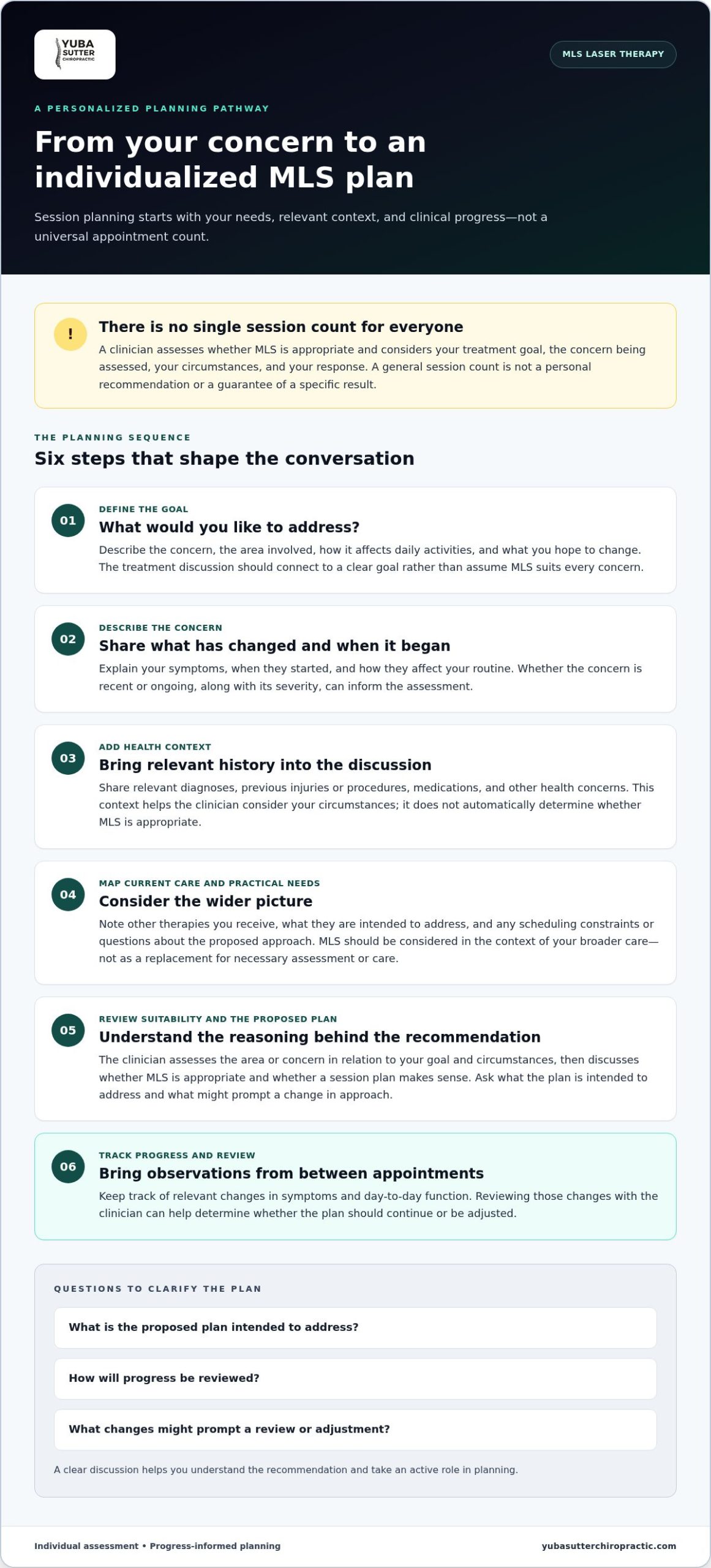
How to prepare for a conversation about your MLS laser sessions
A clear conversation can help you understand the purpose of a proposed MLS laser plan and take an active role in care decisions. You don’t need medical terminology or a perfect timeline. Focus on describing what you’ve noticed, what you hope to address, and which questions you want answered.
If you’re asking how many MLS laser sessions are needed, use the discussion to understand how the clinician is approaching your individual situation. The goal isn’t to secure a guaranteed session count. It’s to understand the treatment goal, how progress will be reviewed, and what could lead to reassessment.
Questions to bring to your appointment
Writing down a few questions beforehand can make it easier to cover the details that matter to you. Start with the purpose of the recommendation, then ask how you and the clinician will assess whether the plan remains appropriate.
- What are you assessing, and what is the proposed treatment intended to address?
- How will we review progress, and what changes will help guide that discussion?
- What might prompt you to continue, adjust, or reassess the plan?
- What should I do if my symptoms change or I have a concern between visits?
Ask for an explanation in plain language if anything feels unclear. You can also repeat back what you understand about the goal and follow-up plan. That gives you and the clinician a chance to clear up misunderstandings before deciding on next steps. If you have concerns about the time commitment or coordinating appointments with other care, raise them so they can be part of the conversation.
Information that helps make the plan personal
Before the appointment, jot down a short account of the concern. Include when it began, how it has changed, and which activities it affects. For instance, note whether it gets in the way of a work task, a regular movement, or another part of your routine. Specific examples give the clinician useful context without requiring you to diagnose the cause.
Share relevant health history and current care as accurately as you can. This includes other treatments you’re receiving, medications, and important changes in your health. If you don’t remember a detail, say so rather than guessing. Complete information supports an appropriate discussion and helps the clinician consider the wider picture.
Keep your notes brief. A few points on your phone or a sheet of paper can help you remember what to mention and make space for questions. Don’t stop medication or change another part of your care on your own. Discuss possible changes with the clinician responsible for that care.
For a conversation about MLS laser therapy in Yuba City, discuss your MLS laser therapy needs with Yuba Sutter Chiropractic & Wellness. Share your questions and relevant history so the discussion can focus on your circumstances.
Discuss an individualized MLS laser plan in Yuba City
Understanding what can shape a session plan gives you a clearer starting point for a personal conversation. Discuss your goals, the concern you want assessed, and whether MLS laser therapy fits your circumstances. You don’t need to arrive expecting a predetermined number of visits or a guaranteed result.
Yuba Sutter Chiropractic & Wellness offers FDA-cleared MLS laser therapy in Yuba City. A conversation about care can focus on your needs, relevant health history, and the purpose of considering this therapy. Whether MLS is appropriate and what a plan could involve depend on professional assessment and your individual situation.
What to expect from a personalized discussion
Start by explaining what you’d like help with and how it affects your routine. Share when the concern began, what you’ve noticed over time, and any care you’re currently receiving. These details give the clinician context for considering your goals and the area or concern being assessed.
You can ask why MLS is being considered, what the proposed approach aims to address, and how progress may be reviewed. If the clinician recommends sessions, ask how that recommendation relates to your circumstances and what might prompt a reassessment. This clarifies the reasoning behind a plan without treating a session count as a promise of a particular outcome.
It’s also reasonable to discuss whether other care should continue alongside the plan. Share questions or concerns about coordinating treatment, and avoid changing medication or other care without guidance from the clinician responsible for it. The goal is a clear, collaborative conversation, not pressure to choose a specific approach.
A local next step for Yuba City and nearby communities
Yuba Sutter Chiropractic & Wellness serves people seeking local care in Yuba City and nearby communities, including Marysville, Live Oak, Gridley, Sutter, Colusa, Plumas Lake, Olivehurst, and Wheatland. Bring a short list of goals and questions, including what the clinician will assess and how decisions may be revisited as your circumstances or response become clearer.
There’s no need to decide on a session count before discussing your situation. A useful plan should be grounded in your individual needs, informed by professional judgment, and open to review. If you’re ready to explore local care, you can Explore MLS laser therapy at Yuba Sutter Chiropractic & Wellness and start a conversation about your goals.
Take the next step with confidence
You don’t need to settle on a session count before you speak with a clinician. Instead, clarify what you want to address and what would help you feel informed about the plan. Asking how many MLS laser sessions are needed can open a broader discussion about your goals, the reasoning behind a recommendation, and how you’ll decide together whether to continue or adjust care.
Bring the questions that matter to you, and take the time you need to understand the answers. A thoughtful plan should give you a clear way to participate in decisions, without promising a particular result or asking you to ignore your concerns.
If you’re ready to explore a local conversation about MLS laser therapy, visit Yuba Sutter Chiropractic & Wellness. Share what you’re experiencing and discuss what may be appropriate for your situation.
Frequently Asked Questions
How many MLS laser sessions are usually needed?
There’s no universal session count for MLS laser therapy. A clinician’s recommendation depends on your concern, goals, assessment, and response during follow-up. To understand a proposed course, ask what it’s intended to address and what information will guide a decision to continue or reassess. The answer to how many MLS laser sessions are needed is personal, not a promise that a specific number will produce a particular result.
How often are MLS laser therapy sessions scheduled?
Session frequency depends on the clinician’s plan and your circumstances, so there isn’t one schedule that applies to everyone. Ask how the proposed appointments fit your treatment goals and what to do if you need to reschedule. You can also clarify when progress will be reviewed and whether that review happens during a session or at a separate appointment. These details help you understand the practical rhythm of your care.
How long does an MLS laser therapy appointment take?
Appointment length can vary with the treatment plan and clinical setting. The time spent receiving therapy may not represent the full visit, which can also include check-in or discussion with the clinician. If you’re coordinating work, travel, or other responsibilities, ask what to expect for the overall visit and whether follow-up discussions are part of the appointment. That gives you a clearer picture for planning without relying on a general estimate.
When might someone notice a change after MLS laser therapy?
Response timing varies, so a particular day or session shouldn’t be treated as a forecast. Notice changes in the concern being addressed and in activities that matter to you, such as walking comfortably or completing a usual task. A lack of immediate change alone doesn’t establish whether therapy is appropriate or successful. Share your observations with the clinician, who can consider them alongside your goals and overall care.
Can MLS laser therapy be combined with other treatments?
A clinician may consider MLS alongside other care, depending on your needs and the overall plan. The right approach isn’t the same for everyone, and combining therapies doesn’t guarantee additional benefit. Tell the clinician about treatments you’re receiving, including care from other professionals, and ask how each approach fits your goals. Don’t stop medication or change another treatment on your own; discuss possible changes with the professional responsible for that care.
Is MLS laser therapy suitable for every type of pain?
No. A therapy that may be considered for one person isn’t automatically appropriate for every concern. Suitability requires a clinical assessment of your symptoms and relevant health history, rather than relying on a general list of conditions. People in Yuba City, Marysville, Live Oak, Gridley, Sutter, Colusa, Plumas Lake, Olivehurst, and Wheatland can discuss their circumstances with a clinician. Seek clinical guidance for persistent or concerning symptoms.
What should I do if my symptoms change during an MLS laser course?
Tell your treating clinician about meaningful changes, new concerns, or unexpected symptoms so they can reassess the plan with updated information. Describe what changed, when you noticed it, and how it affects your usual activities. Don’t independently stop medication or alter other care. If symptoms are urgent or severe, seek appropriate medical attention rather than waiting for a routine appointment or assuming the change is part of treatment.