

BPC-157 Peptide Benefits: What the Research Shows in 2026
The most talked-about BPC-157 peptide benefits remain possibilities, not proven treatments. Online claims about tissue repair, gut health, and inflammation can sound convincing, but most supportive findings come from animal studies. Human evidence is limited, and no published randomized controlled efficacy trial has established that BPC-157 works for a medical condition.
It’s understandable to want a clear answer when recovery feels slow and reports conflict. This guide separates promising research signals from established clinical benefits, explains what is and isn’t known about human safety, and outlines why regulatory status and online product claims deserve careful attention. BPC-157 isn’t FDA-approved for human medical use, and the rules around compounding remain in flux.
You’ll learn what researchers are exploring, how to interpret the current evidence, and what to discuss with a qualified healthcare professional before making a decision. Yuba Sutter Chiropractic & Wellness in Yuba City offers peptide therapies as part of a broader wellness practice. An individualized conversation can help put emerging research in the context of your health needs.
Key Takeaways
- Learn which BPC-157 peptide benefits researchers are exploring and how to distinguish proposed effects from established treatment outcomes.
- Understand why theories such as angiogenesis can help explain a research question without proving a benefit for patients.
- Compare what laboratory, animal, and human research can tell you, and where each type of evidence has limits.
- Get a clearer framework for considering safety, regulatory status, and product claims before making a health decision.
- Prepare for an individualized conversation about peptide therapy and your health goals with a clinician.
What BPC-157 peptide benefits are researchers investigating?
BPC-157 is a synthetic peptide studied mainly in laboratory and animal research. Researchers are exploring whether it may affect biological processes involved in tissue repair, injury recovery, digestive health, inflammation, and nerve function. These are research questions, not established medical uses. A change observed in cells or animals can help scientists decide what to investigate next, but it doesn’t show that people will experience the same effect or that the peptide can safely treat a condition.
The proposed BPC-157 peptide benefits can sound compelling because they relate to familiar health goals, such as recovering from an injury or easing digestive problems. But a plausible biological explanation is only a starting point. To establish a clinical benefit, studies in people need to show that an intervention improves meaningful health outcomes and that its potential harms are understood. For general background on the peptide and its research history, see the BPC-157 Wikipedia article.
Which potential benefits appear in BPC-157 research?
Preclinical studies have explored possible roles in soft-tissue repair and recovery after injury. Other research has examined digestive-system effects, while some early work considers nerve-related processes. Each area remains investigational. Results from animals or laboratory models don’t establish faster healing, relief of digestive symptoms, or recovery of nerve function in human patients. They identify topics for further study, not treatment outcomes to expect.
Why do online benefit claims need context?
Personal testimonials describe an individual’s experience, but they can’t show what caused a change or whether the same result would occur for someone else. Animal findings have a similar limitation: they help researchers explore possible effects, but they aren’t proof of effectiveness in people. Claims that BPC-157 treats specific injuries or diseases need reliable human evidence.
When you encounter a claim, ask what kind of evidence supports it. Is it based on a laboratory experiment, an animal study, a person’s story, or a controlled clinical study in people? These types of evidence aren’t interchangeable. A promising research signal points to a question worth investigating. A proven health benefit requires evidence that the intervention produces a meaningful, repeatable benefit for patients.
Proposed benefits do not establish clinical effectiveness: findings in cells or animals cannot show that BPC-157 safely treats a condition in people. This distinction helps keep hope and evidence in balance. It also gives you a practical starting point for discussing health claims with a qualified clinician: ask what was studied, in whom, and whether the results apply to your situation. Next, it helps to understand how researchers think BPC-157 might work, without confusing a proposed mechanism with proof of benefit.
How might BPC-157 work in the body?
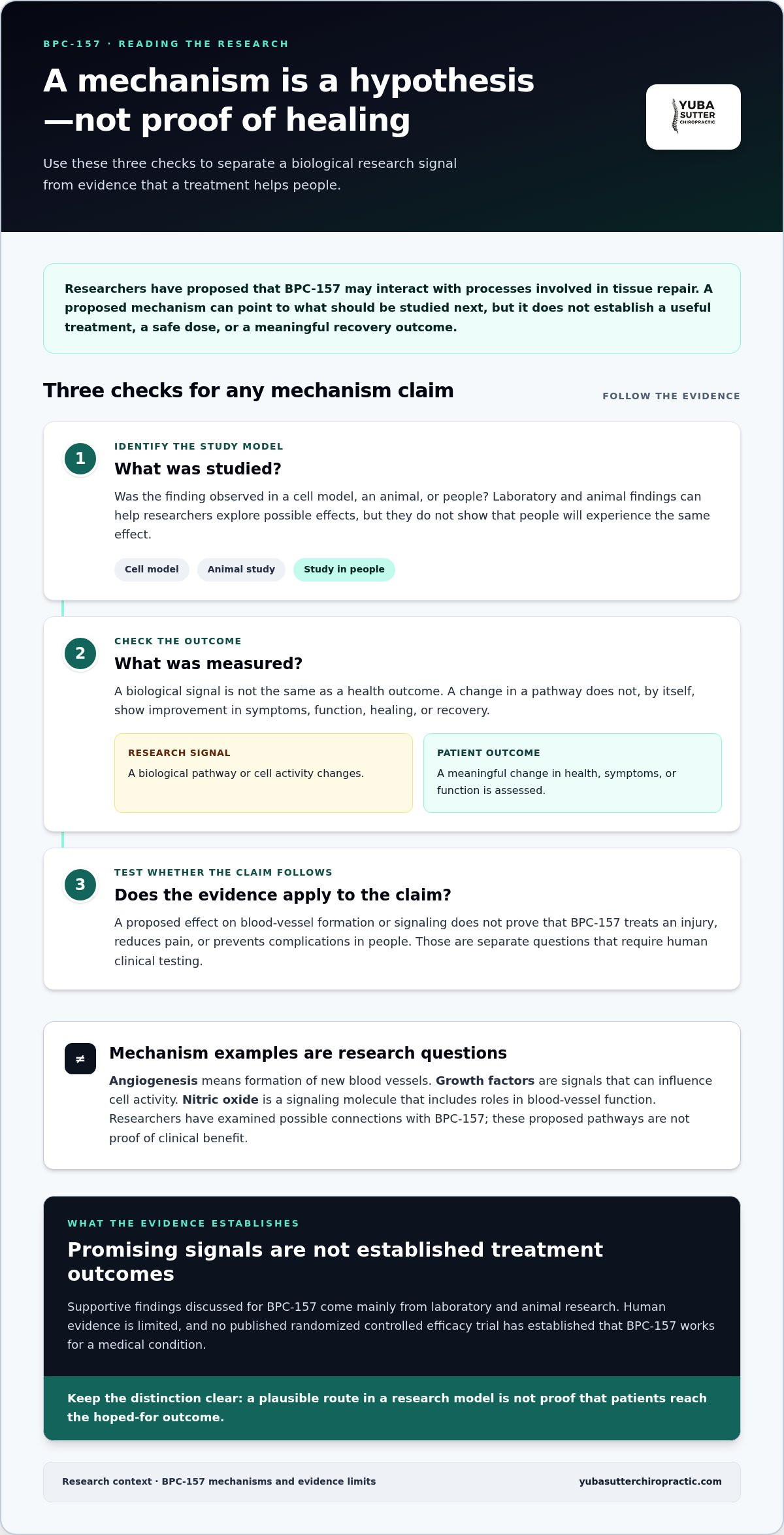
Researchers have proposed several ways BPC-157 might interact with processes involved in tissue repair. These ideas are called mechanisms: they describe how an effect could happen, not whether a treatment improves health in people. A laboratory finding can suggest which pathways to study, but it can’t establish a safe dose, a useful treatment, or a meaningful recovery outcome.
What are angiogenesis and growth-factor signaling?
Angiogenesis is the formation of new blood vessels. Researchers study it because blood vessels deliver oxygen and nutrients to tissues. Growth factors are signals that can influence cell activity, including processes related to tissue maintenance and repair. In BPC-157 research, possible effects on vascular or growth-factor pathways remain hypotheses, not evidence that the peptide speeds healing after an injury.
What role might nitric oxide play?
Nitric oxide is a signaling molecule with broad roles in the body, including helping regulate blood-vessel function. Researchers have examined possible interactions between BPC-157 and nitric-oxide signaling. That doesn’t demonstrate a direct, reliable effect in patients. Even if a pathway matters in a lab model, clinical studies must establish whether an intervention improves outcomes for people.
Think of a proposed mechanism as a map of a possible route, not proof that the destination is reached. For example, a study might suggest that a compound influences signals connected with blood-vessel formation. That observation alone cannot tell us whether a person with an injury would recover faster, experience less pain, or avoid complications. Those are separate questions that require human clinical testing.
When you encounter a mechanism claim, check what it actually supports:
- What was studied? A cell model, an animal, or people?
- What was measured? A biological signal or a health outcome such as function or symptom change?
- Does the evidence apply to the claim? A change in a pathway doesn’t automatically show that a condition can be treated.
This distinction matters when evaluating BPC-157 peptide benefits. Mechanism explanations can sound persuasive because they use familiar terms such as “blood flow” or “repair.” But a plausible explanation is not the same as demonstrated effectiveness. The FDA briefing document on BPC-157 discusses the agency’s assessment context and notes limits in available safety information. It is a regulatory document, not evidence that a proposed pathway produces a clinical benefit.
A proposed mechanism can explain what researchers want to test, but only human clinical evidence can show whether a treatment works for people. If you’re weighing peptide therapy alongside other health goals, a conversation with a clinician can help put mechanistic claims in perspective. Yuba Sutter Chiropractic & Wellness offers peptide therapies. Learn more about peptide therapy at Yuba Sutter Chiropractic & Wellness.
What does the evidence actually show about BPC-157 benefits?
The evidence needs to be read by category. Laboratory experiments, animal studies, and research involving people answer different questions. A result in one category can guide the next stage of investigation, but it can’t automatically be carried over to patient care. The comparison below shows what each type of evidence can help establish and where its limits remain.
Evidence type
What it can help answer
What it cannot establish alone
Laboratory studies
Whether BPC-157 affects cells or biological processes under controlled experimental conditions.
Whether the same effects occur in a whole person, improve symptoms, or are safe as a treatment.
Animal studies
How researchers might investigate biological activity and whether a question merits further study.
Whether people will respond similarly, or what outcomes or risks to expect in human care.
Human clinical research
Whether a treatment may affect measured outcomes in people under the conditions studied.
Broad effectiveness or long-term safety if the studies are small, limited in design, or not independently replicated.
What can animal and laboratory studies tell us?
These studies let researchers examine questions that would be difficult to answer initially in people. They can help identify biological activity, compare conditions, and shape later research. But experimental settings may not reflect human health, and animal biology, study methods, and measured outcomes can differ from clinical care. Findings shouldn’t be used to predict faster recovery or guide treatment decisions.
How much human research is available?
Human evidence remains limited. As of September 2026, ClinicalTrials.gov listed three interventional human studies of BPC-157, but no full, peer-reviewed randomized controlled efficacy trial had been published to establish that it works in people. A registered study signals that research is planned or underway; registration alone doesn’t show a positive result or prove effectiveness.
To evaluate a human study, look at its design, number of participants, health outcomes measured, and whether findings have been independently replicated. A study may offer useful early information without answering whether the results apply to other people, conditions, or longer-term use. If those answers aren’t available, uncertainty remains. This matters when online summaries present BPC-157 peptide benefits as settled facts without explaining the evidence behind them.
Preclinical results can guide research, but they cannot establish benefit or safety in humans. For now, the evidence supports continued investigation, not confident conclusions about clinical effectiveness. The next part is how to interpret safety information and regulatory status alongside these evidence limits.
What safety and regulatory questions should you consider?
Safety and regulatory status are part of evaluating any health claim, especially when human evidence is limited. BPC-157 is not an FDA-approved drug for any human medical use. The FDA’s briefing document discusses concerns about the available safety information, while regulatory discussions about compounding have changed during 2026. Approval, compounding eligibility, and research are distinct issues, so one shouldn’t be mistaken for another.
What does FDA status mean for BPC-157?
As of October 2026, BPC-157 has not received FDA approval for human medical use. On July 23, 2026, an FDA advisory committee voted 8-6, with one abstention, to recommend adding it to the 503A Bulks List. That recommendation is non-binding, and the FDA had not finalized the rulemaking process by October 2026. The FDA briefing document on BPC-157 provides background, but it predates these later developments.
That distinction matters. A committee recommendation about compounding is not FDA approval of a drug, and it does not establish that BPC-157 is effective or safe for a particular condition. An interim access policy was submitted for White House review in October 2026, with details not yet public. Because this area is changing, use current FDA information rather than relying on older posts or vendor descriptions.
What should readers know about safety claims?
Limited clinical research makes it difficult to characterize side effects, interactions, or long-term risks in people. A testimonial can’t reliably identify what caused an outcome, and a product label cannot independently verify purity, concentration, or safety. Products sold as “for research use only” aren’t evidence of a product intended or tested for human medical use. Don’t treat online claims as a substitute for clinical safety data.
If you’re weighing a health decision, bring your questions and relevant health information to a qualified healthcare professional. A useful discussion can cover your goals, other treatments or medicines, what is known and unknown about risks, and which established options apply to your situation. Avoid making decisions based on a claimed benefit alone, especially when the evidence and product details are uncertain.
Athletes should also consider sport rules separately from FDA status. The 2026 World Anti-Doping Agency Prohibited List includes BPC-157 under category S0, Non-Approved Substances, and prohibits it at all times, both in and out of competition. Check the current list and applicable sport guidance before relying on any summary.
Regulatory discussion or a research signal doesn’t establish that a substance is an approved, proven, or risk-free treatment. If you want to discuss peptide therapy in the context of your health goals, schedule a conversation about peptide therapy with Yuba Sutter Chiropractic & Wellness.
How can you discuss peptide therapy with a Yuba City clinician?
After reviewing what research can and can’t show, connect the information to your own health goals. A conversation with a clinician can help you discuss what matters to you, review relevant health information, and identify questions that still need clear answers. You don’t need to arrive with a decision made. It’s reasonable to use the appointment to understand the options and their limits.
What questions can help guide a clinical conversation?
Bring questions that invite a balanced discussion rather than a promise of results. Ask what evidence supports the approach for your specific goal, what remains uncertain, and what other care options may be appropriate. Discuss your health conditions and medications, possible risks, and how concerns or progress would be reviewed. Clear answers can help you make a more informed choice.
A little preparation can make the conversation more useful. Consider bringing or noting:
- Your current medications and supplements.
- Relevant health history, including ongoing conditions and past treatments.
- The health goal you want to address and what improvement would mean to you.
- Questions about evidence, uncertainties, possible risks, alternatives, and follow-up.
Be specific about your priorities. For example, if your interest relates to recovery after an injury, explain what activities or symptoms are affecting your daily life. That gives the clinician a clearer picture of your concern without assuming that BPC-157 peptide benefits are established for your situation. Ask how a proposed plan would account for your overall health and how you can raise concerns if your needs change.
How does peptide therapy fit into personalized wellness care?
Yuba Sutter Chiropractic & Wellness in Yuba City offers peptide therapies as part of a wider wellness practice. That offering doesn’t establish BPC-157-specific outcomes or mean one approach fits everyone. An informed discussion should consider your goals, health history, available evidence, and the uncertainties around a proposed therapy. Personalized care starts with understanding the person, not assuming a standard protocol will suit every situation.
As you explore peptide therapy in Yuba City, keep the discussion grounded in what is known and what still needs answers. Ask how a proposed approach relates to your goals, what alternatives may be considered, and what the next steps would involve. Take time to weigh the information, and don’t feel pressured to act on online claims or testimonials.
If peptide therapy is something you’re curious about, Yuba Sutter Chiropractic & Wellness welcomes a thoughtful conversation about your health goals and questions. The practice serves people in Yuba City, Marysville, Live Oak, Gridley, Sutter, Colusa, Plumas Lake, Olivehurst, and Wheatland. The aim is to help you consider the topic with care and context, not to promise a particular result.
Move Forward With a Clear, Personal Plan
Health decisions are easier to approach when your priorities lead the conversation, not the loudest claim online. If researching BPC-157 peptide benefits has raised questions, consider what you hope to address and what kind of evidence would help you weigh your options. You deserve space to make an informed choice without pressure.
A practical next step is to focus on care that fits your health history, goals, and values. In a personalized clinical setting, you can discuss your concerns and consider how peptide therapy may fit within your broader wellness care, while keeping expectations realistic.
Yuba Sutter Chiropractic & Wellness offers peptide therapies in Yuba City. Explore peptide therapy at Yuba Sutter Chiropractic & Wellness and start a thoughtful conversation about your health goals and questions.
Frequently Asked Questions
Can BPC-157 benefits be considered proven in humans?
No. The BPC-157 peptide benefits often described online haven’t been established as effective human treatments for injury recovery, digestive concerns, or other conditions. Laboratory and animal findings can help researchers decide what to test next, but they don’t show what patients will experience. If you’re weighing a health decision, bring the specific claim you’re considering to a qualified clinician and ask what human evidence supports it.
Is BPC-157 FDA approved for medical use?
No. As of October 2026, BPC-157 isn’t FDA-approved for any human medical use. In July 2026, an FDA advisory committee recommended, by an 8-6 vote with one abstention, that it be added to the 503A Bulks List. That recommendation is non-binding, and the FDA hadn’t finalized the rulemaking by October. Research status, compounding discussions, and drug approval are different things. Check current FDA notices for updates.
How much BPC-157 should someone take?
There’s no established, evidence-based general dose to recommend. A regimen shared online may not reflect reliable clinical evidence or account for someone’s health history, other medicines, or potential risks. This FAQ can’t provide dosing or injection instructions. If you’re considering a peptide-related treatment, discuss your circumstances with a qualified healthcare professional and ask what is known, what remains uncertain, and what other options may fit your health needs.
Can BPC-157 help heal tendon injuries?
It hasn’t been established as a treatment that heals tendon injuries in people. Tendon pain or weakness can arise for different reasons, so the right next step depends on the symptoms and how they affect movement. Don’t use an animal study or another person’s recovery story to decide how to manage an injury. Persistent pain, weakness, or a new injury deserves assessment by a qualified healthcare professional.
Can BPC-157 be taken orally, or is it injected?
Online discussions mention different forms and routes, but that doesn’t establish that any route is safe or effective for a particular person or condition. A label or anecdote also can’t show that a product has verified contents or quality. Don’t interpret online instructions as a treatment plan. If you have questions about a proposed therapy, discuss the evidence, uncertainties, and your personal health context with a qualified clinician.
How long does BPC-157 take to work?
There’s no reliable timeline for benefit in people. Individual stories can’t predict how another person will respond, and experimental findings don’t provide a dependable schedule for treatment. Be cautious of claims that promise a specific recovery window. If you’re monitoring a health concern, note changes in symptoms and daily function to share with a clinician, and seek guidance if symptoms persist or worsen rather than waiting for an advertised timeline.
Is BPC-157 allowed in competitive sports?
The 2026 World Anti-Doping Agency Prohibited List includes BPC-157 in category S0, Non-Approved Substances, and prohibits it at all times, in and out of competition. Rules can change, so athletes should consult the current list and their sport’s governing guidance before making decisions. If you compete in Yuba City, Marysville, Live Oak, Gridley, Sutter, Colusa, Plumas Lake, Olivehurst, or Wheatland, verify eligibility with the relevant authority.