

How Does the ReStora Chair Work? A Clear Guide
How does the ReStora chair work when you stay seated and fully clothed? The ReStora EMS Chair uses electrical muscle stimulation, or EMS, and is intended to support pelvic floor and core strengthening. The seated format means you don’t have to get down on a mat to use the chair, but it does not tell you exactly what a session will feel like or what results you will experience.
If you’re considering a chair-based service, it helps to separate what’s known about its purpose from what you may want to ask about your own care. This guide explains the general EMS concept, the ReStora chair’s stated use, and practical questions to bring to a conversation with the Yuba City team. The goal is to help you understand the basics and discuss how the service relates to your goals.
Key Takeaways
- Learn how does the ReStora chair work and how EMS relates to pelvic floor and core strengthening.
- Understand the chair’s intended purpose without assuming a particular result.
- The ReStora EMS Chair is used while fully clothed.
- Prepare practical questions about your goals and relevant health history.
- See how the chair can be discussed as part of an individualized approach to care.
How the ReStora Chair Works: Start With the Pelvic Floor
To understand the ReStora chair’s purpose, start with the pelvic floor and then distinguish the general idea of electrical muscle stimulation from the details confirmed about this particular service. That distinction makes it easier to understand what the chair is designed to support without assuming how any one person will respond.
What does the pelvic floor do?
The pelvic floor is a group of muscles and supporting tissues at the base of the pelvis. These muscles help support pelvic organs and contribute to functions such as bladder and bowel control. They also work with other muscles in the trunk as part of the body’s support system.
Thinking of the pelvic floor as a coordinated group of muscles makes the term less abstract. It is not a single muscle, and its role is connected to the rest of the body. The ReStora chair is intended to support pelvic floor and core strengthening. That general description does not diagnose the cause of someone’s symptoms or determine what care is appropriate for them.
What does EMS mean in this context?
EMS stands for electrical muscle stimulation, a broad term for using electrical signals to prompt muscle activity. The Electrical Muscle Stimulation (EMS) overview explains the general concept. It describes EMS as a category, not the precise technology, settings, or operation of a particular chair.
Keeping those points separate is useful. A general explanation of EMS can describe the relationship between stimulation and muscle activity, but it does not establish the specific mechanism or expected response for every device. The confirmed description of the ReStora EMS Chair is that it is used while fully clothed and is intended for pelvic floor and core strengthening.
The ReStora EMS Chair is designed to support pelvic floor and core strengthening while the user remains fully clothed.
This describes the chair’s stated purpose and format. It does not mean that everyone will experience the same sensation, muscle response, or change in function. If you have questions about what to expect, raise them with the care team as part of a conversation about your needs.
With the pelvic floor and EMS basics in mind, the next step is to consider what stimulation can mean in general while seated. The key is to understand the broad concept without assuming unconfirmed device details or treating the mechanism as a guarantee of results.
How EMS Stimulation Works While You Sit in the ReStora Chair
Once the pelvic floor’s role is clear, it helps to define “stimulation” in practical terms. EMS is a method of using electrical signals to prompt muscle activity. That describes the general concept, not the exact technology, settings, or response associated with every device.
From an electrical signal to muscle activity
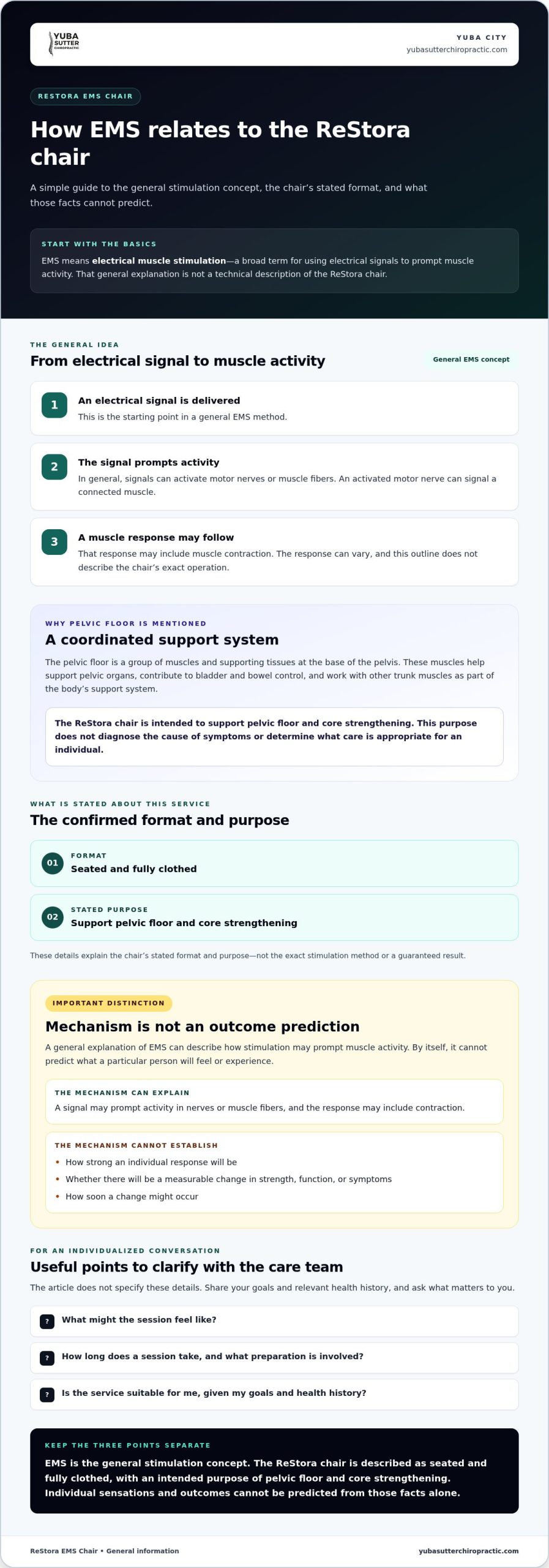
In general, electrical muscle stimulation uses signals that can activate motor nerves or muscle fibers. When a motor nerve is activated, it can signal a connected muscle to contract. The basic sequence is:
- An electrical signal is delivered as part of an EMS method.
- The signal prompts activity in targeted nerves or muscle fibers.
- The response may include muscle contraction.
This outline explains the general relationship between electrical stimulation and muscle activity. It is not a technical description of the ReStora chair. EMS is a broad category, and the chair’s exact signal type, delivery method, settings, and individual response are not described here.
That distinction matters when you’re weighing information about the service. A general explanation can describe how stimulation may prompt muscle activity, but it cannot tell you precisely what will happen during an individual session. The mechanism alone also does not establish a specific change in strength, function, or symptoms.
What the seated format does, and does not, tell you
The ReStora EMS Chair is a seated service used while fully clothed and intended to support pelvic floor and core strengthening. Those details explain its format and stated purpose. They do not specify how stimulation feels, how long a session takes, what preparation involves, or whether it is suitable for a particular person.
For example, knowing that a service is seated does not predict what sensations someone may notice or how their muscles will respond. It also does not replace a conversation about personal goals and relevant health history. If you’re considering the chair, describe what you hope to address and ask the team the questions that matter to you.
A useful way to frame how does the ReStora chair work is to keep three points separate: EMS is the general stimulation concept, the chair’s confirmed format is seated and fully clothed, and individual outcomes cannot be predicted from those facts alone. This gives you a practical starting point without turning an explanation of the mechanism into a promise.
To discuss how the chair relates to your goals, talk with the Yuba City team about ReStora EMS Chair care as part of an individualized care conversation.
ReStora EMS: What the Mechanism Can Explain, and What It Cannot
Understanding a possible mechanism can explain how stimulation is intended to prompt muscle activity. It cannot answer what will happen for a particular person. Keeping those questions separate helps you evaluate information about the ReStora EMS Chair without mistaking an explanation of the process for a prediction of results.
Mechanism versus outcome
In general, electrical muscle stimulation uses electrical signals to prompt activity in muscles or the nerves connected to them. This explains how stimulation may lead to a muscle response. It does not establish how strong that response will be for a particular person, whether it will lead to a measurable change, or how soon a change might occur.
The ReStora EMS Chair is a fully clothed, chair-based service intended for pelvic floor and core strengthening. This describes what it is designed to support. It does not establish that a particular person will experience a specific benefit, and it should not be interpreted as a claim that the chair treats incontinence, pain, or disease. A mechanism is one piece of information, not a forecast.
What EMS can explain
- Electrical stimulation is intended to prompt muscle activity.
- Muscle activity can include contraction.
- The ReStora chair’s stated purpose is pelvic floor and core strengthening.
What EMS cannot predict for an individual
- The size or timing of a personal response.
- Whether an individual will notice a change in function.
- Whether this approach fits someone’s goals or circumstances.
Use this distinction when reading claims about a stimulation-based service. Ask whether a statement describes the intended mechanism or predicts an outcome for an individual. Those are different kinds of claims and should not be treated as interchangeable.
Why treatment plans aren’t universal
Session schedules, preparation steps, and follow-up plans can differ between care settings. They should not automatically be treated as recommendations for you. The same applies to advertised outcomes: another provider’s statements do not determine what an individual should expect from care at Yuba Sutter Chiropractic.
Instead of relying on a schedule from another source, bring practical questions to your care conversation. Ask what the ReStora chair is intended to support, how the team considers your goals, and what health-history information would help guide the discussion. This keeps the focus on your circumstances rather than a plan designed for someone else.
In short, how does the ReStora chair work is a question about the service and its intended muscle-strengthening purpose. What that may mean for you is a separate question to consider with the care team. Understanding the difference helps you stay informed without assuming a particular result.
What to Consider Before Discussing the ReStora EMS Chair
A useful care conversation starts with your goals, not an assumption about what a device should achieve. You do not need to arrive with technical language or a complete explanation. A few notes about what you hope to address, relevant health history, and questions you want answered can help the Yuba City team understand what matters to you.
Questions to bring to a care conversation
Write down what you want to understand before speaking with the team. For example, ask how the ReStora EMS Chair relates to the goals you’ve described, how it may fit into a broader care discussion, and what the process involves. These prompts can guide a conversation without assuming a specific session or treatment plan.
- What pelvic floor or core-strengthening goals would I like to discuss?
- How might the chair fit alongside the rest of my care plan?
- What should I expect from the process, and what details will be explained before care?
- What parts of my health history or current concerns would be useful to share?
- What questions or reservations do I want the team to address?
Share relevant health history openly, including details you think may affect your goals or your comfort discussing care. You do not need to decide on your own whether a detail matters. The care team can help guide the conversation in the context of your circumstances.
Set clear expectations without assuming an outcome
Knowing the general mechanism behind EMS does not predict how a particular person will experience the service or what results they may have. Suitability, expectations, and care decisions are individual. A clear discussion can help you understand the chair’s intended purpose and how the team considers your goals, without turning an explanation of stimulation into a promise.
Care approaches can differ because they address different goals and use different methods. For broader context on the clinic’s technology-focused approach, explore its advanced chiropractic technology overview. This can help you frame questions, but it does not determine whether a particular option fits your circumstances.
Regular chiropractic adjustments are a different care approach from the ReStora EMS Chair. They should not be treated as interchangeable. Discuss your specific goals with the team to understand how different care options relate to them.
If you’re asking, “how does the ReStora chair work, and could it fit my goals?”, bring that question to the care conversation. Discuss the ReStora EMS Chair with the Yuba City care team and share what you’d like to understand before making decisions about care.
Explore the ReStora EMS Chair at Yuba Sutter Chiropractic
Yuba Sutter Chiropractic & Wellness offers the ReStora EMS Chair for pelvic floor and core strengthening while fully clothed. It is one option within the clinic’s approach to care, where conversations begin with your goals rather than an assumed result.
Understanding how does the ReStora chair work can help you ask more focused questions, but it cannot determine whether the chair suits your circumstances. The team can discuss its intended purpose, listen to what you hope to address, and help you understand how it may fit into a broader conversation about your healthcare goals.
A local conversation about your goals
You don’t need to arrive with every detail figured out. Start by describing what you’d like to work toward and what you want to understand about the chair. Bring questions about the general process or how the service relates to your goals. Sharing relevant health history can also help make the conversation more useful to you.
It’s reasonable to want clear information before considering a care option. The Yuba City team is there to help patients work toward their healthcare goals. A discussion is an opportunity to learn more and raise concerns, not a promise that a particular outcome will follow.
A simple next step in Yuba City
Yuba Sutter Chiropractic & Wellness is located at 437 Century Park Dr Ste A, Yuba City, CA 95991. If you’d like to explore the ReStora EMS Chair, talk with the Yuba City team about its purpose, your goals, and the information you need to make an informed decision.
Use this guide as a starting point for understanding the chair, not as a substitute for individualized care. Your circumstances and questions deserve a direct conversation with the care team.
Take the Next Step With Confidence
Your next step does not have to be a decision about care. It can simply be a chance to share what you hope to understand and hear how the ReStora EMS Chair may fit into a discussion of your healthcare goals. Keep the focus on your priorities, not assumptions about what a device will do.
If you’re still wondering how does the ReStora chair work, bring that question, along with any concerns or relevant health history, to the conversation. The Yuba City team is there to help you explore your options and work toward your goals with supportive, individualized care.
Talk with our Yuba City team about the ReStora EMS Chair when you’re ready to take the next step.
Frequently Asked Questions
How does the ReStora chair work?
The ReStora EMS Chair uses electrical muscle stimulation and is intended to support pelvic floor and core strengthening. EMS is a general term for using electrical stimulation to prompt muscle activity. That explanation does not specify the chair’s exact technical settings or predict an individual response. To understand how the service relates to your needs, discuss your goals with the Yuba City care team.
What does EMS mean in a pelvic floor chair?
EMS means electrical muscle stimulation. In general, it refers to using electrical signals to prompt muscle activity. The term alone does not specify a device’s design or how it will feel to a particular person. The ReStora EMS Chair is intended to support pelvic floor and core strengthening, and the care team can discuss its purpose in relation to your questions.
Do you stay clothed in the ReStora chair?
Yes. The ReStora EMS Chair is used while fully clothed. If you have questions about privacy or what the visit involves, raise them with the care team before care so you understand the format.
Can the ReStora chair replace pelvic floor exercises?
The chair is intended to support pelvic floor and core strengthening, but that purpose alone does not establish whether it should replace exercises or other parts of your routine. If you already follow exercise guidance, share that with the care team and ask how the chair may fit with your personal goals before changing your routine.
Does the ReStora chair guarantee improvement?
No specific improvement is guaranteed. A device’s intended purpose or general mechanism cannot predict the size, timing, or likelihood of an individual result. Discuss your goals with the care team and ask what the chair is designed to support without assuming a particular outcome.
Where can I learn about the ReStora EMS Chair in Yuba City?
Talk with Yuba Sutter Chiropractic in Yuba City. The clinic is located at 437 Century Park Dr Ste A, Yuba City, CA 95991. Patients from nearby Marysville, Live Oak, Gridley, Sutter, Colusa, Plumas Lake, Olivehurst, and Wheatland can use the clinic’s website to learn more and raise questions about the chair.