

Non-Invasive Bladder Control Treatment Near Live Oak: Options and Next Steps
What if the first step toward better bladder control isn’t choosing a device, but understanding your symptoms? Leakage or sudden urgency can interrupt work, errands, and time with family. It’s understandable if bringing it up feels awkward. Searching for non-invasive bladder control treatment Live Oak options can also bring up claims that are difficult to compare.
You deserve clear information and a conversation that starts with your needs. This article explains common approaches, including bladder training, fluid-management strategies, and pelvic floor exercises. It also offers practical questions to discuss with a healthcare professional, such as what might contribute to your symptoms and which options may suit your situation.
Pelvic floor strengthening may be one part of a broader plan, but it isn’t a guaranteed fix for every cause of leakage or urgency. Yuba Sutter Chiropractic & Wellness serves the Live Oak area from its Yuba City location and offers the ReStora EMS Chair for pelvic floor and core strengthening. Read on to learn about the service and how to approach bladder care with realistic expectations.
Key Takeaways
- Noting when leakage or urgency happens can help you describe your symptoms and discuss possible patterns with a healthcare professional.
- Bladder training, lifestyle adjustments, pelvic floor rehabilitation, and device-based services are distinct approaches, not one universal solution.
- For non-invasive bladder control treatment Live Oak options, compare each approach by its purpose and the questions you want answered, not by unsupported promises.
- Bring a brief symptom record, your goals, questions, and relevant health history to your appointment to support a focused discussion.
- Live Oak-area residents can learn how Yuba Sutter Chiropractic & Wellness’s fully clothed ReStora EMS Chair pelvic floor and core strengthening service may fit into their next steps.
Non-invasive bladder control treatment near Live Oak: start with the symptom
Bladder control problems can involve urine leaks you didn’t intend or urgency that makes it difficult to reach a bathroom in time. These experiences can affect errands, exercise, work, and sleep. They’re worth discussing with a healthcare professional, even if they feel uncomfortable to bring up. Describing what happens is a useful first step; you don’t need to identify the cause yourself.
What symptoms might prompt a bladder control conversation?
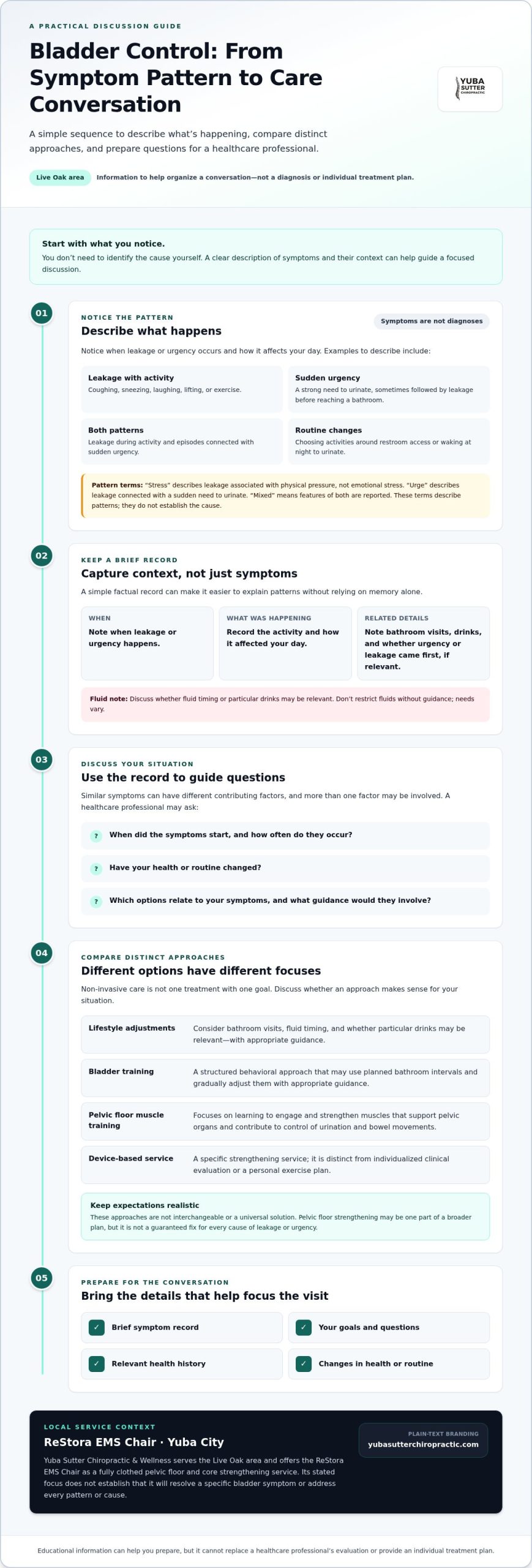
Notice the circumstances around leakage or urgency. These examples can help you explain what you’re experiencing:
- Leakage during coughing, sneezing, laughing, lifting, or exercise.
- A sudden, strong need to urinate, sometimes followed by leakage before reaching a bathroom.
- Both leakage during activity and episodes tied to sudden urgency.
- Changes in routine, such as choosing activities based on restroom access or waking at night to urinate.
These are descriptions, not diagnoses. Keep a simple record of when symptoms occur, what you were doing, and how they affect your day. Note whether urgency or leakage came first, if that seems relevant. A brief, factual record can make it easier to explain patterns during an appointment without relying on memory alone.
Why identifying the pattern matters
Healthcare professionals may use terms such as stress, urge, and mixed incontinence to describe different symptom patterns. “Stress” refers to leakage associated with physical pressure, such as coughing or exercise, not emotional stress. “Urge” describes leakage connected with a sudden need to urinate. “Mixed” means a person reports features of both. These labels help guide questions and evaluation, but a symptom description by itself can’t establish the cause.
Bladder control options depend on symptoms and individual evaluation. Similar experiences can have different contributing factors, and more than one factor may be involved. A healthcare professional may ask when symptoms started, how often they occur, and whether your health or routine has changed. This context can help shape a discussion about next steps rather than assuming one approach fits everyone.
For general background, Bladder training describes a behavioral approach involving planned bathroom intervals. Whether it belongs in someone’s care plan is a personal question to discuss with a healthcare professional. Educational information can help you prepare, but it can’t replace an evaluation or provide an individual treatment plan.
If you’re exploring non-invasive bladder control treatment Live Oak residents can access nearby, Yuba Sutter Chiropractic & Wellness is located in Yuba City and serves Live Oak. Its ReStora EMS Chair is a fully clothed pelvic floor and core strengthening service. It’s one local pelvic floor care option to consider as you discuss your symptoms and goals with an appropriate healthcare professional. Don’t assume it addresses every pattern or cause of bladder symptoms.
How non-invasive bladder control approaches work
Non-invasive care isn’t one treatment with one goal. It can include everyday habit adjustments, structured bladder training, pelvic floor muscle work, or a device-based strengthening service. These approaches differ in their focus and in the professional guidance involved. A healthcare professional can help you understand which options relate to your symptoms and how they may fit into an individualized plan.
Lifestyle and bladder training approaches
Along with noting bathroom visits and urgency, track what you drink and when symptoms happen. This can help you discuss whether fluid timing or particular drinks may be relevant. Don’t restrict fluids without guidance; needs vary, and self-care steps shouldn’t replace evaluation when symptoms persist or affect daily life.
Bladder training is a structured behavioral approach that may involve following planned bathroom intervals and gradually adjusting them with appropriate guidance. The Treatments for Bladder Control Problems overview from the National Institute of Diabetes and Digestive and Kidney Diseases describes behavioral and lifestyle approaches among the options for bladder control concerns. Discuss whether a structured plan makes sense for you instead of forcing longer intervals on your own.
Pelvic floor strengthening and device-based services
The pelvic floor is a group of muscles and tissues that supports pelvic organs and contributes to control of urination and bowel movements. Pelvic floor muscle training focuses on learning to engage and strengthen those muscles. The right technique and approach can depend on the person, so ask a healthcare professional whether this type of training is appropriate and how it should be guided.
A pelvic floor strengthening service is not interchangeable with every bladder treatment. It has a particular focus, while bladder training and lifestyle adjustments address different aspects of daily habits and bathroom patterns. A device-based service is also distinct from individualized clinical evaluation or a personal exercise plan.
Yuba Sutter Chiropractic & Wellness offers the ReStora EMS Chair as a fully clothed pelvic floor and core strengthening service. This describes the service’s focus; it doesn’t establish that it will resolve a specific bladder symptom. If you’re considering non-invasive bladder control treatment Live Oak options, bring your goals and symptom questions into the conversation to understand how pelvic floor strengthening may fit alongside other approaches.
For Live Oak-area residents, Yuba City is a nearby place to learn about pelvic floor and core strengthening. You can learn about pelvic floor care and consider what questions you’d like to raise before deciding on next steps.
Comparing non-invasive bladder control options and setting expectations
Compare options by what each approach is intended to address, what guidance may be involved, and what you want to learn before taking a next step. The table is a starting point for discussion, not a ranking or a personal recommendation.
| Approach | General focus | Professional involvement and useful question |
|---|---|---|
| Lifestyle changes | Reviewing daily habits, such as fluid timing, in relation to symptoms. | Discuss changes with a healthcare professional. Ask, “Could any of my habits be relevant to my symptoms?” |
| Bladder training | Using a structured approach to bathroom timing. | Ask whether it suits your symptom pattern and how guidance or progress would be handled. |
| Pelvic floor rehabilitation | Working with pelvic floor muscles through individualized instruction and practice. | Ask what the plan focuses on and how it will be adapted to your needs and goals. |
| Device-based services | A service may focus on pelvic floor or core strengthening, depending on the device and offering. | Ask what the specific service is intended to support and how it fits with your broader care discussion. |
Questions that help distinguish treatment approaches
Bring your symptom pattern, relevant health history, and personal goals into the conversation. Useful questions include: What is this approach intended to support? How will we discuss progress? What would be a reasonable next step if my concerns continue? Clear answers can help you understand an option’s purpose and limits without relying on broad claims that one approach is superior.
Device names and descriptions matter. BTL Emsella is a separate branded device, and claims made about it shouldn’t be assumed to describe another service. Yuba Sutter Chiropractic & Wellness describes its ReStora EMS Chair as a fully clothed pelvic floor and core strengthening service. That information doesn’t establish a bladder-control outcome or mean the service is interchangeable with other treatments.
What to expect from a realistic treatment discussion
No single non-invasive approach is right for every bladder control concern. A useful discussion connects your symptoms and goals to the purpose of each option, then considers whether it belongs in your next steps. Individual experiences and responses can differ, so an article can’t predict your outcome or replace professional advice. If you’re considering non-invasive bladder control treatment Live Oak residents can access, use this comparison to prepare focused questions and support an individualized conversation.
Preparing for a bladder control appointment near Live Oak
A little preparation can make a conversation about bladder symptoms feel more manageable. You don’t need to arrive with a diagnosis or a perfect record. A few notes about what you’ve noticed, what matters most to you, and what you’d like to ask can help a healthcare professional understand your concerns and discuss next steps.
What information can help guide the conversation?
Before your appointment, jot down when symptoms happen and how they affect your day. Note whether leakage occurs during a particular activity, urgency interrupts errands, or symptoms affect sleep or exercise. Include changes you’ve noticed and questions that come up. If you’ve had an evaluation or tried an approach before, share that context with the appropriate professional.
Use this simple sequence to organize your notes:
- Record symptoms: Note what happens, when it happens, and how it changes your routines.
- Name your goals: Describe what you’d like to do more comfortably, such as taking a walk or getting through a workday with less disruption.
- Prepare questions: Ask what might help clarify your symptoms, what an option is intended to support, and how follow-up will be discussed.
Share relevant health history, including prior evaluations, care, or changes you think may relate to your symptoms. You can also ask about daily habits, fluid intake, or pelvic floor strengthening. General online information can help you prepare, but it can’t determine the cause of your symptoms or tell you which approach fits your circumstances.
How to discuss goals and follow-up
Make your goals specific to everyday life. For example, explain that you want to feel more comfortable during exercise or plan outings with less concern about restroom access. Ask how you and the professional will review progress, what changes to watch for, and how next steps will be decided. The discussion should account for your symptoms, history, and priorities.
Consider arranging a medical evaluation if bladder symptoms persist, recur, or interfere with activities you value. An evaluation can help put the pattern in context and guide a discussion about possible next steps. Don’t rely on an online article alone to make a diagnosis or treatment decision. If you’re considering non-invasive bladder control treatment Live Oak residents can access nearby, keep the roles clear: discuss symptoms and medical questions with an appropriate healthcare professional, and use a pelvic floor service conversation to clarify its focus and how it relates to your goals.
Yuba Sutter Chiropractic & Wellness is located in Yuba City and serves nearby Live Oak. Its ReStora EMS Chair is a fully clothed pelvic floor and core strengthening service. Discuss your pelvic floor strengthening goals with the clinic as one practical local next step.
Pelvic floor strengthening in Yuba City for Live Oak-area residents
For Live Oak residents exploring pelvic floor care nearby, Yuba Sutter Chiropractic & Wellness is located in Yuba City and serves Live Oak and other nearby communities. The clinic offers the ReStora EMS Chair as a fully clothed pelvic floor and core strengthening service. Learn about its focus as you consider your goals and discuss bladder symptoms with an appropriate healthcare professional.
What the ReStora EMS Chair service is
The ReStora EMS Chair service focuses on pelvic floor and core strengthening while you remain fully clothed. This explains the service’s stated focus. It doesn’t establish that the service treats or cures urinary incontinence, predict an individual result, or replace a healthcare professional’s evaluation of bladder symptoms.
A helpful conversation can start with what you hope to work toward, such as learning about pelvic floor strengthening as part of your broader wellness goals. You can also describe the concerns that led you to explore care. Sharing that context keeps the discussion centered on your priorities without assuming one service is suitable for every person or every bladder concern.
Finding local care from Live Oak
The Yuba City clinic is located at 437 Century Park Dr Ste A, Yuba City, CA 95991. Live Oak is among the nearby communities it serves. If you’re comparing options for non-invasive bladder control treatment Live Oak, this local pelvic floor and core strengthening service offers a nearby place to learn about the service and discuss your goals.
Before reaching out, prepare a brief description of what you’d like to understand. You might ask about the service’s pelvic floor and core strengthening focus, explain why you’re exploring pelvic floor care, or share what you hope to discuss next. For medical questions about leakage or urgency, keep an appropriate healthcare professional involved; a service conversation isn’t a substitute for individualized medical advice.
You can call (530) 441-2225 or Contact Yuba Sutter Chiropractic & Wellness to discuss the ReStora EMS Chair and your pelvic floor strengthening goals. The clinic serves people in Yuba City, Marysville, Live Oak, Gridley, Sutter, Colusa, Plumas Lake, Olivehurst, and Wheatland. Take the next step with clear questions and realistic expectations. Website information is provided as is and may change without notice.
Take a thoughtful next step toward pelvic floor care
You don’t need to have every answer before starting a conversation. A clear sense of what you want to understand can help you move forward, whether you’re exploring pelvic floor strengthening or preparing questions for a healthcare professional. Keep your expectations grounded in your symptoms and circumstances, and give yourself room to consider which options make sense for you.
If you’re exploring non-invasive bladder control treatment Live Oak, Yuba Sutter Chiropractic & Wellness offers its ReStora EMS Chair service for pelvic floor and core strengthening. A conversation about your goals can help you understand the service’s focus without assuming a particular result.
Contact Yuba Sutter Chiropractic & Wellness to discuss your pelvic floor strengthening goals. Start with your questions and take the next step at a pace that feels right for you.
Frequently Asked Questions
Can bladder control problems affect people of different ages?
Yes, bladder control concerns can occur at different ages, though possible contributing factors vary. Pregnancy, childbirth, aging, prostate-related care, medications, or other health changes may be relevant for some people. Age alone can’t explain a symptom, and leakage isn’t something you have to dismiss as an inevitable part of getting older. If symptoms began after a health change or a new medication, note the timing and discuss it with a healthcare professional.
Is urinary leakage always caused by weak pelvic floor muscles?
No, pelvic floor weakness is only one possible contributor to urinary leakage. Bladder function, health conditions, medications, and other factors may also be involved, so the symptom alone can’t identify its cause. For example, someone who leaks during activity and someone who experiences sudden urgency may need different questions explored. A healthcare professional can consider your health history and symptoms before discussing which options may be appropriate.
Can men experience bladder control problems?
Yes, men can experience urgency, frequent urination, or leakage. These symptoms can occur in different circumstances, including after prostate-related care, but they don’t point to one cause by themselves. Note whether the change is new, whether it happens at certain times, and whether you’ve also noticed changes in your urinary stream. Sharing these details with a healthcare professional can help guide a more relevant discussion.
How long does non-invasive bladder control treatment take to work?
There’s no single timeline that applies to every non-invasive approach or person. The type of care, the concern being addressed, and individual circumstances all matter, so it wouldn’t be reliable to promise a specific time to see a change. Before beginning an approach, ask how you’ll review progress, what changes are useful to track, and when you’ll discuss whether the plan still fits your needs.
Should I limit fluids to reduce bladder leakage?
Don’t sharply reduce your fluid intake on your own to try to prevent leakage. Your fluid needs depend on personal health circumstances, and restricting fluids isn’t a substitute for understanding the symptoms. Instead, note what you drink and when urgency or leakage occurs, then ask a healthcare professional whether timing or particular drinks may be relevant for you. This gives the conversation useful context without making a drastic change first.
When should I talk with a healthcare professional about bladder control?
Arrange a discussion if symptoms persist, return, interfere with activities, or leave you unsure about what’s happening. Seek prompt medical advice for blood in your urine or difficulty urinating. For people in Yuba City, Marysville, Live Oak, Gridley, Sutter, Colusa, Plumas Lake, Olivehurst, and Wheatland, non-invasive bladder control treatment Live Oak searches can be a starting point for finding local information, but online content can’t assess your individual health.