

MLS Laser Therapy Side Effects: What to Expect & When to Ask
What should you expect from MLS laser therapy, and what should you do if something feels uncomfortable? It’s understandable to wonder whether treatment might cause discomfort or make symptoms worse. Questions about MLS laser therapy side effects deserve clear answers, not blanket reassurance.
Some people may notice temporary warmth, redness, or tingling in the treated area. A short-lived increase in soreness can also occur. Your response may depend on your health history, current symptoms, and the area being treated. Knowing what to report before, during, and after a session can help you have a more useful conversation with your care team.
This guide covers possible short-term effects, factors to discuss before treatment, and practical ways to describe a reaction. At Yuba Sutter Chiropractic & Wellness in Yuba City, MLS laser therapy is part of a broader conversation about care tailored to you. Patients from Yuba City, Marysville, Live Oak, Gridley, Sutter, Colusa, Plumas Lake, Olivehurst, and Wheatland can bring their questions to the care team and make an informed decision.
Key Takeaways
- MLS laser therapy side effects should be considered in the context of this specific therapeutic approach, not assumed from information about surgical lasers.
- Multiwave Locked System (MLS) describes a therapeutic use of light that differs from lasers designed to cut or remove tissue.
- Share relevant health history, medications, and current symptoms so your care team can discuss whether treatment suits your situation.
- Speak up if you feel discomfort during a session, and note how you feel afterward.
- Yuba Sutter Chiropractic & Wellness offers MLS laser therapy in Yuba City, where questions about treatment can be discussed as part of personalized care.
MLS Laser Therapy Side Effects: What Patients May Want to Know
It’s reasonable to ask about safety before trying a treatment, especially when you’re already dealing with pain or sensitivity. “Laser therapy” covers different technologies and uses, so information about one procedure may not apply to another. Discuss MLS laser therapy side effects in the context of the specific treatment and your health history instead of relying on general claims about lasers.
MLS therapy uses the Multiwave Locked System to apply therapeutic light without cutting or removing tissue. That distinction can help set expectations, but it doesn’t mean every person will have the same experience or that therapeutic lasers share identical risks.
What does MLS mean in laser therapy?
MLS stands for Multiwave Locked System, a therapeutic laser approach that coordinates light waves for treatment. It’s used differently from surgical lasers, which are designed to cut, reshape, or remove tissue. With MLS, light is applied to a treatment area as a non-surgical therapy. Precautions and effects depend on the device and how it’s used, so details about other laser procedures shouldn’t automatically be applied to MLS.
For a broader introduction to low-level laser therapy, see this Low-level laser therapy (LLLT) overview. It provides general context, not MLS-specific guidance or an assessment of your circumstances.
What kinds of side effects should patients ask about?
Reported short-term responses to MLS treatment can include warmth, redness, or mild tingling in the treated area. Some people may also notice temporary soreness or a brief increase in discomfort. These responses aren’t guaranteed, and their presence or absence doesn’t by itself show what the treatment is doing. Your starting symptoms, the area treated, and your individual response all matter.
Before a session, ask what sensations may occur and how to speak up if something feels uncomfortable. During treatment, mention a concern as soon as you notice it rather than waiting until the session ends. Afterward, note what you feel, when it began, and whether it changes. A brief, specific description can help your care team understand your response.
- Temporary sensations: Ask whether warmth, redness, tingling, or soreness could be relevant to your planned treatment.
- Unexpected changes: Describe new, unusual, worsening, or persistent symptoms to your care team for individualized guidance.
A general side-effect list can’t predict how you’ll respond. If a symptom concerns you or doesn’t settle as expected, share the details with your care team instead of assuming it’s a routine reaction. Questions before and after treatment help keep the discussion focused on your needs.
How MLS Laser Therapy Works, and Why Laser Risks Differ
Understanding how the treatment is intended to work can put safety questions in perspective. MLS laser therapy directs light at a selected area. Its proposed biological action is often described as photobiomodulation: light energy may influence activity within cells. This proposed mechanism helps explain the therapy’s rationale, but it doesn’t prove a particular outcome or predict how you’ll feel.
MLS is a non-surgical therapeutic use of light, distinct from laser procedures designed to cut, reshape, or remove tissue. That difference matters, but it isn’t a guarantee of no side effects. Risks depend on the device and how it’s used, not simply on the word “laser.”
What happens during therapeutic light treatment?
A practitioner directs light toward a chosen area according to the treatment plan. MLS is described as synchronizing continuous and pulsed light wavelengths, including 808-nanometer and 905-nanometer wavelengths. These technical details describe the system’s light delivery. They don’t establish that a particular person will experience a specific sensation, cellular change, or clinical result.
Photobiomodulation is a proposed cellular response to light, not proof that healing or symptom relief will occur. A proposed mechanism also can’t tell you whether treatment will feel warm, neutral, or uncomfortable. Your experience needs to be considered separately from explanations of how the therapy may work.
Why general laser-complication studies need context
“Laser treatment” can refer to very different applications. Cosmetic procedures may target skin, dental lasers may interact with oral tissues, and surgical lasers may cut or remove tissue. Therapeutic MLS treatment has a different purpose. Findings from one category shouldn’t automatically be treated as evidence of MLS laser therapy side effects because the device, settings, treatment area, and clinical goal may differ.
When you encounter a broad claim about laser risks, consider which type of laser and use it describes. A complication linked to tissue removal, for example, doesn’t by itself establish the same risk for a non-surgical therapeutic application. Broad descriptions of low-level laser therapy also shouldn’t be treated as MLS-specific proof. Device-specific information should be considered alongside the particular treatment plan.
- Device: Laser systems may differ in design and light delivery.
- Settings and area: Treatment parameters and the body area can affect how a session is planned.
- Purpose: A therapeutic application and a procedure intended to alter tissue aren’t interchangeable.
The OSHA Laser Safety Standards address laser hazards in occupational settings. They offer safety context, but they aren’t a guide to MLS treatment outcomes or a substitute for device-specific clinical information.
At Yuba Sutter Chiropractic & Wellness, a discussion of MLS laser therapy care in Yuba City can connect general information to your treatment goals and health history. That keeps the conversation focused on the specific therapy rather than assumptions drawn from unrelated laser procedures.
Who Should Discuss MLS Laser Therapy Suitability Before Treatment?
Suitability is a personal clinical discussion, not a universal checklist. Your reason for considering MLS laser therapy, the area being treated, your health history, and your current symptoms all help shape that conversation. Share relevant details before a session, even if you feel generally well, so your care team can consider the treatment in the context of your needs.
This is especially useful if your symptoms have changed, you’re managing a health condition, or you’ve had an unexpected response to another treatment. These details don’t automatically rule MLS therapy in or out. They give your care team a clearer picture and help focus the discussion. A broader look at advanced chiropractic technology can also help put MLS therapy into the context of a personalized care plan.
Which personal details are useful to share?
Describe your symptoms in practical terms: where they occur, how they feel, and whether they’ve recently changed. Mention relevant diagnoses, medications and supplements, previous treatments, and any reactions you’ve had during or after care. If you’re unsure whether a detail matters, bring it up so your care team can consider its relevance.
Keep the conversation current. A new medication, a recent change in symptoms, or a new health concern may be relevant even if you’ve discussed your history before. You don’t need to decide for yourself whether a condition or medication is a contraindication. Share the information and ask how it applies to your planned treatment. This is more useful than relying on a generic online list that may describe a different laser, device, or clinical use.
How should patients think about FDA clearance?
Yuba Sutter Chiropractic & Wellness describes its MLS laser therapy as FDA-cleared. Clearance applies to a specific device and its stated indications. It doesn’t mean treatment is risk-free, guarantee results, or establish that every use of a device is covered. The exact clearance language matters, so claims about cleared uses should stay within the device’s applicable documentation.
For your decision, separate three questions: what the device is cleared for, why MLS therapy is being considered in your case, and what individual factors may affect the plan. These questions can be discussed together without assuming that clearance alone predicts safety or benefit for every person.
Sharing your history isn’t a test you need to pass. It’s part of collaborative care. Bring a written list of medications, diagnoses, and questions if that makes the conversation easier. You might ask what the planned treatment is intended to address, which details from your history are relevant, and what changes should prompt you to speak up. Clear answers can help you understand the rationale and make an informed choice about MLS therapy.
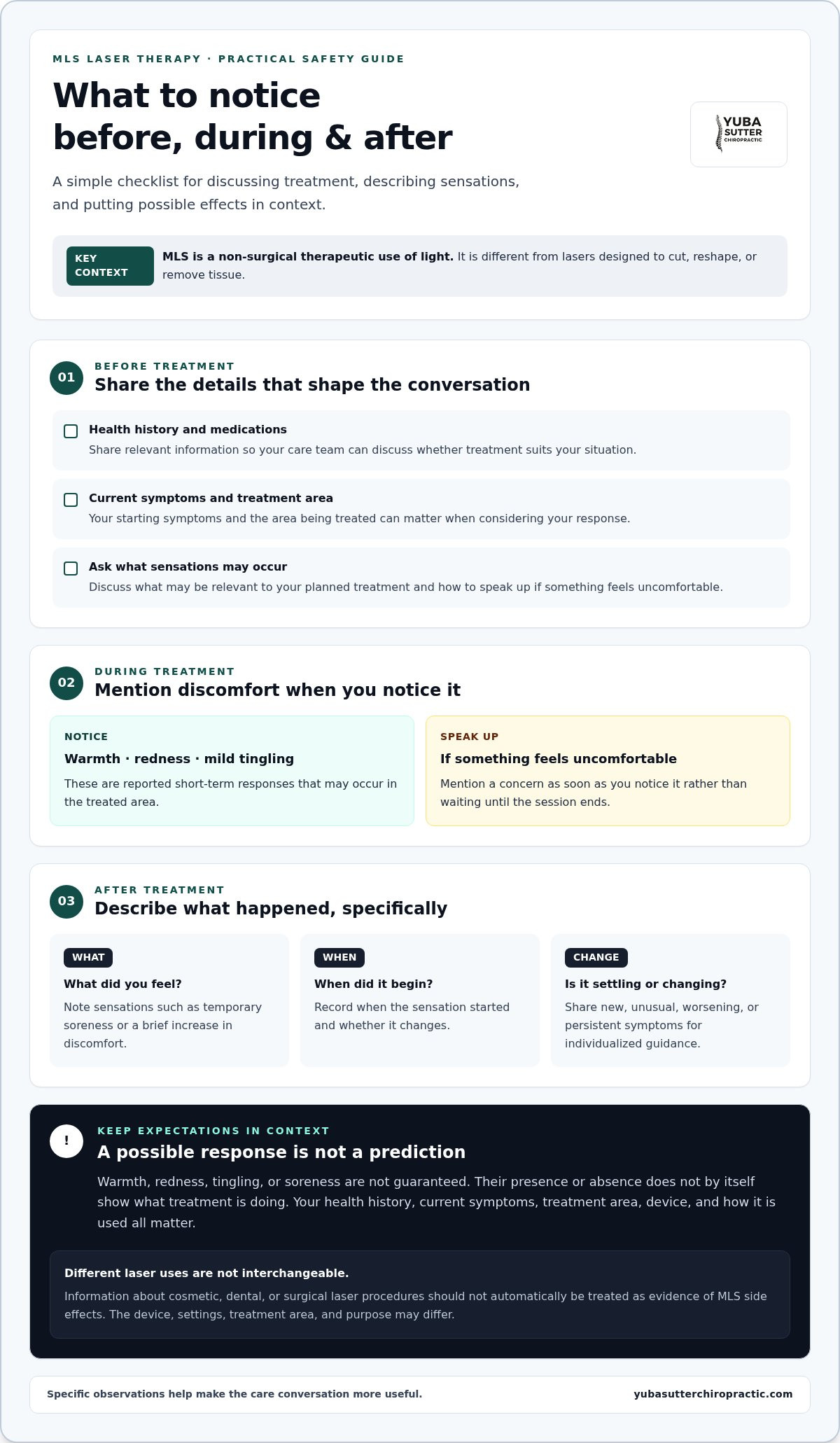
Before, During, and After MLS Laser Therapy: A Practical Safety Guide
A simple plan can make it easier to raise concerns and describe your experience clearly. Treat the session as a conversation before, during, and after treatment. You don’t need to predict how you’ll respond. Focus on sharing useful information and speaking up if something feels unexpected.
Before your session: Share and clarify
Tell your care team about relevant health conditions, medications and supplements, current symptoms, and previous treatment reactions. Explain what you hope the treatment will address and whether anything has recently changed. These details help your clinician consider the plan in the context of your health history.
Ask what sensations may occur during treatment and how to flag a concern. You can also ask how the planned treatment area relates to your care plan. A clear explanation should address your situation, not just laser therapy in general. If you’re unsure whether a detail matters, share it and let your care team help assess its relevance.
During treatment: Speak up promptly
Pay attention to how the treated area feels. If you notice discomfort or a sensation you weren’t expecting, tell the clinician promptly rather than silently continuing the session. You don’t need to wait until you’re certain something is wrong. Describing what you feel gives the care team a chance to respond and decide what to do next.
Use plain, specific language: “This feels different from what I expected,” or “The discomfort is increasing.” You don’t need to find the perfect medical term. Your description is useful information, and speaking up is part of making the session responsive to you.
After treatment: Notice and report changes
Notice how you feel after the session without assuming every change is caused by treatment. If you notice a reaction, make a brief note of what it feels like, where it occurs, when it began, and whether it changes. For example, describe warmth or soreness in the treated area and whether it eases, stays the same, or worsens. Follow your treating clinician’s guidance on how and when to report concerns. Don’t add activity restrictions or aftercare steps unless they’ve been recommended for your individual plan.
Report unexpected or persistent symptoms to your treating clinician, describing what you feel and how it changes. If symptoms are severe, rapidly worsening, or feel urgent, seek appropriate medical care rather than waiting for a routine follow-up.
A short record can make it easier to discuss possible MLS laser therapy side effects at your next visit. To talk through your questions and treatment plan, discuss MLS laser therapy safety with our care team.
Discuss MLS Laser Therapy Side Effects with a Yuba City Care Team
Good treatment decisions start with a clear conversation. Understanding how MLS therapy is used, sharing relevant health information, and reporting unexpected responses can help you take part in decisions about your care. No general guide can determine whether treatment is suitable for you or predict exactly how you’ll respond. Your goals and individual circumstances matter.
What to expect from a treatment discussion
At Yuba Sutter Chiropractic & Wellness in Yuba City, MLS laser therapy is part of the practice’s therapeutic care. A treatment discussion can cover what you hope to address, your current symptoms, relevant health history, medications, and questions about possible reactions. Sharing these details helps your care team consider the therapy in the context of your situation rather than relying on a one-size-fits-all approach.
You can ask what the treatment is intended to address, what you might notice during or after a session, and how to report a concern. Mention any reaction to a previous treatment or changes in your symptoms. The goal is a practical exchange: you explain what matters to you, and your care team discusses how it relates to the plan. Treatment decisions should be individualized, and no discussion can guarantee a particular result.
The practice describes its MLS laser therapy as FDA-cleared. FDA clearance applies to a specific device and its stated indications. It isn’t proof that treatment is risk-free, a promise of benefit, or clearance for every condition. Understand the statement within its specific scope, not as a blanket claim about all uses of MLS therapy.
A low-pressure next step for local patients
If you live in Yuba City or a nearby community, bring your questions about MLS laser therapy to the care team. You don’t need to arrive with every detail settled. Share what you’re hoping to address, explain any concerns about side effects, and ask how your health history informs the discussion.
As you consider MLS laser therapy side effects, keep the central points in mind: understand the treatment being discussed, share relevant health details, and report reactions that feel unexpected or concerning. Reach out to Yuba Sutter Chiropractic & Wellness to discuss MLS laser therapy and your individual questions. A clear conversation can help you make an informed choice without assuming the treatment is right for everyone.
Take Your Next Step with Confidence
Deciding whether to try a treatment doesn’t have to happen all at once. Start by identifying what you want help with and which questions would make you feel more informed. Concerns about MLS laser therapy side effects are a useful part of the conversation, not something you need to set aside before discussing care.
Yuba Sutter Chiropractic & Wellness offers MLS laser therapy in Yuba City and describes the therapy as FDA-cleared. That clearance applies within the device’s specific scope. It isn’t a promise of results or an assurance that treatment is right for everyone. Your care discussion can focus on your goals, personal health details, and concerns you want addressed before making a decision.
If you’re ready to explore whether MLS laser therapy may fit your care goals, learn about MLS laser therapy at Yuba Sutter Chiropractic & Wellness. Bring your questions and take the time you need to understand your options.
Frequently Asked Questions
Is MLS laser therapy safe for older adults?
Older age alone doesn’t determine whether MLS laser therapy is suitable. Your overall health, treatment area, current symptoms, and care goals all matter. Mention changes in sensation, mobility, or health since your last appointment, along with relevant diagnoses and medications. Your care team can consider those details when discussing the approach. If you’re helping an older family member prepare, bring their questions and relevant health information to the conversation.
Can I drive after an MLS laser therapy session?
Whether you should drive depends on how you feel and on your individual situation. Don’t assume you’re ready to drive if you feel unwell, unusually uncomfortable, or less alert than usual. Before the session, ask your treating clinician what to do if you notice a reaction that could affect driving. If you have concerns afterward, arrange another way home rather than driving while unsure.
How long does an MLS laser therapy session take?
A typical MLS laser therapy session is reported to last about 10 to 20 minutes, though the time can vary with the treatment plan and area addressed. That estimate doesn’t determine how long your appointment will take overall. Before your visit, ask how much time to allow for discussion and treatment. Your care team can explain what to expect for your specific plan without assuming every session follows the same schedule.
Can medications affect whether MLS laser therapy is suitable for me?
Medications may be relevant to the suitability discussion, so tell your care team about prescription medicines, over-the-counter drugs, and supplements you use. Include recent medication changes, too. Don’t stop or adjust a medication to prepare for MLS therapy unless the clinician who manages it advises you to. If you’re unsure of a medication’s name, bring a current list or the packaging so your care team can review it with you.
Can MLS laser therapy cause burns?
A burn shouldn’t be treated as an expected or harmless response. MLS therapy is a therapeutic light treatment, but that doesn’t justify promising that unwanted reactions are impossible. If you feel uncomfortable heat or pain, or notice a skin change during treatment, tell the clinician promptly so they can respond. Don’t try to judge the cause on your own, especially if the area becomes more painful or the change persists afterward.
Are side effects from MLS laser therapy permanent?
MLS therapy is generally described as having temporary, mild responses, and no known long-term side effects are reported. That isn’t a guarantee that every reaction will be brief or that every person responds the same way. If a symptom persists, worsens, or concerns you, contact your treating clinician for individualized advice. Describe when it started and how it has changed since treatment.
What should I do if I notice an unexpected reaction after treatment?
Record what you notice, when it began, where it occurs, and whether it’s changing, then report it to your treating clinician for guidance. Seek appropriate medical care promptly if symptoms feel severe or urgent. Patients in Yuba City and nearby Marysville, Live Oak, Gridley, Sutter, Colusa, Plumas Lake, Olivehurst, and Wheatland can discuss MLS therapy concerns with the Yuba Sutter Chiropractic & Wellness care team.