

Spinal Alignment for Health: What It Means and What You Can Do
What if a healthy spine isn’t perfectly straight? Spinal alignment for health is sometimes discussed as though every curve or posture difference signals a problem. In fact, the spine naturally has curves that support movement, and no single posture defines your overall health. If you have recurring stiffness or discomfort, it’s reasonable to wonder whether alignment is part of the picture. The practical focus is how comfortably you move and manage everyday activities.
This article explains spinal alignment, how it relates to movement, and why claims about alignment and whole-body health deserve a closer look. You’ll find practical habits to support comfortable movement, ways to prepare for a care conversation, and guidance on when to seek medical attention. Yuba Sutter Chiropractic & Wellness provides hands-on chiropractic care for back and neck concerns in Yuba City, serving people from nearby communities including Marysville, Live Oak, Gridley, Sutter, Colusa, Plumas Lake, Olivehurst, and Wheatland.
Key Takeaways
- Spinal alignment describes structure and positioning, not one ideal shape every healthy spine must match.
- Spinal joints, discs, muscles, and nerves work together, and comfort can vary from person to person.
- Spinal alignment for health has limits: a straighter-looking spine doesn’t guarantee better overall health.
- Changing positions and building activity gradually are practical ways to support comfortable movement.
- A chiropractic conversation can help you discuss movement concerns and whether individualized care fits your goals.
What Spinal Alignment Means for Everyday Health
Spinal alignment describes how the bones and curves of the spine are arranged. It is not a score that measures the health of your whole body.
Spinal alignment is the arrangement of the vertebrae and the spine’s natural curves in relation to one another and the rest of the body. It describes structure, not a single posture everyone must maintain. In practical terms, consider spinal alignment alongside how comfortably and effectively you move.
Spinal alignment, posture, and movement are related but different
Your spine is made up of small bones called vertebrae, separated by cushioning discs. Viewed from the side, it has natural curves through the neck, upper back, and lower back, with the pelvis and sacrum forming the base. These curves support balance and movement, and their appearance varies between people.
Alignment refers to the relationship between these structures. Posture is the position you adopt at a particular moment, such as leaning toward a screen, standing in line, or reaching into a cupboard. Posture naturally changes through the day. A position that feels comfortable for one task may not suit another. For a general overview of these terms and discussion around neutral posture, see Spinal Posture.
You don’t need to hold yourself rigidly upright or chase a picture-perfect shape. Notice whether a position feels comfortable and whether you can change it easily. People differ in proportions, flexibility, and movement habits, so one visual standard can’t define healthy posture for everyone.
What the spine does in daily life
The spine supports the body and helps the trunk bend, turn, and stay upright. Its vertebrae also surround and protect the spinal cord, while nerves branch out to connect the brain and spinal cord with other parts of the body. Muscles and joints around the spine contribute to stability and movement.
When you reach down to pick up a bag, your trunk bends, your hips and other joints move, and muscles help control the action. The spine is part of that coordinated movement, not a standalone structure. Comfort can reflect a range of factors, including activity, strength, mobility, and individual circumstances. Alignment alone can’t explain every ache or predict how you’ll feel.
That’s why function matters. Can you manage everyday activities with manageable discomfort? Can you change positions and move in ways that suit your needs? These are useful observations to bring to a conversation about recurring stiffness or movement concerns. They focus attention on your real-life experience rather than the idea that every spine should look the same.
How Spinal Structure and Movement Affect Comfort
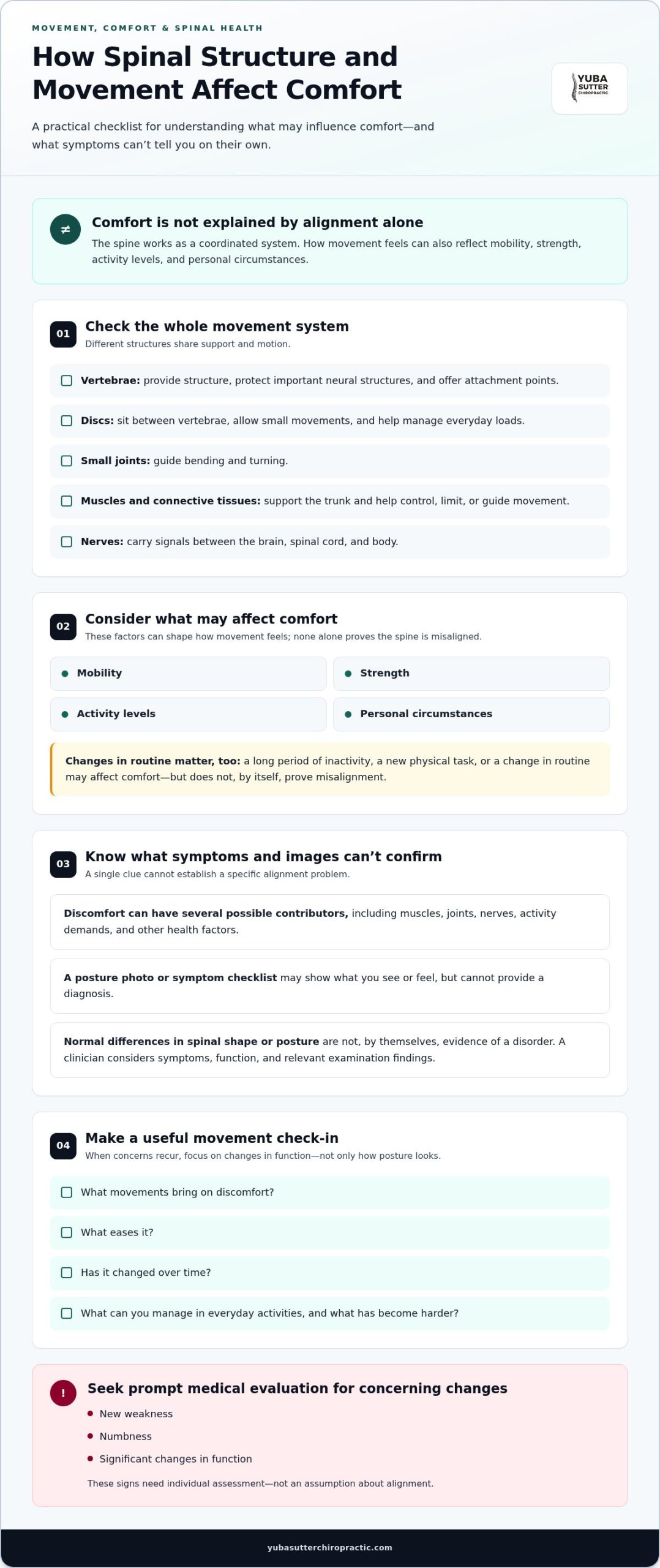
The spine works as a coordinated system, not as a stack of bones that must stay perfectly still. Vertebrae provide structure, while the discs between them help distribute forces and allow movement. Small joints guide bending and turning. Muscles and connective tissues, including ligaments, help support the trunk and control motion. Nerves carry signals between the brain, spinal cord, and body.
These parts share the work when you move. Turning to look behind you, for example, involves joints and muscles in the neck and upper back, while nerves carry the sensory and movement signals involved. The contribution of each structure depends on the movement and the person.
How spinal structures work together
Think of the vertebrae and discs as parts of a flexible support system. The bones protect important neural structures and provide attachment points; the discs between them allow small movements and help manage everyday loads. Muscles provide active support, and connective tissues help limit or guide movement. Comfort depends on how the system functions together, not on one structure viewed in isolation.
Mobility, strength, activity levels, and personal circumstances can all shape how movement feels. A long period of inactivity, a new physical task, or a change in routine may affect comfort, but none of these factors alone proves that the spine is misaligned. People can also have different ranges of motion and still move comfortably through daily activities.
Why symptoms do not reveal alignment by themselves
Back or neck discomfort can have several possible contributors, including muscles, joints, nerves, activity demands, and other health factors. The sensation alone can’t identify which structure is involved or establish a specific alignment problem. A posture photo or symptom checklist has the same limitation: it may show what you see or feel, but it cannot provide a diagnosis.
Normal differences in spinal shape or posture are not, by themselves, evidence of a disorder; a clinician evaluates whether a finding represents a condition by considering symptoms, function, and relevant examination findings. This distinction helps avoid treating natural variation as a problem while recognizing that an assessment can be useful when symptoms persist, worsen, or interfere with everyday activities.
Pay attention to changes in what you can do, not just how your posture looks. Note which movements bring on discomfort, what eases it, and whether it changes over time. Seek prompt medical evaluation for concerning symptoms such as new weakness, numbness, or significant changes in function. These signs need individual assessment rather than an assumption about alignment.
For general context on posture and practical approaches, the National Spine Health Foundation shares Tips for Improving Spinal Alignment. Treat suggestions as options to adapt, not rigid rules. If movement concerns affect your routine, an individualized discussion of chiropractic care for back and neck concerns can help you consider your goals and possible next steps.
Does Better Spinal Alignment Improve Overall Health?
A straighter-looking spine doesn’t automatically mean better overall health. Alignment may be one factor a clinician considers when assessing a specific movement concern, but it isn’t a universal explanation for pain, illness, or how well the body functions. Claims about spinal alignment for health should distinguish a possible change in comfort or mobility from promises about preventing disease or improving organ function.
What alignment claims can and cannot tell you
Care decisions are best based on your symptoms, goals, health history, and an appropriate clinical assessment, rather than a promise to “correct” everyone to one ideal shape. The National Center for Complementary and Integrative Health describes spinal manipulation as a treatment studied for certain musculoskeletal concerns, including low-back pain, not as a proven way to improve overall health or prevent disease.
| Claim | What the evidence supports |
|---|---|
| Care may help with a particular movement or pain concern. | Evidence varies by condition and treatment. The National Center for Complementary and Integrative Health reviews research on spinal manipulation for specific conditions, including low-back pain. |
| A straighter spine means better overall health. | Spinal appearance alone can’t establish general health, explain every symptom, or show that treatment is needed. |
| Adjustments prevent illness or improve organ function. | These broad promises aren’t established by evidence for spinal manipulation. Treatment should focus on an individual’s assessed concern and goals. |
Guidance also emphasizes matching treatment to the problem. For example, the UK’s National Institute for Health and Care Excellence recommends considering manual therapy for low-back pain only as part of a package that includes exercise. That differs from presenting alignment as a stand-alone route to whole-body wellness. Individual needs and responses vary, so a care plan should be discussed in that context.
When spinal concerns deserve medical attention
Seek medical advice if discomfort is persistent, worsening, unusual for you, or limiting daily activities. A clinician can review your symptoms and decide whether an examination or further assessment is appropriate. Don’t try to diagnose a misalignment from a photo, posture, or symptom list; those observations can’t determine the cause on their own.
New weakness, numbness, or changes in bladder or bowel control need urgent medical assessment. These symptoms can signal a serious problem and shouldn’t be managed by focusing only on posture or alignment. The NHS advises urgent assessment for back pain accompanied by changes in bladder or bowel function or loss of feeling around the genitals or anus.
Use this information as a guide, not a diagnosis. An educational article can’t replace medical advice tailored to your symptoms, history, and examination. If you’re unsure how concerning a change is, seek guidance from a qualified health professional.
Everyday Steps to Support Spinal Comfort and Mobility
Small, repeatable habits can make it easier to stay comfortable through daily activities. The goal isn’t to hold one “correct” posture all day. Instead, vary positions, choose movement that suits your current ability, and notice how your body responds. These steps can support mobility without guaranteeing that discomfort will be prevented or resolved.
Build movement into ordinary routines
Try this flexible routine and adjust it to your needs. The steps don’t need to happen at set times or in a specific order.
- Change positions regularly. If you’ve been sitting for a while, stand, stretch gently, or take a short walk. If standing for a long time feels uncomfortable, sit or shift your stance. Let comfort guide the change.
- Add manageable movement. Choose an activity that fits your current fitness and mobility, such as walking or gentle range-of-motion movements. Start at a comfortable level and increase gradually rather than making a sudden jump in duration or effort.
- Make your setup work for you. Adjust a chair, screen, or work surface for comfort, and consider support if it helps. These are options, not strict posture rules. The National Spine Health Foundation offers further ideas in its spinal alignment guidance.
- Pay attention to your response. Pause an activity if it causes concerning symptoms, such as new weakness or numbness, and seek medical guidance. Don’t push through severe or worsening discomfort.
Prepare useful information for a care visit
A brief record can help you describe what’s happening clearly. It isn’t a way to diagnose yourself or prove that your spine is out of alignment. Use it to note patterns and questions for a healthcare conversation.
- Note when the discomfort began, where you feel it, and whether it’s changing.
- Record activities or positions that seem to affect it, along with what makes daily tasks easier or harder.
- Bring relevant health history, current medications, and details of previous evaluations or care.
- Write down your main goals, such as moving more comfortably at work or returning to a familiar activity.
This information can help guide a conversation about your symptoms, priorities, and options. If you’re exploring ongoing care, ask how regular chiropractic adjustments may fit into an individualized discussion of your movement concerns and goals. Yuba Sutter Chiropractic & Wellness provides hands-on chiropractic adjustments for back and neck concerns in Yuba City. An assessment can help clarify whether care is appropriate for your situation, without assuming alignment explains every symptom.
Discuss Spinal Alignment With a Yuba City Chiropractor
If recurring stiffness or discomfort affects your routine, a conversation with a chiropractor can help you describe what you’re experiencing and what you hope to do more comfortably. The focus should be your movement concerns and individual circumstances, not an assumption that a particular spinal shape explains every symptom. Spinal alignment for health is most useful as a topic when connected to your needs and goals.
What to discuss during an individualized evaluation
Before a visit, think about when symptoms began, which activities feel difficult, and what you’d like to improve. Mention relevant health history, previous evaluations, and medications. These details provide context but don’t diagnose the cause. An individualized assessment can help inform whether chiropractic care may fit your situation and what options are appropriate to discuss.
Bring your questions, too. You might ask what an assessment involves, how a suggested approach relates to your specific concern, and what alternatives or next steps are available. Care recommendations should take your circumstances into account. Shared decision-making helps you understand the reasoning behind a plan and decide whether it aligns with your preferences.
Explore local chiropractic care in Yuba City
Yuba Sutter Chiropractic & Wellness provides chiropractic care in Yuba City, including hands-on adjustments for back and neck concerns. The practice also offers SoftWave shockwave therapy, DRX9000 spinal decompression, and MLS laser therapy. These are distinct care options, not measures of overall spinal health; discuss your concern and goals as part of considering what may be appropriate for you.
Rather than judging your health by appearance alone, focus on the movement or activity you want to manage more comfortably. An individualized discussion can help connect that goal with your circumstances and the care options available at the practice.
There’s no need to decide everything at once. Start by describing what’s bothering you and what you’d like to do more comfortably. If you’re in Yuba City or a nearby community, explore chiropractic care in Yuba City as a next step in discussing your movement concerns.
Choose a Next Step That Fits Your Goals
Your next step doesn’t need to be a major correction or a perfect-posture goal. Think about one activity you’d like to do more comfortably, then use it to shape a conversation about care. This keeps spinal alignment for health grounded in your daily priorities rather than an abstract ideal.
A useful discussion should help you understand what an assessment can tell you, which options may suit your circumstances, and what questions remain. You can take time to weigh the potential benefits and limits of care without feeling pressured to decide on the spot. If your concerns affect your routine, individualized chiropractic care may be one option to explore.
Yuba Sutter Chiropractic & Wellness welcomes people in Yuba City and surrounding communities to learn more about local care. Explore chiropractic care in Yuba City and take a considered step toward the movement goals that matter to you.
Frequently Asked Questions
What does spinal alignment mean?
Spinal alignment describes how the vertebrae and natural curves relate to each other and the rest of the body. It isn’t a single measurement that determines whether someone is healthy. Two people may have different-looking spinal curves and both move comfortably. When relevant, clinicians consider structure alongside symptoms and function rather than using appearance alone to judge spinal health.
Can spinal alignment affect overall health?
Spinal alignment may be relevant when assessing a specific musculoskeletal concern, but a particular spinal shape doesn’t determine your overall health. Changes in mobility or discomfort can matter to your daily well-being, while claims that alignment changes prevent illness or improve organ function need strong evidence. The phrase spinal alignment for health is most useful when it refers to movement, comfort, and an individual’s clinical needs.
Does poor posture mean my spine is misaligned?
No. Slouching at your desk or rounding your back while reading doesn’t establish that your spine is misaligned. Posture can reflect habit, fatigue, comfort, or the task you’re doing, and it naturally changes during the day. If you’re concerned, note whether discomfort or movement limits persist rather than relying on a photo or mirror to diagnose a spinal problem.
Can chiropractic adjustments improve spinal alignment?
Chiropractic adjustments may be discussed as part of care for certain back or neck concerns, but they don’t guarantee a lasting structural change or a specific result. Whether this approach makes sense depends on your symptoms, health history, goals, and an individual assessment. Ask what the proposed care is intended to address, how progress will be discussed, and what other options may fit your needs.
How can I support spinal health at home?
Build movement into tasks you already do, such as standing briefly between periods of desk work or taking a short walk during a break. Choose activity that feels manageable and increase it gradually. You can also adjust your chair or screen for comfort instead of forcing a rigid posture. If an activity brings on new or concerning symptoms, pause and seek medical guidance.
When should I see a chiropractor for spinal concerns?
Consider a chiropractic discussion if recurring back or neck discomfort affects work, sleep, or activities you value. Bring notes about what changes your symptoms and describe your health history and goals. Yuba Sutter Chiropractic & Wellness provides hands-on chiropractic care in Yuba City for people in nearby communities, including Marysville, Live Oak, Gridley, Sutter, Colusa, Plumas Lake, Olivehurst, and Wheatland. Seek urgent medical assessment for new weakness, numbness, or bladder or bowel changes.