

Peptide Therapy for Healing: What the Evidence Can, and Cannot, Tell You
Peptides are often discussed as tools for healing, but evidence about one peptide cannot stand in for evidence about another. That distinction matters when claims about peptide therapy for healing, BPC-157, and tissue regeneration blend early research with marketing. If you’re trying to separate what’s established from what’s still being studied, start by identifying the exact substance and the evidence behind the claim.
This guide explains what peptides are, how they may relate to biological processes, and what current evidence can and cannot tell us. A promising research finding does not, on its own, show that a treatment is safe or effective for a specific person.
We’ll clarify key terms, put healing claims into context, and outline practical questions to raise when discussing care. Yuba Sutter Chiropractic & Wellness in Yuba City offers peptide therapies as part of its wellness services. Any treatment discussion should take your health history, goals, and overall care plan into account.
Key Takeaways
- Peptides differ in how they act, so claims about one peptide don’t automatically apply to another.
- To assess peptide therapy for healing, identify the substance, intended outcome, type of evidence, and limits of the research.
- Check whether findings come from lab research, animal studies, or human trials, and whether they measure outcomes relevant to you.
- Discuss your health history, medications, goals, and uncertainties with a qualified professional before considering treatment.
- Use the Yuba City peptide therapy checklist to prepare for a personalized care conversation at Yuba Sutter Chiropractic & Wellness.
What Is Peptide Therapy for Healing? Start With the Basics
Peptides are short chains of amino acids, the same basic building blocks the body uses to make proteins. You can think of a peptide as a small molecular message or component. Some peptides occur naturally in the body and participate in biological activities. Others are made or prepared for use as products. Sharing a name does not mean peptides share the same purpose, effects, or level of research.
A useful definition: Peptide biology describes how peptides function in the body. Peptide therapy refers to using a particular peptide product with a specific health goal. The first is a biological fact. The second is a treatment question that requires evidence about the substance, its use, and the people it may help.
That distinction matters when evaluating peptide therapy for healing. A peptide may be involved in a process related to tissue repair, but that role alone does not establish that using a product will improve an injury or speed recovery. A treatment claim needs evidence connecting a defined product and use to meaningful outcomes in people.
How do peptides relate to the body’s healing processes?
Cells communicate through many kinds of signals. Some peptides take part in signaling that may influence how cells respond to their surroundings. Researchers study whether particular peptides relate to processes such as inflammation or tissue repair. These are areas of investigation, not guarantees that a treatment will produce a desired result.
The body’s own peptides are part of complex, regulated systems. An administered product is a separate matter: its composition, amount, and delivery can differ from the body’s normal activity. A biological connection is a reason to study a peptide, not proof that using it will recreate or improve that process.
What does “peptide therapy” mean in healing discussions?
The phrase can describe different substances and clinical contexts. It may refer to an approved medication used for a specific indication, a product prepared for an individual, or a substance promoted in wellness settings. These categories are not interchangeable. The phrase itself does not identify a standardized treatment protocol or establish that a particular use is supported by clinical evidence.
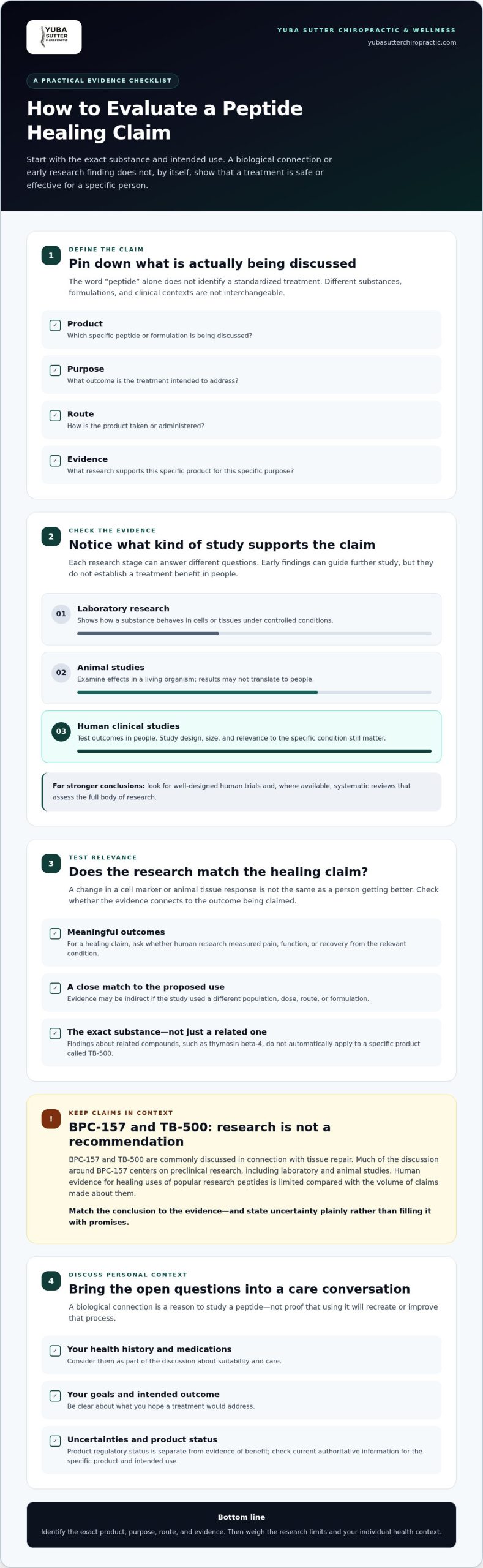
To understand a claim, look beyond the word “peptide.” Pin down the details:
- Product: Which specific peptide or formulation is being discussed?
- Purpose: What outcome is the treatment intended to address?
- Route: How is the product taken or administered?
- Evidence: What research supports that product for that purpose?
These details shape what a claim means. Evidence about one peptide, formulation, or route does not automatically apply to another. Findings about a biological process also do not answer whether a particular product is suitable for an individual. Clear terms help distinguish a research idea from a supported clinical use and make the treatment conversation more specific.
How Peptides May Relate to Tissue Repair, and What Research Shows
Researchers investigate whether certain peptides influence cell signaling, inflammation, or other processes involved in tissue repair. These questions can help identify possible biological effects. They do not establish that taking or receiving a peptide will relieve symptoms, restore function, or speed recovery. A proposed mechanism is a starting point for research, not proof of treatment benefit.
The type of evidence matters. Laboratory studies can show how a substance behaves in cells or tissues under controlled conditions. Animal studies examine effects in a living organism, but results may not translate to people. Human clinical studies can test outcomes in patients, though their size, design, and relevance to a specific injury or condition still matter. Stronger conclusions generally require well-designed human trials and, where available, systematic reviews that assess the full body of research.
Why do researchers study peptides such as BPC-157 and TB-500?
BPC-157 and TB-500 are commonly discussed in connection with tissue repair, but their mention in research or wellness claims is not a treatment recommendation. Much of the discussion around BPC-157 centers on preclinical research, including laboratory and animal studies. That evidence can suggest questions to test, but it cannot establish benefit in people. Claims involving TB-500 also require care: findings about related compounds, such as thymosin beta-4, do not automatically apply to a specific product called TB-500.
Before accepting a claim, check which exact substance was studied, in what formulation, and in what kind of study. Product regulatory status is a separate question from evidence of benefit and should be checked against current authoritative information for the specific product and intended use.
How strong is the evidence for healing benefits in people?
For a healing claim, ask whether human research measured outcomes that matter, such as pain, function, or recovery from the relevant condition. A change in a cell marker or an animal tissue response is not the same as a person getting better. Evidence may also be indirect if a study involves a different population, dose, route, or formulation.
For popular research peptides such as BPC-157 and TB-500, human evidence for healing uses is limited compared with the volume of claims made about them. That does not mean the research question has no value. It means conclusions should match the evidence, and uncertainty should be stated plainly rather than filled with promises.
Evidence about one peptide cannot validate another: each substance needs evidence for its own formulation, use, and patient outcomes. That standard is especially important when evaluating peptide therapy for healing, where broad claims can blur meaningful differences.
If you’re weighing a healing goal, bring the specific claim and questions about the evidence into a personalized care discussion. Yuba Sutter Chiropractic & Wellness in Yuba City offers peptide therapies as part of its wellness services. A care conversation about peptide therapy can help keep your goals and the available evidence in view.
How to Evaluate Peptide Therapy for Healing Claims
Strong claims deserve specific evidence. Use this step-by-step framework to assess peptide therapy for healing, whether you encounter a social media post, product description, or research summary. It can help you separate a plausible biological idea from evidence that a treatment improves an outcome relevant to you.
- Identify the exact peptide and product. Find the substance name and, where available, the formulation and route of use. Evidence about a related compound or a different preparation may not apply.
- Define the intended outcome. Is the claim about pain, function, wound healing, or another measurable result? Broad phrases such as “supports regeneration” do not specify what should change.
- Check the evidence type. Does the claim rely on a proposed mechanism, laboratory work, animal research, or a human clinical study? Human studies are more directly relevant to patient outcomes, but their design and limitations still matter.
- Look at the study details. Note the condition studied, participant characteristics, comparison group, and outcomes measured. Ask whether independent studies have reproduced the result.
- Consider limitations and oversight. Check whether the findings apply to the product and use being discussed. Regulatory status is separate from proof of effectiveness or safety.
Which questions reveal whether a healing claim is well supported?
Start with the original research, not just a headline or summary. Did the study examine the same condition and treatment goal as the claim? Did it measure something meaningful to patients, such as symptoms or function, or only a biological marker? A small or early study can inform future research, but usually cannot settle whether a therapy works in routine care.
Look for a clear study design and independent replication. Testimonials may describe someone’s experience, but they cannot show what would have happened without the treatment or establish that others will have the same result. Words like “heals” and “regenerates” also need specific outcomes behind them.
Why are research compounds different from clinical treatment?
Research interest means a substance is being investigated; it does not establish routine clinical use. Regulatory status is also separate from whether a treatment works or is safe for a particular person. For current FDA information, use the agency’s official resources for the specific product and intended use rather than relying on a broad claim about “peptides.” Approval for one use, if applicable, does not establish effectiveness for another.
Bring the exact claim, product details, and any study you’ve found to a personalized care discussion. Use the Yuba City peptide therapy checklist to organize questions about your goals and the evidence before discussing peptide therapy at Yuba Sutter Chiropractic & Wellness.
Safety, Suitability, and Practical Questions to Discuss
Safety cannot be judged by the word “peptide” alone. It depends on the specific substance, the product’s formulation, how it’s used, and a person’s health circumstances. Products in the same broad category may have different evidence and risk profiles. Do not assume a peptide is risk-free or that information about one product applies to another.
Preliminary research is not a substitute for individualized medical guidance. Before considering a therapy, discuss your health history, current medications and supplements, treatment goals, and uncertainties with a qualified professional. Share the exact product information you have, if available. These details make the conversation specific rather than relying on general claims about peptide therapy for healing.
Who should be especially careful with peptide therapy claims?
Take extra care if you’re pregnant or nursing, managing a chronic condition, or taking medication. These circumstances can affect how a treatment should be considered, but they do not automatically determine whether a particular option is appropriate. A qualified professional can review your individual context and identify questions that need further attention.
If you experience urgent symptoms or a serious reaction after using any product, seek prompt medical attention. Do not rely on online discussions or informal advice to assess a potentially serious problem.
What should a thoughtful care conversation cover?
Begin with the goal. Ask what change the therapy is intended to support and how you and your care team would recognize meaningful progress. A clear outcome, such as a change in a specific symptom or daily activity, is easier to assess than a broad promise of “healing” or “regeneration.”
A useful discussion can also cover:
- The exact therapy: What substance and formulation are being discussed, and how would it be used?
- The evidence and uncertainties: What is known about this specific product and goal, and what remains unclear?
- Your health context: How might your medical history, medications, or other care considerations affect the discussion?
- Alternatives and follow-up: What other approaches could address the goal, and how would progress or concerns be reviewed?
You don’t need to arrive with every answer. Bring your questions, product information, and priorities, then take time to understand potential benefits and uncertainties. A careful discussion should address the specific therapy rather than treating all peptides as interchangeable.
Yuba Sutter Chiropractic & Wellness offers peptide therapies in Yuba City as part of its wellness services. Discuss your healing goals and peptide therapy questions in a personalized care conversation.
Discussing Peptide Therapy for Healing in Yuba City
Learning about peptide research is one step. Deciding whether a particular therapy fits your goals and health context is a separate, personal conversation. A discussion can connect general information with the specific outcome you hope to address while keeping expectations grounded in what’s known and what remains uncertain.
How can a local conversation make the topic more practical?
Bring a clear description of your healing goal, any product or claim you’re considering, and relevant health information. For example, you might discuss what “supporting recovery” means in your situation, what evidence applies to the specific peptide, and which questions still lack clear answers. You don’t need to arrive with a decision already made.
A good conversation leaves room for questions about evidence, expectations, and uncertainty without pressure to pursue a particular option. To organize your thoughts beforehand, use the Yuba City peptide therapy checklist. It can help you bring focused questions to a discussion about peptide therapy for healing and your individual goals.
How do overall wellness factors fit into healing?
Healing rarely comes down to a single choice in isolation. Your care plan may need to account for the broader context of your health and daily life alongside the specific concern you want to address. That does not establish that any one intervention will improve an outcome. It keeps the conversation centered on your needs rather than on a product alone.
For a wider look at how overall health and biological optimisation relate to recovery, insights from functional medicine providers like Emagene Life offer broader context to consider alongside questions about a specific therapy.
If you’re in Yuba City or a nearby community, Yuba Sutter Chiropractic & Wellness offers a local setting for discussing your healing goals and questions about peptide therapies. Bring your priorities and what you’ve learned, then ask for a clear conversation about the options and uncertainties that matter to you.
Take the Next Step at Your Own Pace
You don’t need to decide on a treatment before asking questions. A useful next step is to identify what you hope will change, what uncertainty you still have, and what information would help you make a decision. That can turn a broad interest in peptide therapy for healing into a focused conversation about your priorities and care options.
Give yourself room to consider how any proposed approach fits with your health history and the rest of your care. It’s reasonable to ask what progress would look like, how it might be assessed, and what alternatives deserve consideration. Thoughtful care isn’t about pressure or certainty where evidence is still developing. It’s about making a decision with your goals in view.
For readers in Yuba City and surrounding communities, Yuba Sutter Chiropractic & Wellness offers a local setting to discuss peptide therapies and personal healing goals. Discuss your healing goals with Yuba Sutter Chiropractic & Wellness and take the next step with care and confidence.
Frequently Asked Questions
What is peptide therapy for healing?
Peptide therapy for healing describes using a particular peptide with a health goal, but the phrase does not identify one standard treatment. Before weighing a claim, write down the substance’s name and the outcome it’s meant to support, such as improving a specific symptom or activity. Then consider whether available information addresses that exact product and goal, rather than relying on a general claim about peptides.
Can peptides help with tissue repair?
Some peptides are being investigated for possible connections to tissue-related processes, but that research does not establish that every peptide helps people recover. If a claim refers to a laboratory result or animal model, treat it as an early research finding, not a prediction about your injury. Look for human studies involving the same peptide and a relevant outcome, such as function or symptoms for the condition in question.
Is peptide therapy proven to speed up healing?
There isn’t one answer that applies to every peptide or healing goal. “Faster healing” should be defined clearly: faster than what, and measured by which outcome? A biological explanation or an individual’s story cannot answer those questions on its own. Before drawing conclusions, look for reliable human evidence about the specific use, and do not change an existing care plan based only on a broad claim.
What is the difference between research peptides and prescribed peptide therapy?
The terms describe different contexts, but neither label alone confirms a product’s quality, safety, effectiveness, or legal status. A research compound may be discussed in scientific studies or marketed for research, while prescribed therapy refers to a clinical use of a specific product. If you’re unsure what a product is intended for, check current authoritative information and discuss its identity and intended use with a qualified health professional.
Are peptides safe to use for healing?
Safety depends on the exact substance and product, how it’s used, and your personal health circumstances. Before making a decision, tell a qualified professional about your medical conditions, medications, supplements, and relevant allergies. Do not assume a product is harmless because it’s described as natural or popular online. If you experience severe or urgent symptoms after using a product, seek prompt medical attention rather than waiting for an online response.
How do I know whether a peptide healing claim is reliable?
Trace the claim back to its source. Check whether it names the peptide, condition, and outcome, then see if the evidence involved people and a comparison group. Consider how many participants were studied and whether independent research found similar results. A testimonial may be personally meaningful, but it cannot establish that a therapy caused the outcome or show what another person should expect.
Can I discuss peptide therapy with a provider in Yuba City?
Yes. A discussion can help you clarify your healing goal, health context, and questions about a specific therapy without treating any result as guaranteed. The practice serves nearby communities, including Marysville, Live Oak, Gridley, Sutter, Colusa, Plumas Lake, Olivehurst, and Wheatland.