Shockwave therapy can reduce heel pain from chronic plantar fasciitis, though results depend on the energy used. A 2019 meta-analysis of 14 placebo-controlled trials found medium-energy treatment beat placebo for up to 12 months, while low- and high-energy results were inconsistent. It is typically used for long-lasting cases that haven’t improved with other treatments.
The evidence has limits. That meta-analysis rests on few trials in some energy groups, and its pain scores varied widely between studies. An earlier 2014 review of 7 trials and 550 participants called the short-term pain relief satisfactory but lacked the long-term follow-up to say how long it holds.
How do sound waves help a sore heel?
The leading explanation is mechanotransduction. The 2020 EFORT review describes mechanical energy changing a cell’s internal skeleton and setting off a cascade that improves healing, and it notes the mechanism is still being studied. The Mayo Clinic describes sound waves increasing blood flow to the plantar fascia. Both are explanations. What the trials above measured was pain and treatment success, not the repair itself.
FDA clearance is a narrower matter. One FDA clearance for the OrthoGold 100, from the maker of SoftWave, lists relief of minor muscle aches and pains, a temporary increase in local blood circulation and activation of connective tissue. It does not name plantar fasciitis.
What changes whether it works for you?
- How long it has hurt. The Mayo Clinic says most people recover within a few months using simple treatments such as stretching and icing. The FDA’s record for one early shockwave device defined chronic plantar fasciitis as heel pain lasting six months or more that had not responded to conservative treatment.
- The energy setting. In the 2019 meta-analysis, high-energy treatment beat placebo on success rate only at three months. Medium-energy treatment held up to 12 months, and low-energy treatment was uncertain.
- A heel spur, which matters less than you’d think. The Mayo Clinic says spurs don’t cause pain, and a long-term follow-up of 174 patients found a spur at the start had no effect on prognosis.
- Weight and hours on your feet. Extra weight puts more pressure on the heel, and teachers, factory workers and healthcare workers who stand or walk for long hours on hard surfaces run a higher risk.
- Shoes and foot mechanics. Flat feet, high arches and an unusual walking pattern can change how weight is spread across your foot, and old shoes lose their support.
- Whether you keep stretching. A 2023 narrative review says shockwave can be combined with static stretching, which can enhance its effect. Our older post on stretching covers why the habit matters.
What happens at a SoftWave session for heel pain?
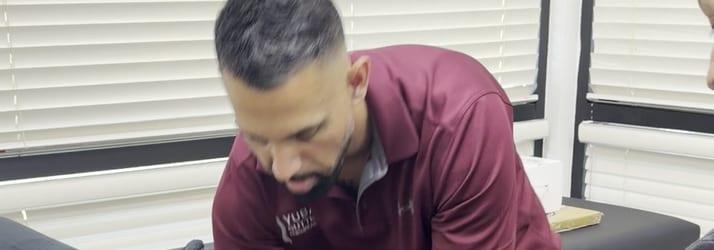
Wear shorts or loose pants, and skip any other preparation. At your first visit, Dr. Gurj Kalay, DC, examines the sore area and the joints around it. Gel goes on the skin and the applicator passes over the area. Healthy tissue barely registers, while irritated tissue answers with a dull ache that shows where to focus.
Treatment takes 10 to 15 minutes, and if it’s too much, say so and the intensity comes down. There are no needles and no numbing, and you go straight back to your day. As our SoftWave therapy page explains, a course often runs 6 to 8 sessions, about once a week.
For plantar fasciitis, orthotics are often paired with SoftWave. Pedics custom orthotics are made from a scan of how your feet carry your weight, and your evaluation decides whether they make sense for you.
What are the side effects, and who should not have it?
Pain during treatment and redness afterward are the common ones. A 2017 systematic review of 39 studies and 2,493 patients recorded 225 patients with pain during treatment and 247 with temporary red skin. It also lists temporary pain afterward, swelling, bruising, altered skin sensation and a throbbing feeling.
That review found two complications, chest pain and a superficial skin infection after regional anesthesia, and called shockwave likely safe for plantar fasciitis while noting that long-term complications are unknown. Mild redness or soreness after SoftWave fades on its own within a day or two.
The EFORT review names three contraindications: severe clotting disorders for high-energy treatment, aiming waves at a fetus or embryo, and aiming them at a severe infection. Mention pregnancy, a clotting problem or an infection before you start. Plates, pins and screws are generally not a barrier, since the waves don’t affect them.
Does shockwave therapy hurt?
It can, and pain during treatment is the most-reported effect in the 2017 review. SoftWave mostly feels like a light tapping that turns into a dull ache over irritated tissue, and most people tolerate it without anesthesia.
Is SoftWave covered by insurance?
Usually not. Most plans, Medicare included, treat SoftWave as an elective, self-pay service. Many patients use HSA or FSA funds, and you get a Good Faith Estimate of the full cost before care starts.
Do custom orthotics help plantar fasciitis?
They can help some, modestly. A 2018 meta-analysis of 19 trials and 1,660 participants found moderate-quality evidence that orthoses beat sham orthoses for pain at 7 to 12 weeks, was unsure the change was clinically important, and found no difference between custom and prefabricated pairs. A second 2018 review found orthoses no better than sham or other conservative treatment. A store-bought insert is sometimes enough.
How long does plantar fasciitis last without treatment?
It can last years in some people. In a follow-up of 174 patients, the risk of still having symptoms was 80.5% one year after they began and 50% after five, though some of these patients had treatment such as steroid injections. The Mayo Clinic warns that untreated plantar fasciitis can become chronic heel pain that makes daily activities difficult.
If your heel still hurts on your first steps after months of stretching and inserts, you can book an exam without a referral. Our blog has more on everyday aches and how they’re treated.
Sources
- Wang YC et al. “Efficacy of Different Energy Levels Used in Focused and Radial Extracorporeal Shockwave Therapy in the Treatment of Plantar Fasciitis: A Meta-Analysis of Randomized Placebo-Controlled Trials.” J Clin Med, 2019;8(9):1497. PMC6780733
- Yin MC et al. “Is extracorporeal shock wave therapy clinical efficacy for relief of chronic, recalcitrant plantar fasciitis? A systematic review and meta-analysis of randomized placebo or active-treatment controlled trials.” Arch Phys Med Rehabil, 2014;95(8):1585–93. PubMed 24662810
- Roerdink RL et al. “Complications of extracorporeal shockwave therapy in plantar fasciitis: Systematic review.” Int J Surg, 2017;46:133–145. PubMed 28890412
- Auersperg V, Trieb K. “Extracorporeal shock wave therapy: an update.” EFORT Open Rev, 2020;5(10):584–592. PMC7608508
- De la Corte-Rodríguez H et al. “Extracorporeal Shock Wave Therapy for the Treatment of Musculoskeletal Pain: A Narrative Review.” Healthcare (Basel), 2023;11(21). PubMed 37957975
- Whittaker GA et al. “Foot orthoses for plantar heel pain: a systematic review and meta-analysis.” Br J Sports Med, 2018;52(5):322–328. PubMed 28935689
- Rasenberg N et al. “Efficacy of foot orthoses for the treatment of plantar heel pain: a systematic review and meta-analysis.” Br J Sports Med, 2018;52(16):1040–1046. PubMed 29555795
- Hansen L et al. “Long-Term Prognosis of Plantar Fasciitis: A 5- to 15-Year Follow-up Study of 174 Patients With Ultrasound Examination.” Orthop J Sports Med, 2018;6(3):2325967118757983. PubMed 29536022
- “Plantar fasciitis: Diagnosis and treatment.” Mayo Clinic, 7 August 2026. mayoclinic.org
- “Plantar fasciitis: Symptoms and causes.” Mayo Clinic, 7 August 2026. mayoclinic.org
- OssaTron, premarket record P990086. U.S. Food and Drug Administration, decision 12 October 2000, withdrawn 8 February 2021. accessdata.fda.gov
- OrthoGold 100, 510(k) K210451. U.S. Food and Drug Administration, 5 May 2021. accessdata.fda.gov